
EV Charger Installation at Home: What London Households Need to Check
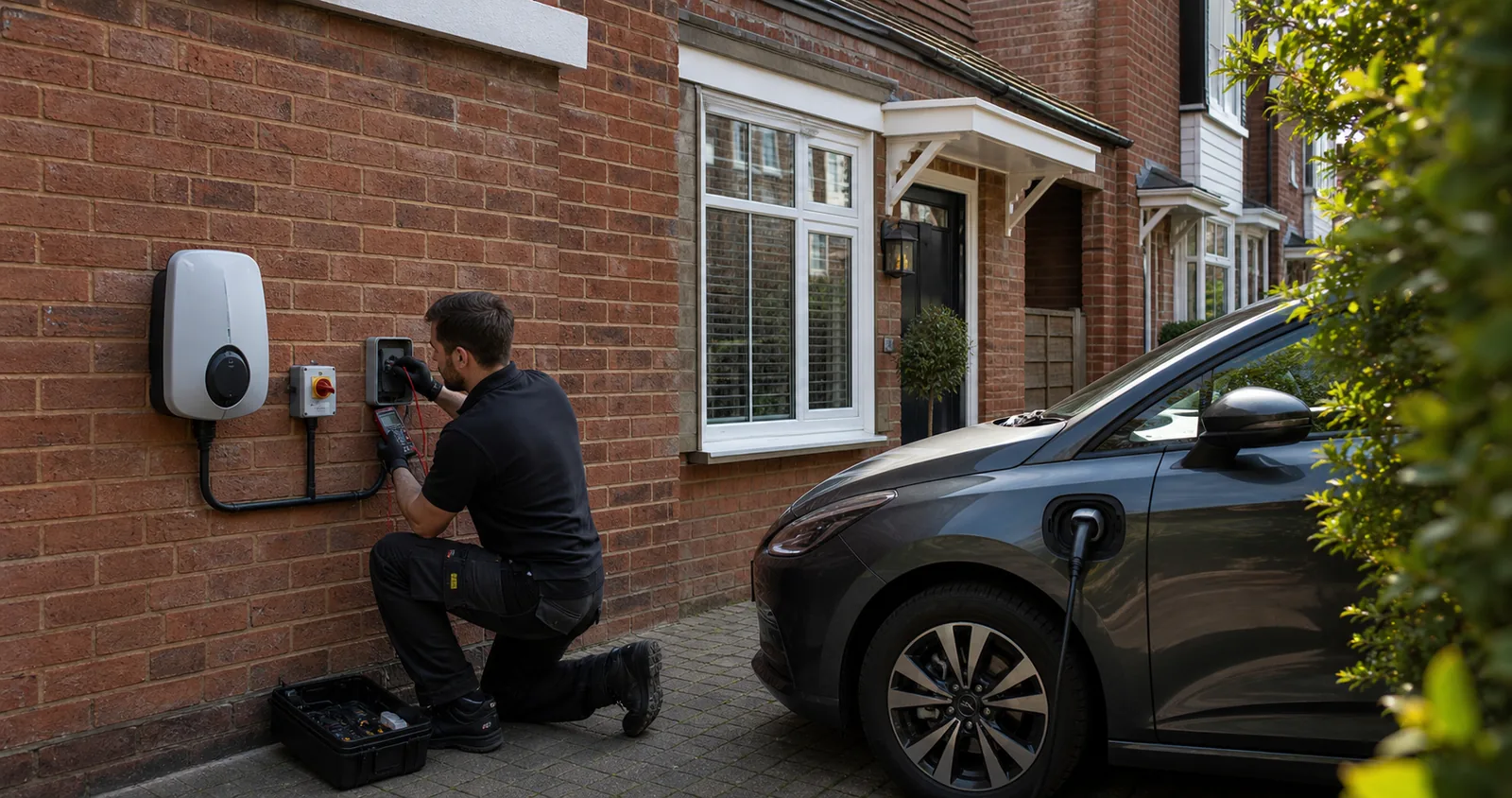
A London home needs off-street parking, a safe cable route and an electrical design before an EV charger is ordered. A competent installer must assess supply capacity, earthing, protective devices, consumer-unit condition and the proposed mounting position. Leasehold permission, conservation constraints and distribution-network steps can also affect the project.
Start at the parking space
Photograph where the car normally stops and measure the practical distance to the charging port. Consider different vehicles and parking directions. The lead should reach without being stretched, trapped under a garage door or left as a trip loop.
A cable must not simply trail across a public pavement. Local channel schemes and permissions vary; do not cut the footway or install a cover without authority. If there is no lawful route from private property to the vehicle, establish that before selecting hardware.
Freeholder and managing-agent permission
Leasehold flats may need written consent for equipment on external walls, cable routes through communal areas, meter cupboards and parking-bay works. Ask who owns the wall and electrical supply and whether the bay is demised to the flat.
Provide drawings, product details, contractor insurance and proposed making-good if requested. A neighbour’s previous installation does not prove that the same route or capacity is available.
The electrical survey
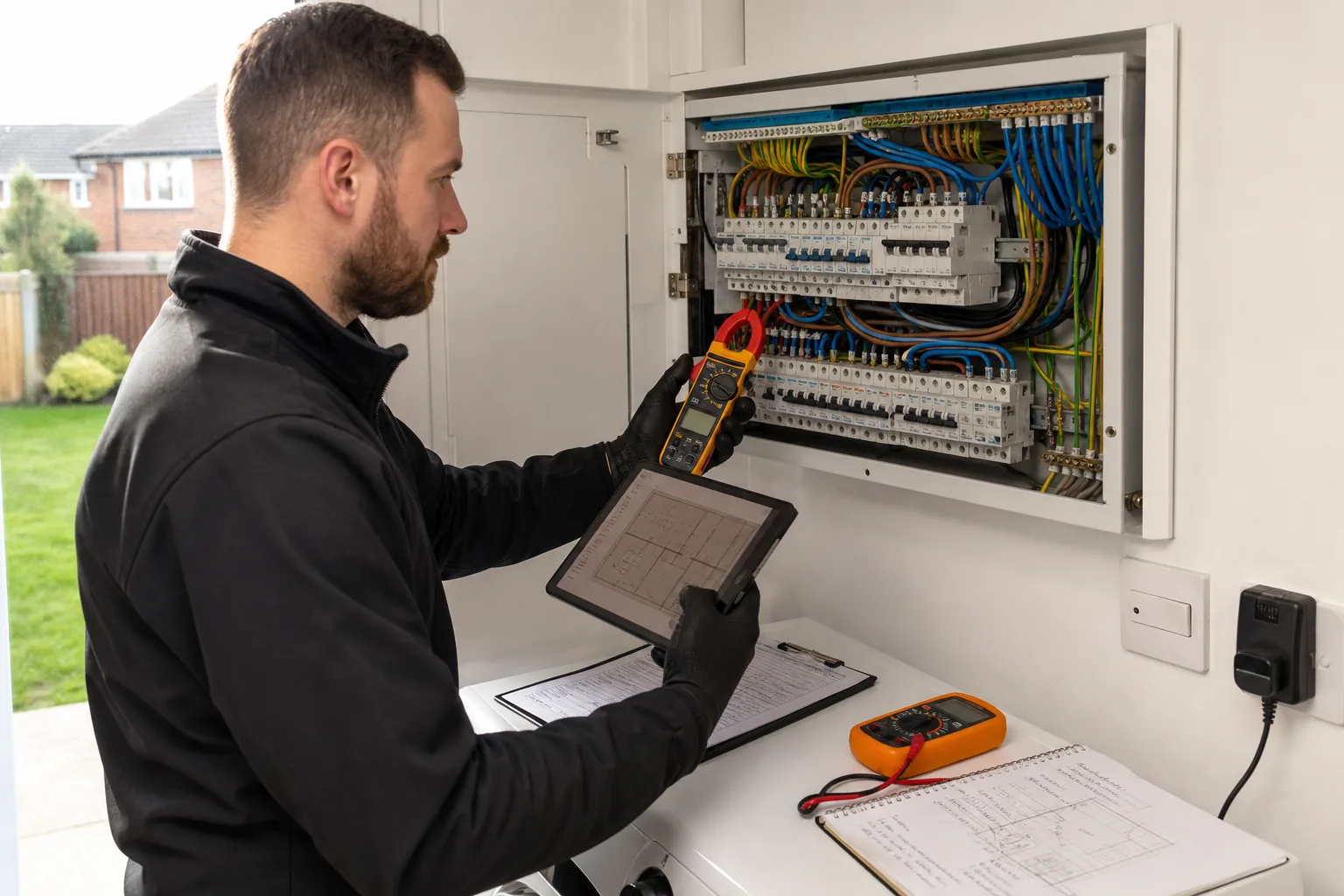
The installer should inspect the supply, cut-out information available to them, earthing arrangement, consumer unit, existing protective devices and cable route. They may need load measurements or information about electric heating, showers, solar PV, batteries and other large loads.
Do not remove sealed covers or photograph live interiors yourself. Use qualified electrical assessment where faults, bonding or existing installation concerns need resolving before charger work.
Available capacity and load management
A charger’s headline rating is not the same as guaranteed charging power at every home. Supply capacity, diversity and simultaneous demand matter. Dynamic load management can reduce charger demand when the property uses more electricity, but it needs correct design and commissioning.
Ask what maximum rate the quotation assumes and what happens when the cooker, shower or heating runs. Do not oversize the project purely for a future vehicle without checking the upstream limits.
Earthing and EV-specific protection
Vehicle charging presents particular earthing and fault-protection considerations. The solution depends on the equipment, installation and current requirements; it is not safe to assume that an ordinary outdoor socket arrangement is equivalent.
Ask the installer to identify the protective devices included in the charger and distribution equipment and how compliance will be tested. Technical choices should appear in the design record, not only in sales language.
Consumer-unit work is a separate scope decision
Some homes need a new circuit with suitable space and protection; others reveal defects or limitations requiring remedial work. A consumer-unit replacement should be justified by inspection and testing, not added automatically because an EV charger is modern.
If replacement is proposed, compare the written reason and included certification with Alesta’s consumer-unit assessment. Clarify whether tails, bonding, labels and fault finding are included.
Choose the mounting position carefully
The unit needs a location compatible with its environmental rating, ventilation and manufacturer clearances. Consider impact from bins and car doors, direct hose spray, flood risk, strong sun and whether the display or cable attracts interference.
Route cables neatly with suitable support and mechanical protection. Penetrations must be sealed appropriately without blocking ventilation or drainage paths.
Wi-Fi, mobile signal and smart functions
Check connectivity at the proposed position before relying on an app. Some chargers use Wi-Fi, Ethernet, mobile data or a combination. Ask which functions continue if the internet is unavailable.
Smart scheduling can use off-peak tariffs, but confirm compatibility with the vehicle and energy supplier. A cheap tariff is not useful if the charger repeatedly loses its schedule or cannot receive updates.
Solar panels and batteries
If you want solar-aware charging, tell the installer about inverter type, metering and battery system. “Solar compatible” can describe several control methods with different results. Ask how surplus generation is measured and what minimum vehicle-charging rate applies.
Future integration should be planned without modifying existing solar wiring casually. Product ecosystems and warranties matter.
Network notification or application
The installer should determine the distribution-network process for the installation and explain whether notification or prior approval is required. Give accurate supply and charger details and retain the response with your certificates.
Do not accept “the network never checks” as a substitute for the correct process. Paperwork is part of the installation, not an optional administrative extra.
Compare quotations on the same route
Send each installer the parking photograph, approximate cable route, consumer-unit location, property type and permission status. Ask for charger, cable length, ground works, protective devices, network process, testing, certification, VAT and making-good.
A low hardware price can exclude a long route, difficult floor construction or connectivity equipment. A site-specific home EV charger installation quote should show those assumptions.
Commissioning and handover
Test a charging session with the vehicle. Confirm scheduled charging, load management, app ownership and user accounts. Learn how to isolate the charger safely and what indicator or error messages mean.
Collect electrical certification, commissioning results, warranty information, product serial number and network paperwork. Photograph the finished route and any area that needs later decoration.
Questions worth asking before payment
Who designed and certifies the circuit? What charging rate is expected? Which permissions and network steps are included? How is earthing addressed? What happens without internet? Who supports faults involving the charger, vehicle and app?
The right installation is not merely a box fixed to a wall. It is a tested circuit, lawful route and usable charging arrangement documented for the home.
Garage, driveway and terraced-house cable routes
A garage installation still needs the route from the main electrical intake assessed; a detached garage may have an existing submain that is unsuitable for the proposed load. On a driveway, check vehicle impact, gates, drainage channels and how the lead is stored when not connected. Terraced homes can present long internal routes where fire stopping and decoration become part of the work.
Ask the installer to walk the full route with you and mark every penetration, external section and access point. Confirm who moves furniture and who repairs finishes. A short cable shown on a quotation can conceal the most disruptive part of the job.
What happens if you move house or change vehicle?
Check whether the cable type, connector and smart features suit likely vehicles, but avoid paying for speculative functions that the electrical supply cannot support. Ask how user accounts, installer access and energy-tariff integrations are transferred or removed.
If the charger may stay with the property, keep manuals, certificates and login-transfer instructions with the home records. If removal is planned later, it remains electrical work: the circuit must be isolated and left safe, with weatherproof making-good where equipment was mounted.
