
How to Remove Pet Urine Smell from Carpet — Not Just Mask It
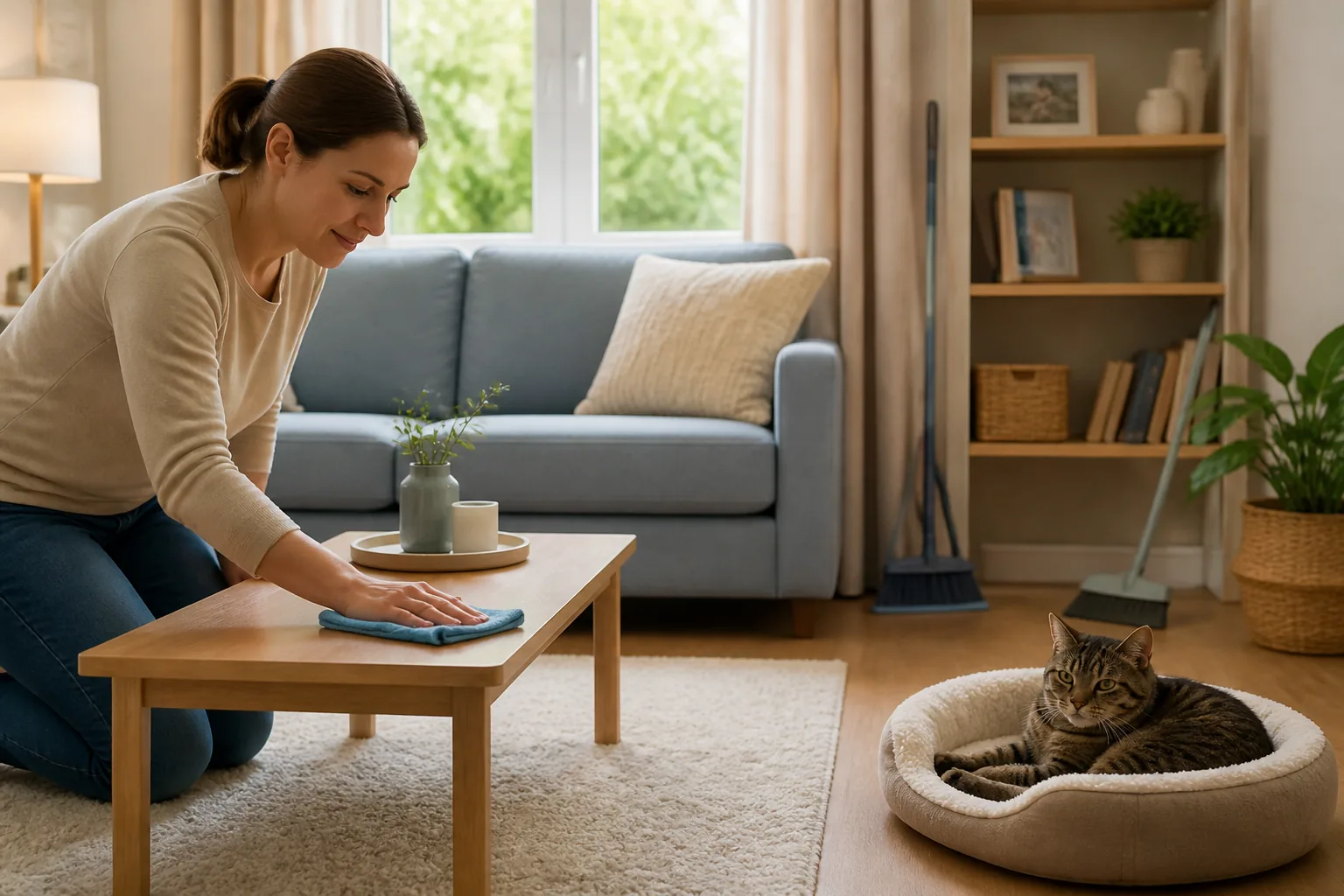
Pet-urine smell leaves a carpet only when the treatment reaches the same depth as the urine. Blot a fresh accident, test a compatible enzymatic cleaner in a hidden area and use enough product to contact the affected fibres without flooding clean carpet. If the odour returns after drying or during humid weather, urine has probably reached the backing, underlay or floor beneath.
Fresh accident: remove liquid before reaching for cleaner
Put on gloves and press white absorbent towels onto the wet area. Work from the outer edge towards the centre and replace towels until little moisture transfers. Stand pressure is more useful than scrubbing: rubbing spreads liquid sideways, distorts pile and can drive it deeper.
Keep pets and children away while you work. If the accident contains blood, diarrhoea or another biological contaminant, treat it as more than an odour problem and obtain suitable cleaning advice.
Find the true boundary
The visible mark is often smaller than the wet area beneath. Use smell, towel transfer and oblique light to map it; do not soak the room searching. A UV torch can reveal some residues but also highlights detergents and unrelated spills, so treat fluorescence as a clue rather than proof.
Mark the edge discreetly with removable tape and inspect nearby skirting, furniture feet and joins. On stairs, liquid can travel over the nosing into the riser. Near a wall, it may wick into timber or plaster.
Check fibre and colour before adding moisture
Read the carpet care information if available. Wool, viscose, plant fibres, natural dyes and certain backings need greater caution than a colourfast synthetic pile. Test the proposed product with a white cloth in a hidden corner and wait for the area to dry.
Stop if colour transfers, texture changes or adhesive odour appears. A delicate or valuable floor covering deserves a professional carpet-cleaning assessment before a large wet treatment.
Why ordinary deodoriser disappoints
Powders and fragranced sprays can make the room smell different without removing urine salts. Once humidity rises, those residues attract moisture and release odour again. Layering perfume also makes it harder to judge whether treatment worked.
Do not mix bleach, ammonia, vinegar, peroxide or proprietary cleaners. Chemical combinations can create hazardous fumes, set colour loss or neutralise the product you actually need. Follow one label and rinse only as it directs.
Using an enzymatic product properly
Choose a product labelled for pet urine and compatible with the carpet. Enzymes need contact with the contamination and the labelled dwell conditions; a quick mist wiped away after a minute cannot work on residue in the backing. Equally, pouring a bottle into the carpet may spread it into clean underlay.
Apply to the mapped area, observe the stated dwell time and keep the patch from being walked on. Blot or extract as instructed. Ventilate the room and arrange airflow for prompt drying without aggressive heat.
When a rinse helps—and when it spreads the problem
After the enzyme stage, a controlled rinse or extraction can remove suspended residue if the product and carpet permit it. Use repeated light passes rather than one saturation. Recover as much moisture as possible and empty equipment hygienically.
A small domestic wet vacuum cannot prove that underlay is dry. If water appears at the edge of the room, the patch squelches or drying stalls, stop. Excess moisture can create browning, backing separation and a second odour unrelated to urine.
The dry-state test
Do not judge while fragrance and moisture dominate. Once the fibres are fully dry, close the room for a short period, then check at floor level without spraying anything first. Note whether the smell is centred on the original patch or strongest at an edge.
If the odour returns only on damp days, deeper salts remain likely. Repeating surface treatment indefinitely is rarely useful; the contamination depth now matters more than product strength.
Underlay and subfloor contamination
Repeated accidents in one place can pass through carpet backing. A technician may need to lift a controlled section, replace underlay and treat the subfloor with a method compatible with timber, screed or sheet material. Landlords and tenants should document the area before lifting.
Do not pour disinfectant through the carpet in an attempt to reach below. It distributes liquid unpredictably and may leave residues trapped between layers. Obtain a written scope that distinguishes carpet cleaning, underlay replacement and building-fabric work.
Rugs and upholstery need their own method
A removable rug can carry urine through to the floor while looking dry on top. Lift it carefully, protect the floor and check both surfaces. Valuable or hand-made pieces belong with specialist rug cleaning, where dyes, fringes and foundation yarns can be assessed.
If the same accident reached a sofa, book appropriate upholstery cleaning rather than using leftover carpet solution. Foam, filling and fabric each change the safe moisture level.
Prevent the next accident while treatment dries
Block access with a washable barrier and take the animal outside or to its tray on a consistent schedule. Clean marking sites completely; residual scent can invite reuse. Do not punish the pet after the event.
Sudden house-soiling, increased frequency, straining or accidents in a previously reliable animal can have a health cause. Seek veterinary advice rather than treating the carpet as the whole problem.
Questions for a carpet cleaner
Describe carpet fibre, backing if known, accident age, frequency, products already used and whether smell changes with humidity. Ask how the affected boundary will be found, what moisture is applied, how drying is measured and what happens if underlay is involved.
A credible provider should not guarantee odour removal without knowing the depth. The finished job is a dry, stable carpet with the contamination removed—not a wet room that smells strongly of fragrance.
A worked example: one old patch beside a doorway
A dog has used the same doorway twice. The top looks clean after a supermarket spray, but the smell returns when the room is closed. Start by mapping the area and testing the carpet, then use one compatible enzyme process. If the dry-state check still centres on the gripper edge, stop wetting the pile. Liquid may have reached underlay, timber strip or skirting.
Tell the cleaner where the earlier product was used and when. That information affects rinsing and spotting. Ask them to inspect beneath the edge rather than promising another surface treatment. This sequence costs less carpet disturbance than treating the whole room and gives a clear reason if a small section of underlay must be replaced.
Keep the product label and cleaner invoice with the treatment record for any later comparison.
