
Cupboard water after basin use
Fill, drain and operate the overflow separately. Until the appointment, remove stored papers and leave the connection visible.
BLOOMSBURY · MAKE THE REPORT SURVIVE A CHANGE OF PERSON
A tenant-to-landlord plumbing record should describe the water event in a way another person can reproduce. Room numbers, fixture names and timing are more useful than a guessed cause passed along a chain of emails.

MAKE THE REPORT SURVIVE A CHANGE OF PERSON
A tenant, agent and owner can discuss the same event accurately when the basin use and cupboard water are recorded in sequence. Attach access authority to that record.
Fill, drain and operate the overflow separately. Until the appointment, remove stored papers and leave the connection visible.
Observe cistern level and overflow without repeated flushing. Until the appointment, report whether a local valve is available.
Compare the cold side and another nearby hot outlet. Until the appointment, clean only a removable outlet screen.
Compare room use above with changes to the mark. Until the appointment, notify the building contact and protect the area.
Room identification, tenant contact, owner authority and any common-area key. Fill, overflow and drain the basin separately while visible joints are watched. Common-corridor marks or remote services require another observer, not an assumption. Fill, overflow and drain the basin separately while visible joints are watched. Common-corridor marks or remote services require another observer, not an assumption.
Follow the fitting inside the room before landlord or freeholder systems. Name the private component, the test result and any access limitation. Refer common systems without converting a limited inspection into a whole-building conclusion.
REPRODUCE THE ROOM-SIDE EVENT ONCE
Fill, overflow and drain the basin separately while visible joints are watched. Common-corridor marks or remote services require another observer, not an assumption.
| What has been noticed | What can be compared | What to do for now |
|---|---|---|
| Cupboard water after basin use | Fill, drain and operate the overflow separately | Remove stored papers and leave the connection visible |
| Toilet refills during quiet periods | Observe cistern level and overflow without repeated flushing | Report whether a local valve is available |
| Hot tap flow weak in one room | Compare the cold side and another nearby hot outlet | Clean only a removable outlet screen |
| Mark in a common corridor | Compare room use above with changes to the mark | Notify the building contact and protect the area |
HAND OVER EVIDENCE THAT AN OWNER CAN AUTHORISE
A tenant, agent and owner can discuss the same event accurately when the basin use and cupboard water are recorded in sequence. Attach access authority to that record. Fill, overflow and drain the basin separately while visible joints are watched. Common-corridor marks or remote services require another observer, not an assumption.
Name the private component, the test result and any access limitation. Refer common systems without converting a limited inspection into a whole-building conclusion. Name the private component, the test result and any access limitation. Refer common systems without converting a limited inspection into a whole-building conclusion. Fill, overflow and drain the basin separately while visible joints are watched. Common-corridor marks or remote services require another observer, not an assumption.
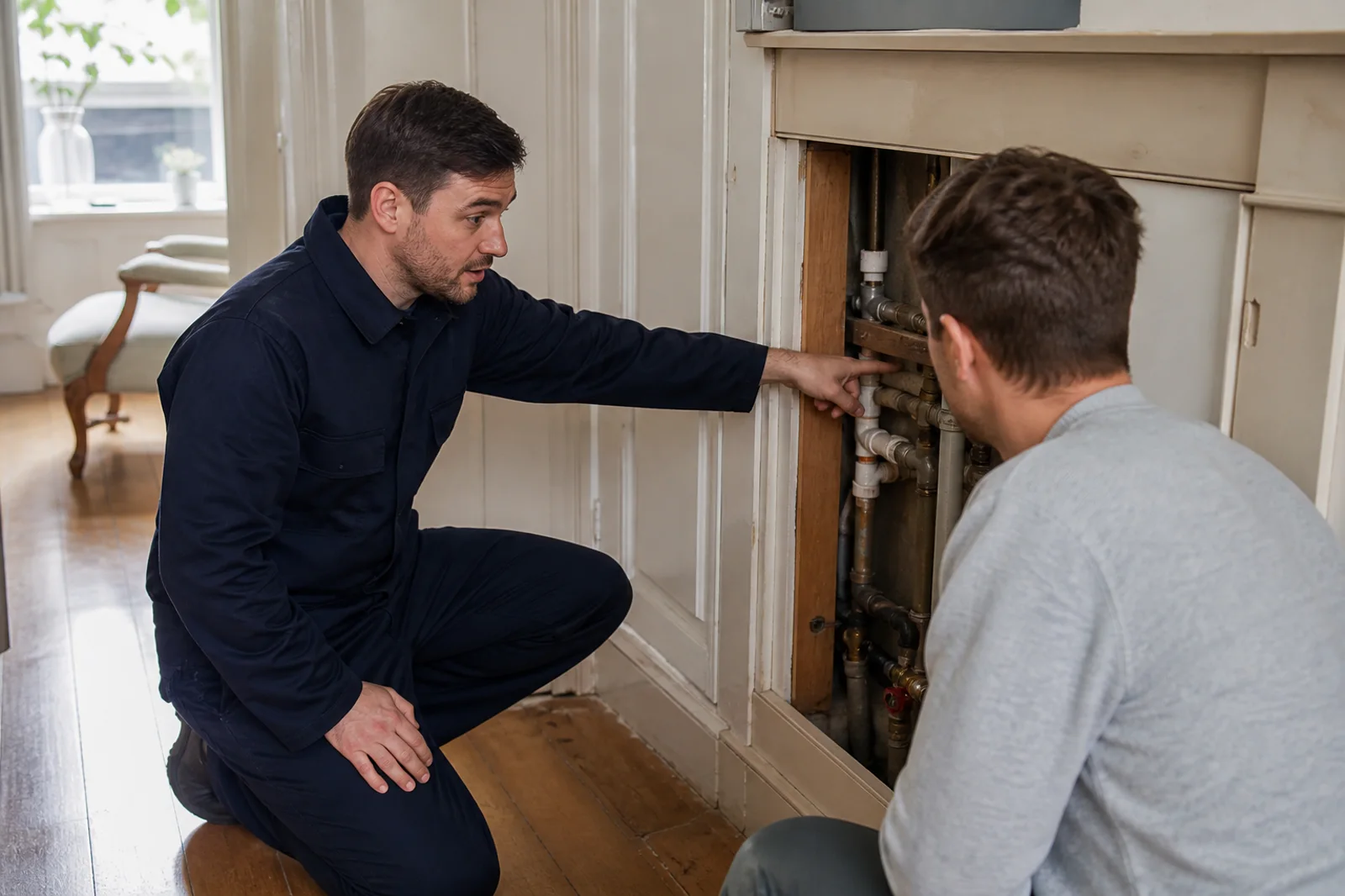
HAND OVER EVIDENCE THAT AN OWNER CAN AUTHORISE
Name the private component, the test result and any access limitation. Refer common systems without converting a limited inspection into a whole-building conclusion.
Remake the joint that leaks during the reproduced test. Name the private component, the test result and any access limitation. Refer common systems without converting a limited inspection into a whole-building conclusion. Use room, fitting and timing instead of a guessed cause: renew the assembly if distorted or incompatible pieces prevent sealing.
Adjust or replace the confirmed faulty part. Name the private component, the test result and any access limitation. Refer common systems without converting a limited inspection into a whole-building conclusion. Use room, fitting and timing instead of a guessed cause: consider related internals only when wear or compatibility supports it.
Clear an accessible restriction or service the valve. Name the private component, the test result and any access limitation. Refer common systems without converting a limited inspection into a whole-building conclusion. Use room, fitting and timing instead of a guessed cause: investigate upstream only if comparison shows a wider issue.
Complete authorised work on the private side. Name the private component, the test result and any access limitation. Refer common systems without converting a limited inspection into a whole-building conclusion. Use room, fitting and timing instead of a guessed cause: record and refer common-pipe evidence without assuming liability.
BLOOMSBURY · WORKSHEET WORKFLOW
Name water collecting in a cupboard after a tenant uses the basin and its triggering use.
Open the lawful Bloomsbury working route.
Prove which Bloomsbury outlets the valve serves.
Relate a loose tap body outlined during a tenancy assessment to accessible evidence.
Name the Bloomsbury part and exclusions.
Demonstrate the repaired item, restore the water supply and record the outcome.
BLOOMSBURY · OPTION WORKSHEET
Bloomsbury choices follow building a tenant-to-landlord plumbing record evidence. The worksheet keeps serviceability, compatibility and access visible.
Keep sound Bloomsbury pipework around water collecting in a cupboard after a tenant uses the basin.
Match a loose tap body outlined during a tenancy assessment using the measured worksheet.
Add Bloomsbury control only within authorised pipework.
Let inspect findings set the next access point.
BLOOMSBURY · QUOTATION WORKSHEET
Bloomsbury location does not set the figure. The worksheet prices access, isolation, components and testing.
| worksheet stage | Bloomsbury evidence | inspect result |
|---|---|---|
| water collecting in a cupboard after a tenant uses the basin | Timing, route and isolation | Supported source or stated limit |
| a loose tap body outlined during a tenancy assessment | Reference and adjoining pipe | Included part and operating check |
| a toilet inlet that fails to end consistently | Relevant sanitary cycle | Stable Bloomsbury water state |
| renewing an appliance valve between occupancies | Dimensions and maintenance route | Approved alteration boundary |
Put keys and panels in the worksheet.
Name the valve and affected outlets.
Match dimensions to actual connections.
List non-plumbing finishes separately.
BLOOMSBURY · SCOPE WORKSHEET
Bloomsbury’s worksheet ties water collecting in a cupboard after a tenant uses the basin to a tested result. Other systems retain separate owners.

BLOOMSBURY · BOOKING WORKSHEET
Use scale where the worksheet needs it. Keep Bloomsbury keys, codes and personal details outside photographs.
BOOKING QUESTIONS
These answers keep the Bloomsbury choice tied to plumbing evidence, authority and a testable result.
Give the Bloomsbury address, relevant room, timing and present water state for “water collecting in a cupboard after a tenant uses the basin”. Outline what adjusted after safe isolation and attach wide and close captures without taking a junction apart.
End using the Bloomsbury draw-off when “a loose tap body noted during a tenancy examination” releases water, will not close or makes a connected part take. Safeguard the zone and schedule the appropriate plumbing advice.
No. Water might run along pipework, fitted-spaces and floors. The timing of “water collecting in a cupboard after a tenant uses the basin” and assessment of reachable Bloomsbury fittings are more informative than proximity alone.
Only when the make, dimensions, joint type and operating requirements for “a loose tap body noted during a tenancy assessment” are established. Concealed preparation at the Bloomsbury premises might still need measuring on site.
common front doors and service cupboards might require a separate contact. For Bloomsbury, verify the owner, freeholder or managing agent authorised before a common valve, riser, stack or service cupboard is altered.
Not necessarily. The Bloomsbury valve could be absent, bound, incorrectly labelled or upstream of other fittings. Its actual effect should be examined carefully before “a toilet inlet that fails to pause consistently” is dismantled.
Agree the likely Bloomsbury access point, the extent of opening-up and who will reinstate joinery, plaster, tiles or decoration after work on “renewing an appliance valve between occupancies”.
Yes. At a Bloomsbury home, ordered elements, concealed damage, drying, management permission or other trade might require a separately settled return after the earliest findings.
Repeat the usual action related to “water collecting in a cupboard after a tenant uses the basin”, monitor the repaired link, check isolation and local junctions, then record any limit caused by wider Bloomsbury access.
Keep the result, authorised scope, sections, isolation used, handover check and exclusions. For Bloomsbury, also record the occupier appropriate for any shared-service follow-up.
RELATED ROUTES
Use the general plumbing hub for water outlets and pipework, then relocate to a specialist service when the checked arrangement falls beyond that scope.
LOCAL PLUMBING CONNECTIONS
Choose the guide for the actual work address. The surrounding pages describe access and water-control questions that differ between nearby property types.
BLOOMSBURY · MAP WORKSHEET
Bloomsbury mapping supplies orientation only. Diagnosis and pricing come from the worksheet, not the marker.
EVIDENCE FOR THE EARLIEST CALL
For Bloomsbury, contain the precise part, normal-use series, present water state, documented isolation, premises path and occupier authorised to sanction the next step.
