
Tree
Consider crown shape, size, vigour and visible concerns.
CROUCH END · TREE · PROPERTY · ACCESS
A tree-work enquiry becomes useful when it describes the concern, the tree and the space around it. In Crouch End, conservation-sensitive streets and character properties can bring access, boundaries and nearby property into the same decision as pruning or removal.
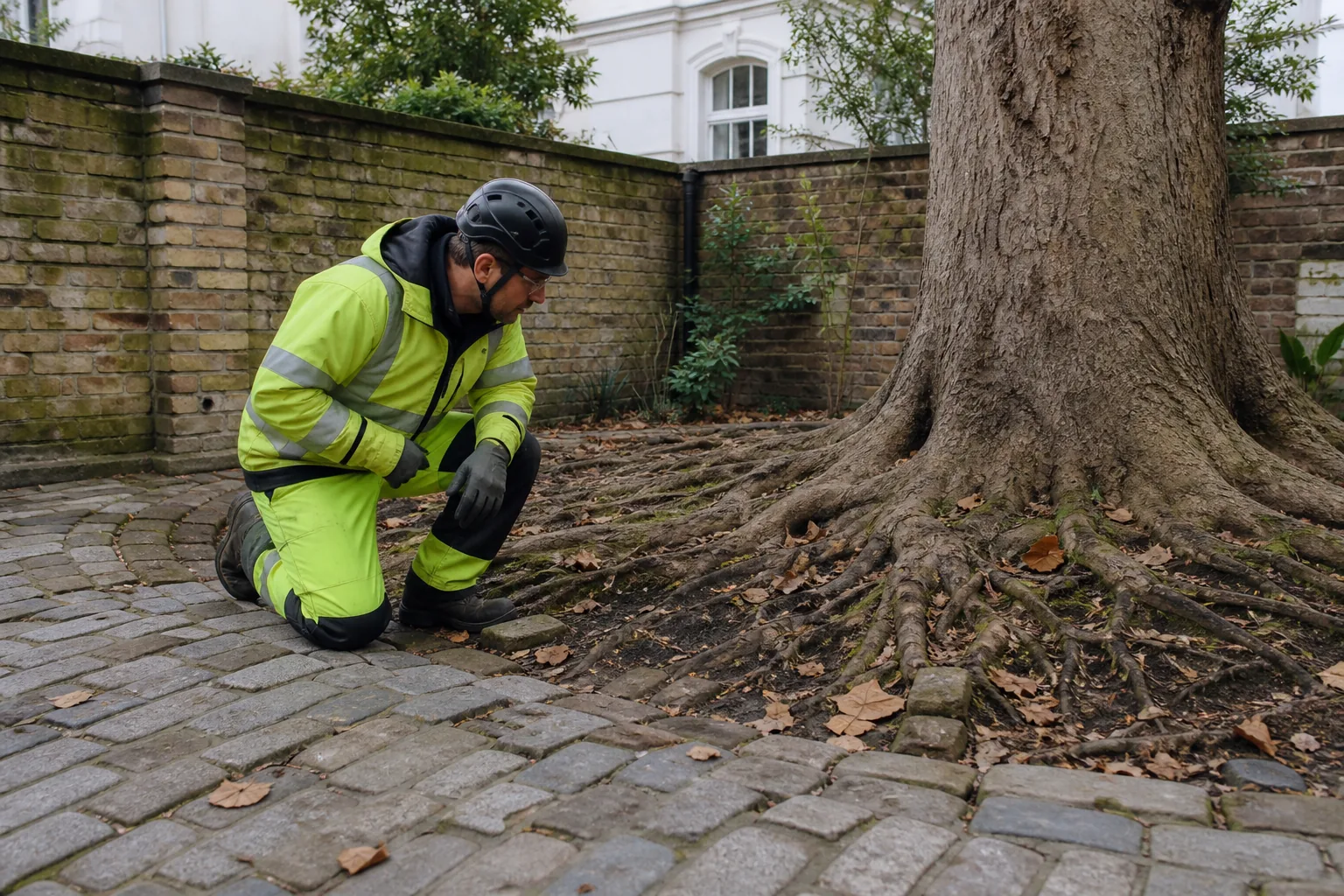
START WITH THE REASON
A useful first review combines whole-tree images with closer views of the concern. It also records careful routes through finished spaces. This makes the later quotation more precise and helps identify where an on-site visit is necessary.
This selector records useful evidence; it does not diagnose the tree or prescribe work.
CROUCH END TREE AND SITE
Tree status and the character of the setting should be checked before dates and methods are fixed. At a period or character property in Crouch End, photographs should show the full tree, its base, the concern and the route from the entrance. This allows an initial conversation about what is practical without assuming that every address presents the same constraints.
Consider crown shape, size, vigour and visible concerns.
Structures, pedestrian routes, boundaries and planting below.
Careful routes through finished spaces.
| Possible situation | Point to confirm | Why it belongs in the plan |
|---|---|---|
| period or character property | Position of branches around the building | Protection needs may change the proposed operation |
| conservation-sensitive streets and character properties | How residents and visitors use the space | The safe area may need to be organised beforehand |
| careful routes through finished spaces | Passage dimensions, slopes and ground finish | Branches and timber must suit the available route |
| Protected or shared setting | Protected status, responsibility and authority | Permissions can influence the timetable |
PLAIN-ENGLISH TREE WORK
A measured scope records what is to change and what should remain. That is especially important around conservation-sensitive streets and character properties, where an unclear instruction can produce the wrong clearance or an unnecessarily severe result.
| Tree work | What it means | Typical objective |
|---|---|---|
| Pruning | Pruning directed at particular growth | Respond to an identified crown or property concern |
| Crown reduction | Reduce crown height or width through measured pruning | Manage overall crown dimensions where justified |
| Crown thinning | Prune selected branches from within the canopy | Open selected internal growth without an overall reduction |
| Crown lifting | Lift the canopy through suitable lower-branch removal | Increase the gap below the canopy |
| Tree removal | Remove the whole tree | Only when the tree-and-site review supports that course |
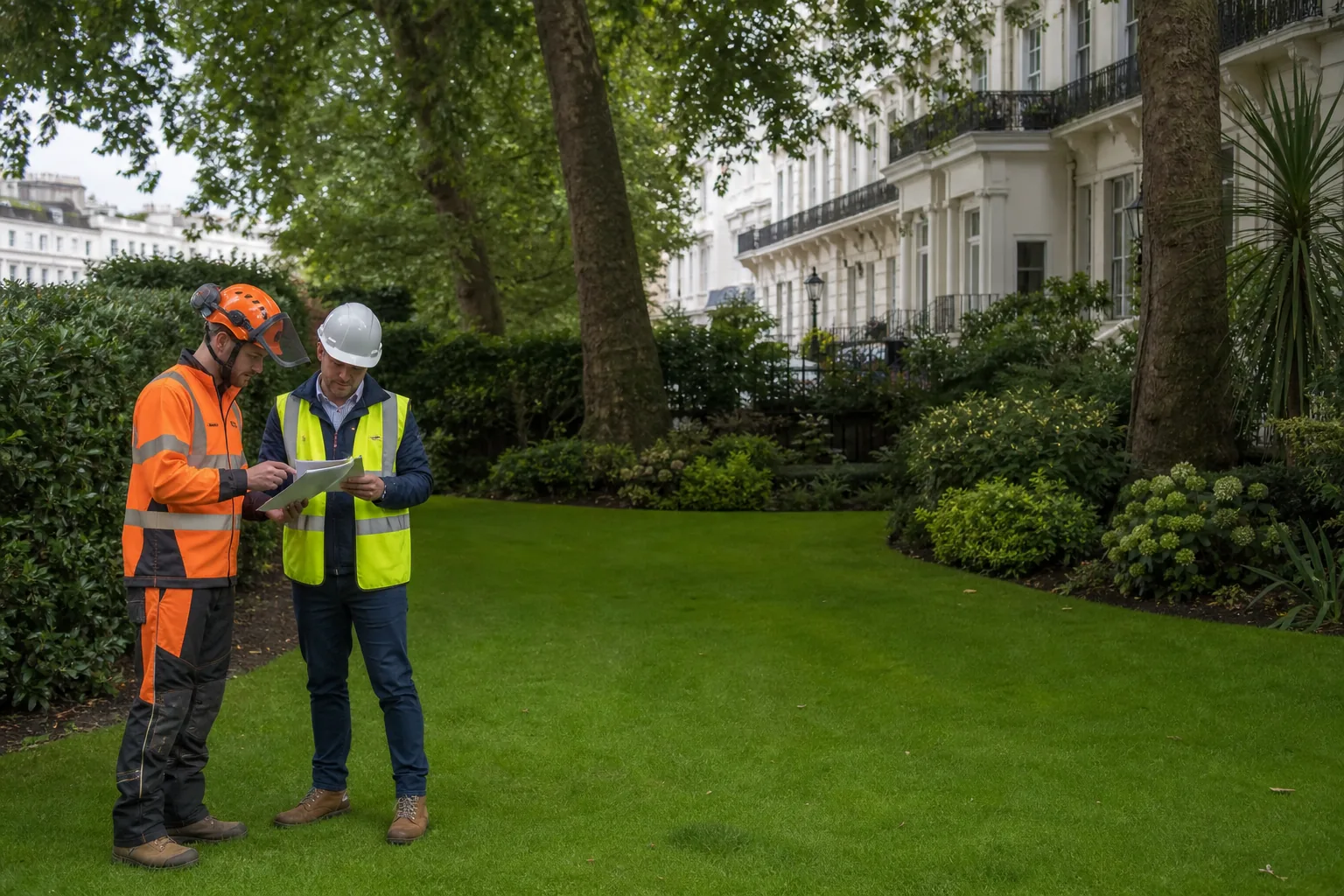
ACCESS CHANGES THE PLAN
Even modest pruning can generate awkward material. Around conservation-sensitive streets and character properties, the quotation should say how arisings are expected to leave the work area and what protection or coordination is needed.
Open space still requires ground, planting and work-zone planning.
Record passage width, corners, levels and vulnerable finishes.
Access arrangements may involve occupiers and site management.
The public-facing area may need timed coordination.
FROM CONCERN TO RESULT
Identify the tree, observed issue and desired result
Review form, condition and nearby structures
Clarify who can instruct work and how the tree is reached
Set out what will be done, how much and at what cost
Prepare the site controls and agreed access
Work to the documented arboricultural scope
Check the result, clearance and retained material
PRUNING OR REMOVAL?
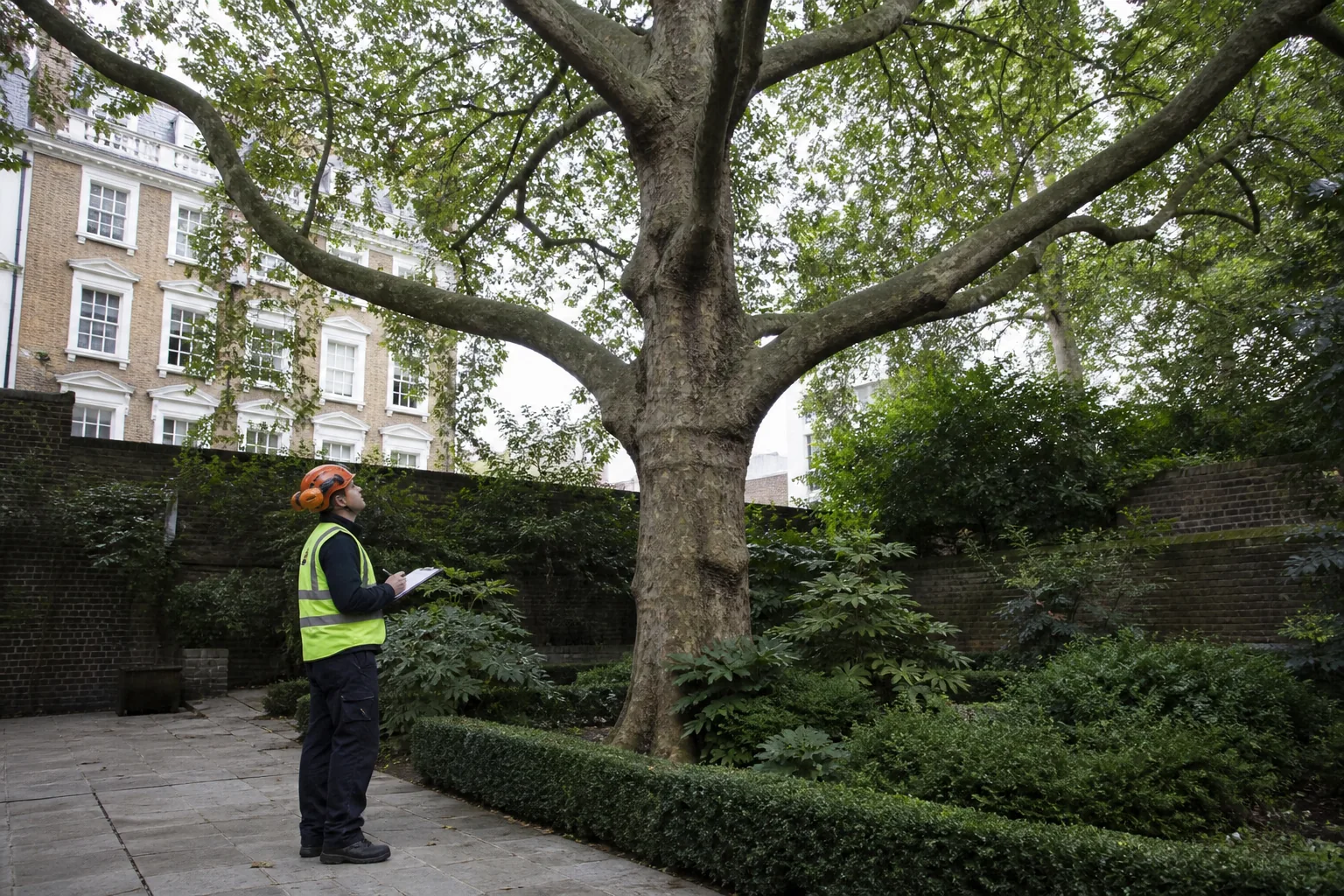
The visible crown is only part of the site picture. The stem, unions, base, root area and targets below all matter, as do careful routes through finished spaces. In Crouch End, these observations help define whether pruning, further investigation or a removal discussion is appropriate.
| Situation noticed | Pruning may be considered | Removal discussion |
|---|---|---|
| Excessive spread | Often, where suitable for the tree | Not automatically |
| Low branches | Targeted lifting may be suitable | Usually unnecessary for that reason alone |
| Dead branches | Selected deadwood removal | Depends on whole-tree assessment |
| Property conflict | Depends on the extent and objective | May require broader assessment |
| Serious visible damage | No online conclusion | Assessment required |
BRANCHES, CHIP AND TIMBER
A tidy work area does not mean every trace disappears. Fine sawdust or ground impressions may remain, while removal of the stump or roots requires its own explicit instruction.
Confirm chipping and removal.
Agree removal or retained log sizes.
Separate unless expressly included.
QUOTE THE ACTUAL WORK
Tree surgery in Crouch End is quoted after the task and site are understood. Tree size, visible condition, exact operation, careful routes through finished spaces, nearby targets, permission checks, waste volume and any separately agreed stump work can all affect the figure.
| Factor | Why it matters |
|---|---|
| Tree size and condition | Has a bearing on the operation and time allowed |
| Type and extent of work | Measured pruning does not carry the same scope as removal |
| Access and surroundings | careful routes through finished spaces can change site planning |
| Arisings | Branch and timber quantities shape the clearance plan |
| Number of trees | Changes the combined specification |
| Stump work | Is not assumed within the main tree operation |
| Permissions | Can influence lead time and work arrangements |
PERMISSION AND RESPONSIBILITY
Tree work may be affected by a Tree Preservation Order, conservation-area requirements, ownership or rules for a managed site. This page cannot determine the legal position of a particular tree. Check the relevant requirements before work is scheduled where applicable.
| Situation | Point to consider |
|---|---|
| Tree with a TPO | Specified work may require permission |
| Conservation area | Notification or permission requirements may apply |
| Boundary tree | Ownership and responsibility should be established |
| Rented property | Landlord or manager approval may be relevant |
| Managed development | Access and site rules may affect the plan |
TIMING AND WILDLIFE
Leaf cover can help or hinder different observations, while tree response varies by species. Timing should therefore follow assessment, not a generic seasonal slogan.
Confirm the objective, boundary and route through the property.
Coordinate authority and access with the occupier where needed.
Record shared-area rules, communication and site constraints.
CROUCH END SERVICE CONTEXT
Tree work should fit the particular Crouch End address, not a stock picture of the area. Tree status and the character of the setting should be checked before dates and methods are fixed. Where permission, ownership or shared access is uncertain, those points are better resolved before a team is scheduled.
USEFUL ANSWERS FOR CROUCH END
Chipping, removal or retained logs can be agreed. The written scope should identify what will happen to each type of material. The written scope should make this explicit.
No responsible outcome can make a living tree maintenance-free. The objective should be realistic and appropriate to the tree.
No. Generic descriptions or photographs alone should not be used to declare a tree diseased or dangerous.
No. The extent, position and whole-tree condition require assessment before pruning or removal is considered. The actual address determines what is practical.
It may. Species, condition, type of work, wildlife and local restrictions can all influence suitable timing.
Authority from the relevant owner, landlord or manager may be needed; this should be established before scheduling.
It is a measured decrease in crown height or spread, carried out through selective pruning where appropriate for the tree. The actual address determines what is practical.
Yes. A TPO, conservation-area requirement, ownership issue or site rule may affect the proposed work. This is not a legal determination for a particular tree.
Send the whole tree, the base, the specific concern, nearby property and the complete access route from the street.
It should identify the operation, relevant part of the crown, intended dimensions or clearance and any branches of concern. Assessment comes before a firm recommendation.
REQUEST AN ASSESSED CROUCH END SCOPE
Share whole-tree photographs, the specific concern and careful routes through finished spaces. We can identify whether an on-site assessment is needed before a quotation.
