
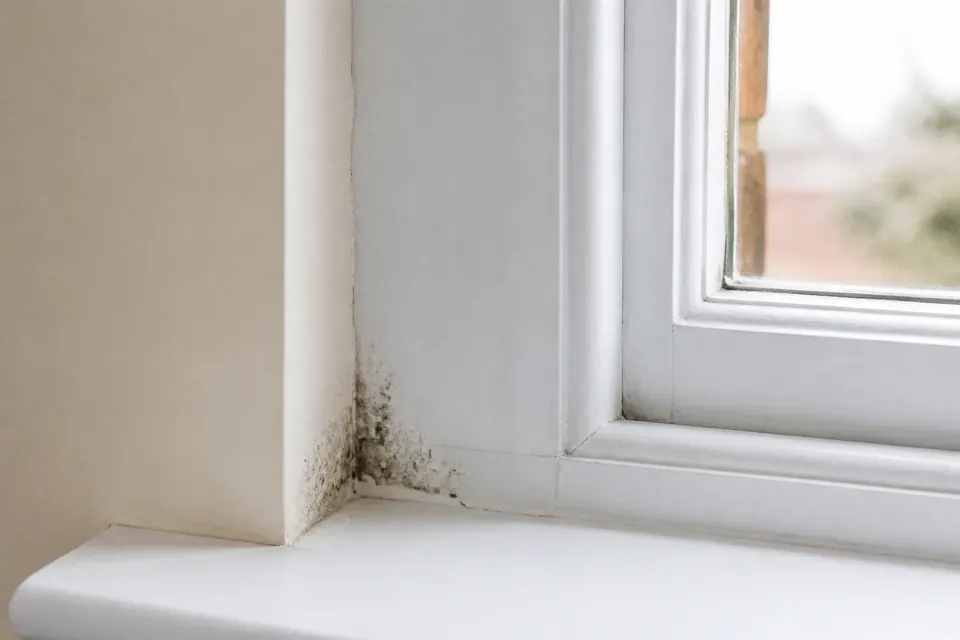
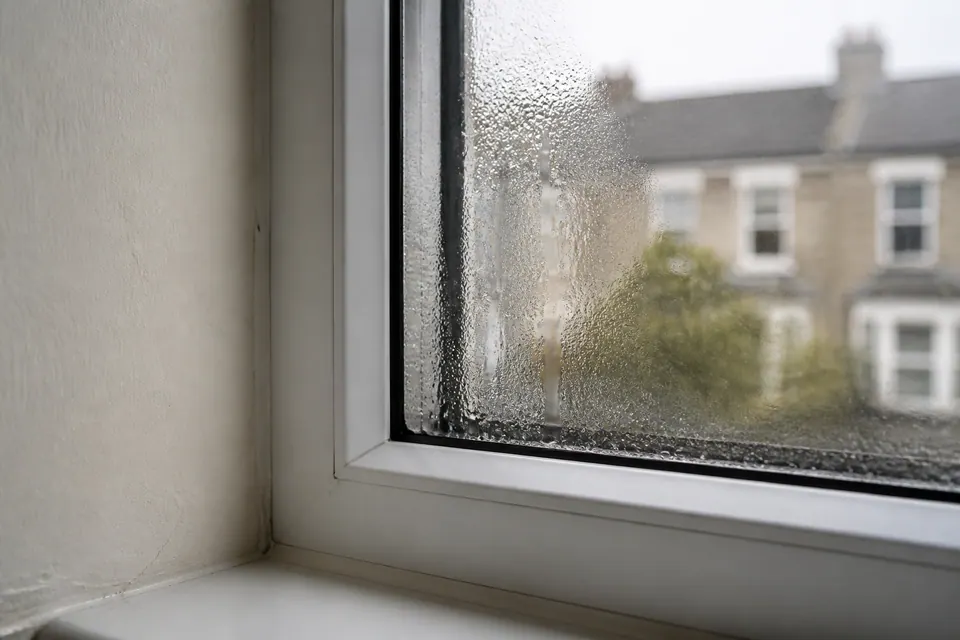
Window detail without room context
Add a view showing the opening and adjoining wall. State whether water has actually been noticed rather than expecting a still image to establish it.
Esher / EVIDENCE AND ITS LIMITS
Show the evidence and name the remaining questions.
A photograph can document a patch without confirming its cause or material suitability. For Esher, confirm postcode availability and combine room context, dimensions and known history with a clear statement of what remains uncertain before discussing a visit.
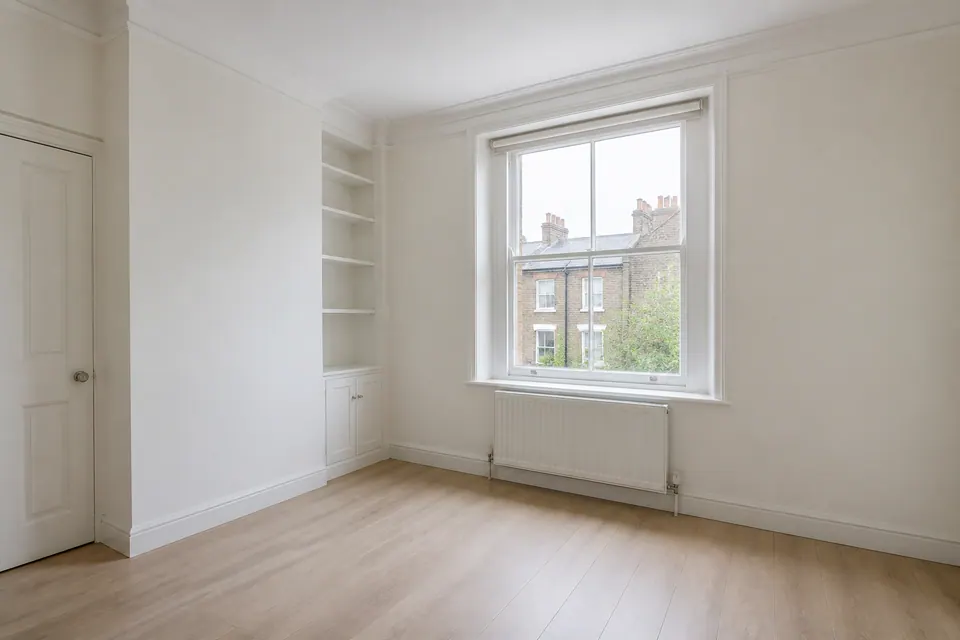
Room view · dimensions · history · uncertainty
01 / SEPARATE THE QUESTIONS
Appearance, material and moisture history provide different kinds of information and should not be merged into one photographic conclusion.
| What the image shows | Information to add | What may remain open |
|---|---|---|
| Visible wall marks | Known material and dimensions | Suitability of the finish |
| A patch near a window | Actual water observations | The moisture explanation |
| A partly hidden surface | Access limitation | Condition beyond the view |
| A returning outline | Previous work and timing | Need for further assessment |
Leak tracing, concealed inspection and material replacement require their own scope where relevant. Do not interpret a photograph review as confirmation of every building condition.
A surface image may show current marks while the moisture history depends on events outside the frame.
| Question | Mould | Damp |
|---|---|---|
| What is documented? | The present visible finish | Actual water or known repair events |
| What may remain uncertain? | Material suitability or hidden extent | The source and continuing condition |
| Why state the limits? | A proposal should reflect reliable evidence | Another assessment may be required |
| What should be agreed? | Appropriate suitable-surface scope | Any separate investigation or repair |
02 / LOCATE THE ISSUE
Choose the setting and add the information that an image may not show. Avoid filling gaps with an assumed cause or material.
Add a view showing the opening and adjoining wall. State whether water has actually been noticed rather than expecting a still image to establish it.
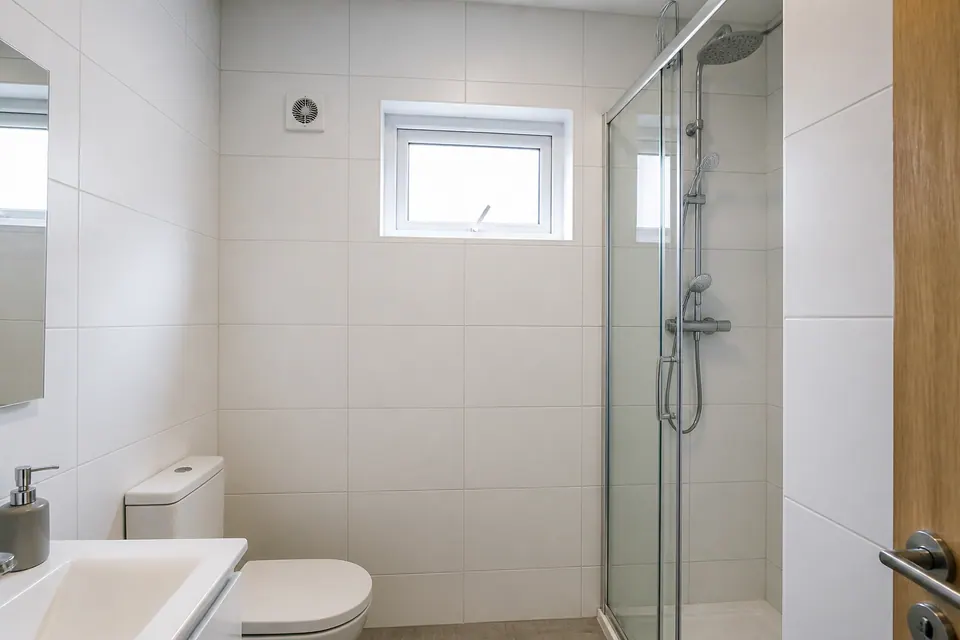
Identify paint, panel or sealant where known and describe any deterioration. An image of a dark edge may not identify the material.
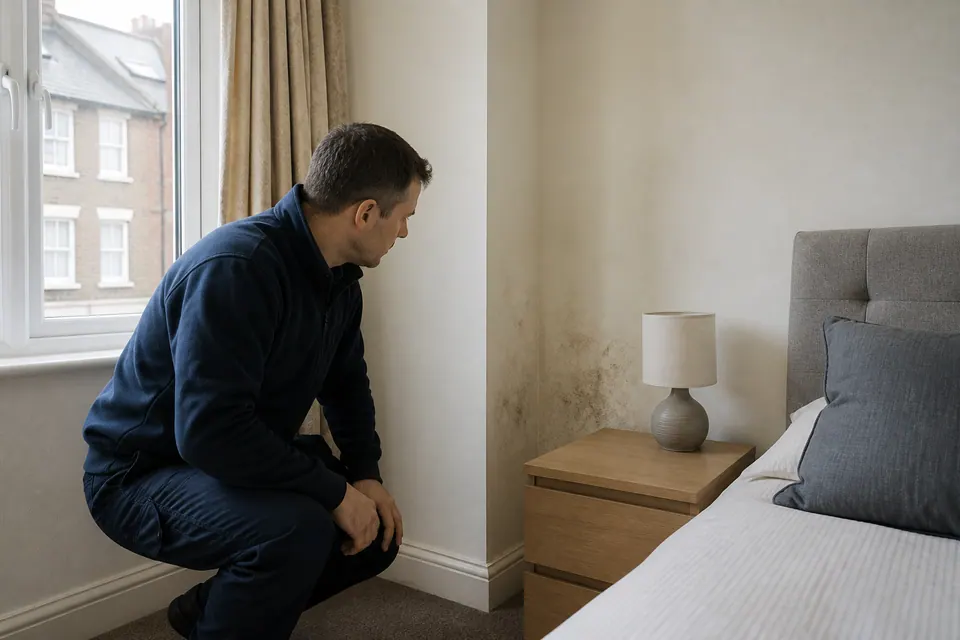
Show furniture and the surrounding finish. Explain whether earlier appearance is known or the patch has only recently become visible.
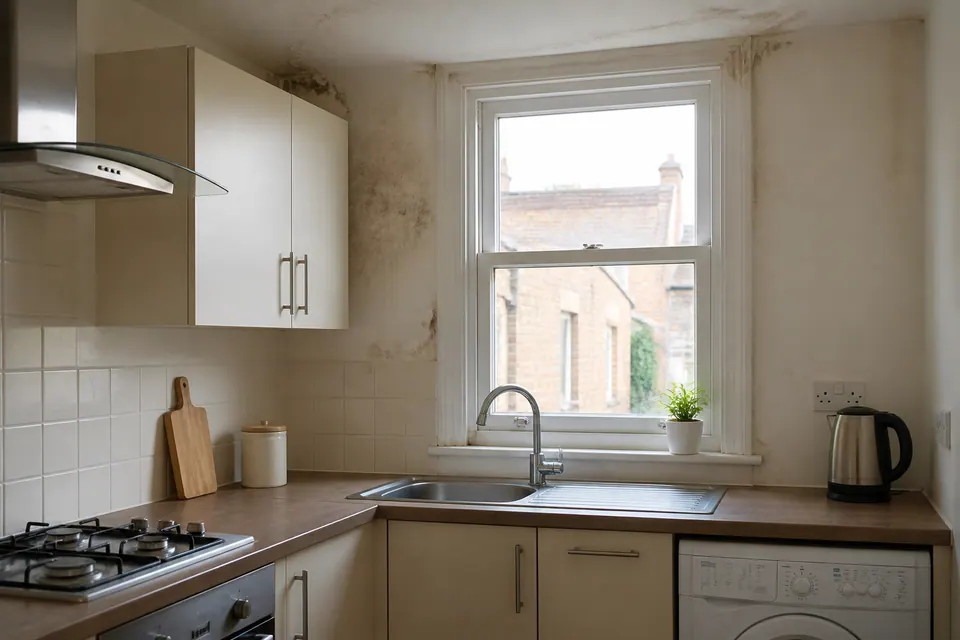
Add confirmed water or repair history in words. Nearby pipework in the picture does not establish its condition or relevance.
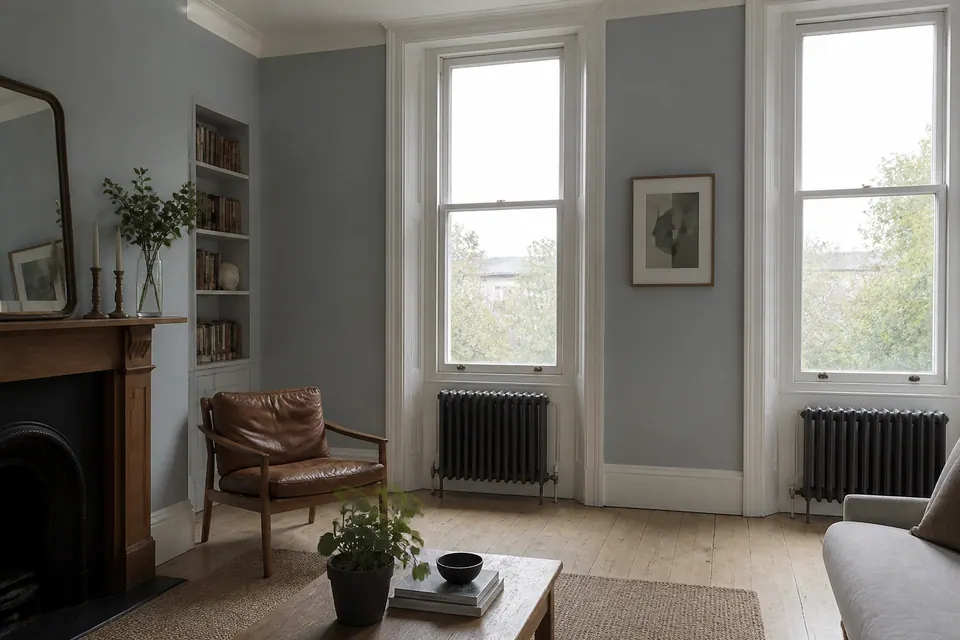
Identify decorative covering or uncertainty and include a fixed room feature. Colour alone should not become a diagnosis.
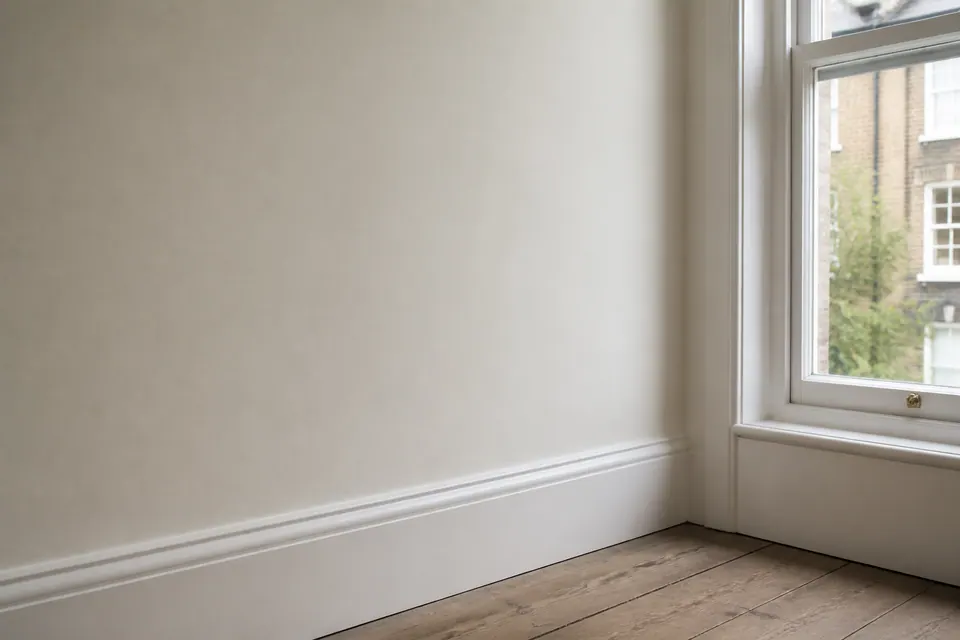
Use a safe room-wide view and approximate position. State access limits without climbing or probing to provide missing detail.
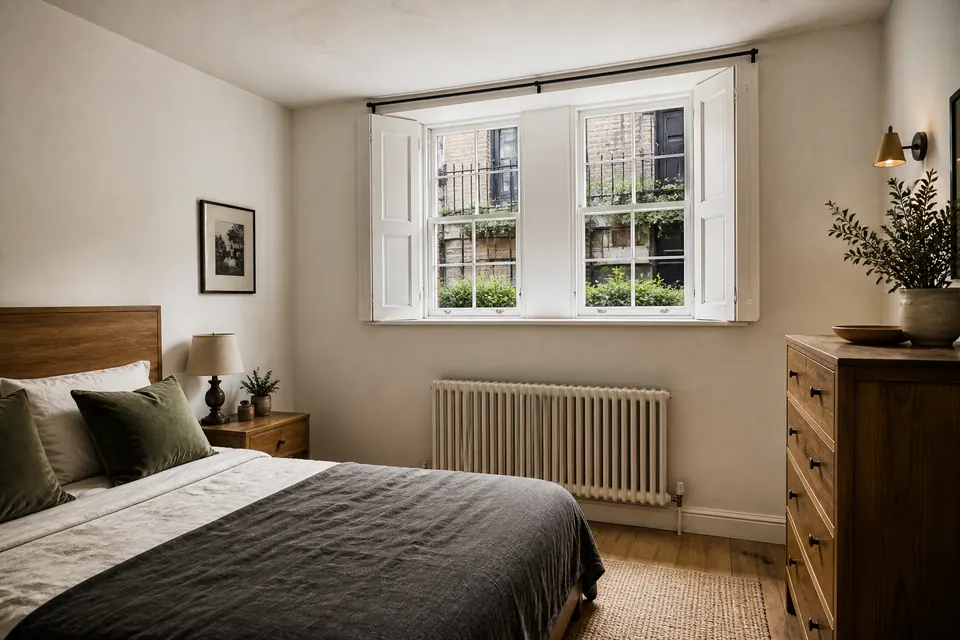
Explain what remains hidden and what the visible panel is, if known. Do not treat an obstructed view as proof of concealed growth.
The enquiry is stronger when its limits are explicit. Photographs support assessment but do not settle every question about material, moisture or scope.
Esher / THE PROPERTY BRIEF
Include uncertainty instead of hiding it.
Confirm availability for the full Esher postcode, then send a wider view, detail photograph and approximate affected dimensions. Add known treatment or water history and identify anything the evidence cannot establish. Ask whether further assessment is needed before pricing rather than assuming that a clear picture guarantees a suitable surface-removal method.
04 / A CONTROLLED APPROACH
Match the images to room, dimensions and known history. Keep uncertainty visible instead of replacing it with assumptions.
Clarify what further information or suitable preparation is needed. Do not move, scrape or cover material merely to fill an evidence gap.
Follow the agreed scope once conditions and arrangements are understood. Newly identified limits may require another decision.
Distinguish treated areas from unanswered material or moisture questions. Avoid overstating what the evidence or visit established.
The sequence does not promise that photographs alone answer every question.
Keep image context and written history together.
Do not include concealed areas by assumption.
Record separate questions still requiring attention.
The illustrations explain stages and are not evidence of customer diagnoses made from images alone.
05 / QUOTATION, NOT GUESSWORK
For Esher, confirm coverage and provide the known evidence with its limits. The pricing route should follow current material and complexity rather than assume every clear photograph supports the same final quotation.
Review the main assessment approach ↗| Current information | Quotation route | What to clarify |
|---|---|---|
| Limited suitable accessible area | Photographs may support a quote | Material and clearance |
| Several or recurring concerns | Assessment informs the proposal | Separate histories and extent |
| Damage or unresolved material questions | Specialist quotation may be needed | Suitability or further investigation |
Confirm availability, inclusions and what remains subject to assessment. A photograph-led enquiry does not guarantee a fixed price or complete moisture diagnosis.
06 / WHEN IT COMES BACK
If the surface changes again, provide a current view and explain what is different. Keep previous work and dates where known without assuming the old proposal remains suitable.
A new image can add information but still leave material or moisture questions open. State those limits before another scope is agreed.
Clear labels prevent old extent or condition from being mistaken for the present enquiry.
Esher / ACCESS & PEOPLE
Provide context and dimensions without extending the claim to the whole room or property.
Label each image and history separately. Avoid presenting repeated views of one area as additional surfaces.
Explain the obstruction and what remains unknown. Do not invent hidden dimensions to make the brief look complete.
Share factual views and known history with the authorised contact. Photographs do not determine legal repair responsibility.
Attach relevant maintenance to the correct area. A general property history may not answer the current surface question.
Ask what the evidence supports and what needs further assessment before arranging repairs or decoration.
08 / ROOM-BY-ROOM CONTEXT
Identify the material and deterioration where known. A dark close-up does not establish paint, panel or sealant suitability.
Describe previous appearance and furniture limits. Recently noticed does not necessarily mean newly developed.
Add actual water and repair history rather than inferring a source from nearby fittings.
Identify coverings and decorative uncertainty. A clear image cannot promise a matching restored finish.
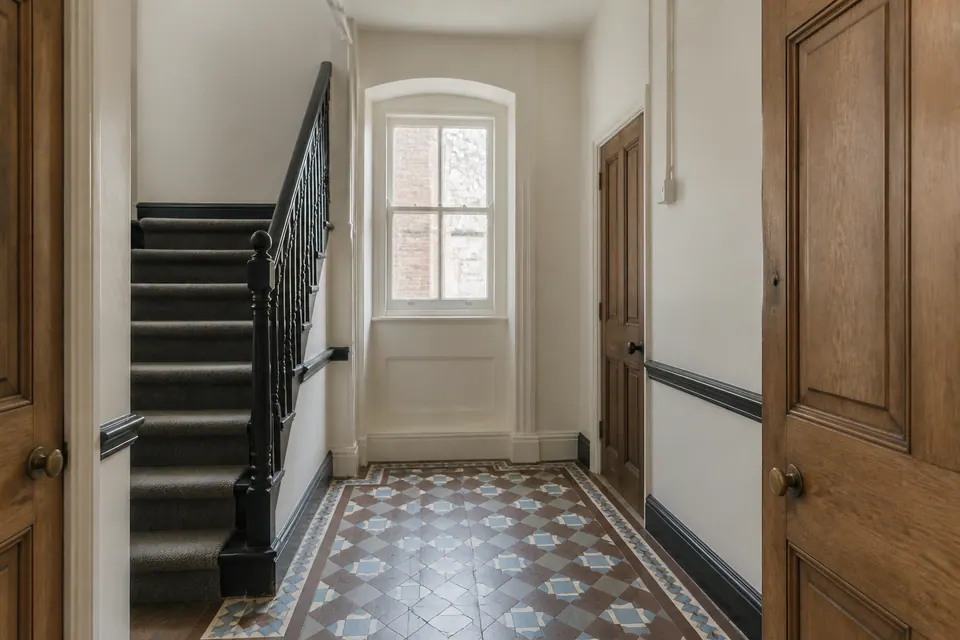
State access and authorisation boundaries alongside the evidence. A photograph is not permission to treat common parts.
Give actual level and known history without assigning a damp type. Position is context rather than diagnosis.
09 / DIRECT ANSWERS
No. They may support pricing for suitable limited areas, while recurring, complex or uncertain concerns can require further assessment.
Do not alter it merely for the enquiry. Show current condition and ask for preparation guidance.
Not alone. Add known timing, previous work and actual moisture observations rather than expecting appearance to identify the cause.
Material, extent, access and method still matter. Ask after the appropriate scope is understood.
No improvised movement should be assumed. Show the available view and describe the limitation before preparation is agreed.
State that openly. Do not label an uncertain panel as ordinary paint to make the enquiry appear complete.
No. Report actual water observations separately and leave the cause open for assessment.
Not automatically. Concealed investigation and repair need separately defined scope.
Esher / PLAN THE APPOINTMENT
Confirm availability for the complete Esher postcode before planning a visit. Send the evidence and open questions together so the appropriate next step can be discussed.
Use the map to locate the address and explain the route where helpful.
Load the Esher area map.
Esher / BEFORE BOOKING
Name the uncertainties rather than expecting the photographs to answer everything.
Yes. State what is uncertain and show the visible surface instead of assigning a convenient material label.
No. Check the complete postcode before arranging access or preparation.
Add a wider room view where safely possible. It provides location, material transitions and access context the detail may omit.
Yes, when described honestly. Do not climb or disturb material to obtain a precise measurement.
Not necessarily. They may support a limited suitable quote or indicate that further assessment is needed.
Avoid changing the evidence’s appearance. Explain the location in words and provide a clear unaltered view.
State that uncertainty. Do not invent a product, method or date to complete the history.
Do not assume that. Actual events and observations can support assessment, but further investigation may be separate.
After availability and appropriate instructions are confirmed, not based on a guessed treatment from the photograph.
SEND THE EVIDENCE AND THE OPEN QUESTIONS
Include the postcode, room context, visible dimensions and known history. Confirm availability and ask what remains to be assessed before a treatment proposal.
The images are illustrative property scenes rather than customer evidence or guaranteed diagnostic examples.
