
Water at the stair foot
Run one outlet at a time and compare the delay. Until the appointment, dry the walking route and keep electrical items away.
ANGEL · READ THE DELAY BETWEEN FLOORS
For an upper-floor home above a shop, the useful starting point is the exact water event and the vertical route between rooms—not a guess based on who occupies the floor below.
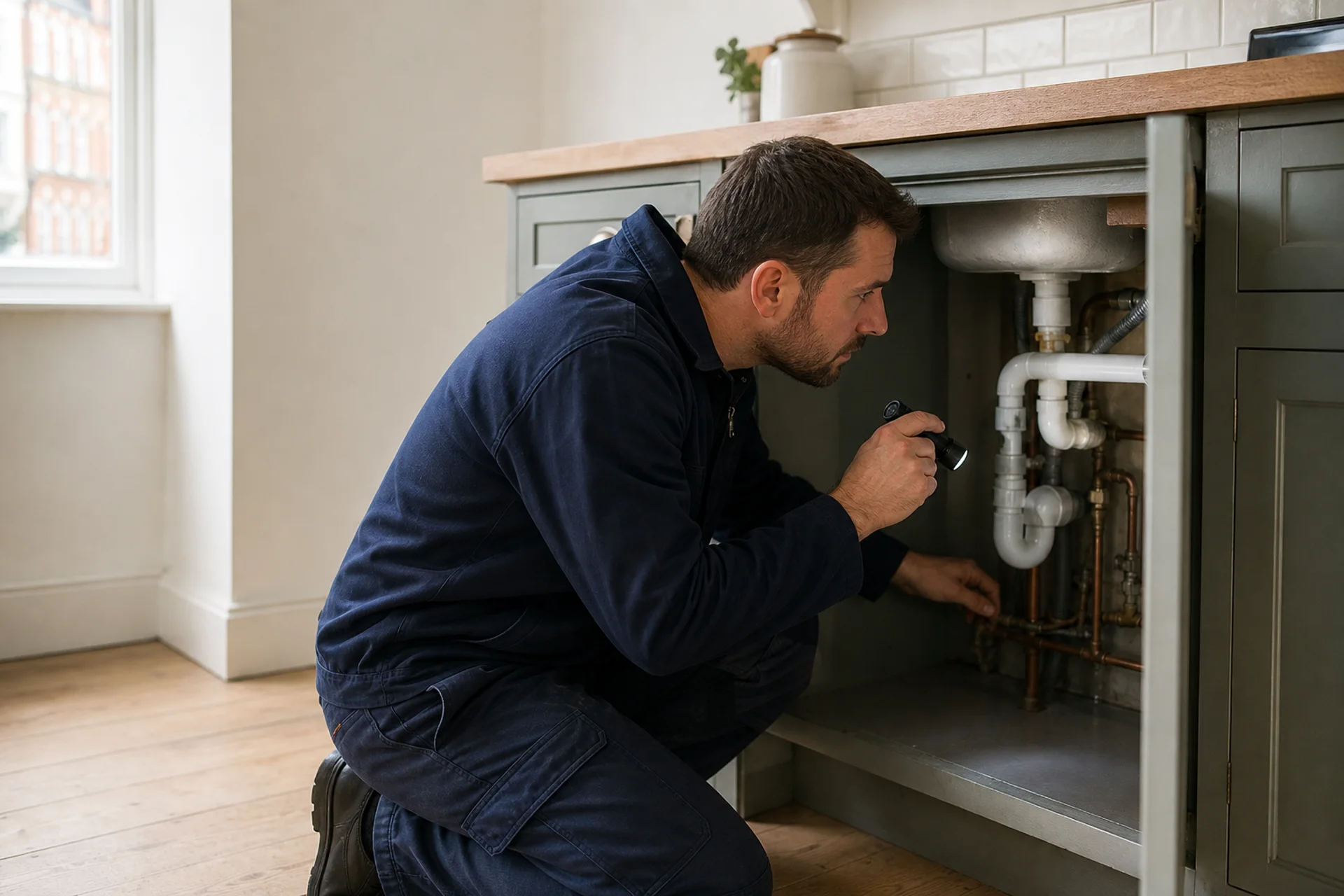
READ THE DELAY BETWEEN FLOORS
Operate one basin or shower at a time, then note the delay before moisture appears. This vertical sequence is more useful than treating every damp edge beside a stair as one fault.
Run one outlet at a time and compare the delay. Until the appointment, dry the walking route and keep electrical items away.
Inspect the trap, overflow and short waste branch. Until the appointment, stop using chemical drain cleaner and note any gurgling.
Listen for flow after the cistern should have stopped. Until the appointment, close the local valve if it operates freely.
Check whether it changes with rain, heating or water use. Until the appointment, do not remove boxing before permission is agreed.
A narrow entrance, business opening times and an internal staircase. A slow basin, moving mixer or shower enclosure requires a different comparison. Check the fitting in use while the route below remains observable. A slow basin, moving mixer or shower enclosure requires a different comparison. Check the fitting in use while the route below remains observable.
Follow the appliance connection, the flat branch and the point where it joins shared drainage. Deal with the confirmed flat connection first. Shared drainage, locked risers and shop-side access retain their own approval routes.
SEPARATE SUPPLY, WASTE AND SURFACE WATER
A slow basin, moving mixer or shower enclosure requires a different comparison. Check the fitting in use while the route below remains observable.
| What has been noticed | What can be compared | What to do for now |
|---|---|---|
| Water at the stair foot | Run one outlet at a time and compare the delay | Dry the walking route and keep electrical items away |
| Slow upstairs basin | Inspect the trap, overflow and short waste branch | Stop using chemical drain cleaner and note any gurgling |
| Intermittent toilet refill | Listen for flow after the cistern should have stopped | Close the local valve if it operates freely |
| Dampness beside a boxed riser | Check whether it changes with rain, heating or water use | Do not remove boxing before permission is agreed |
WORK FROM THE UPPER FITTING DOWN
Operate one basin or shower at a time, then note the delay before moisture appears. This vertical sequence is more useful than treating every damp edge beside a stair as one fault. A slow basin, moving mixer or shower enclosure requires a different comparison. Check the fitting in use while the route below remains observable.
Deal with the confirmed flat connection first. Shared drainage, locked risers and shop-side access retain their own approval routes. Deal with the confirmed flat connection first. Shared drainage, locked risers and shop-side access retain their own approval routes. A slow basin, moving mixer or shower enclosure requires a different comparison. Check the fitting in use while the route below remains observable.
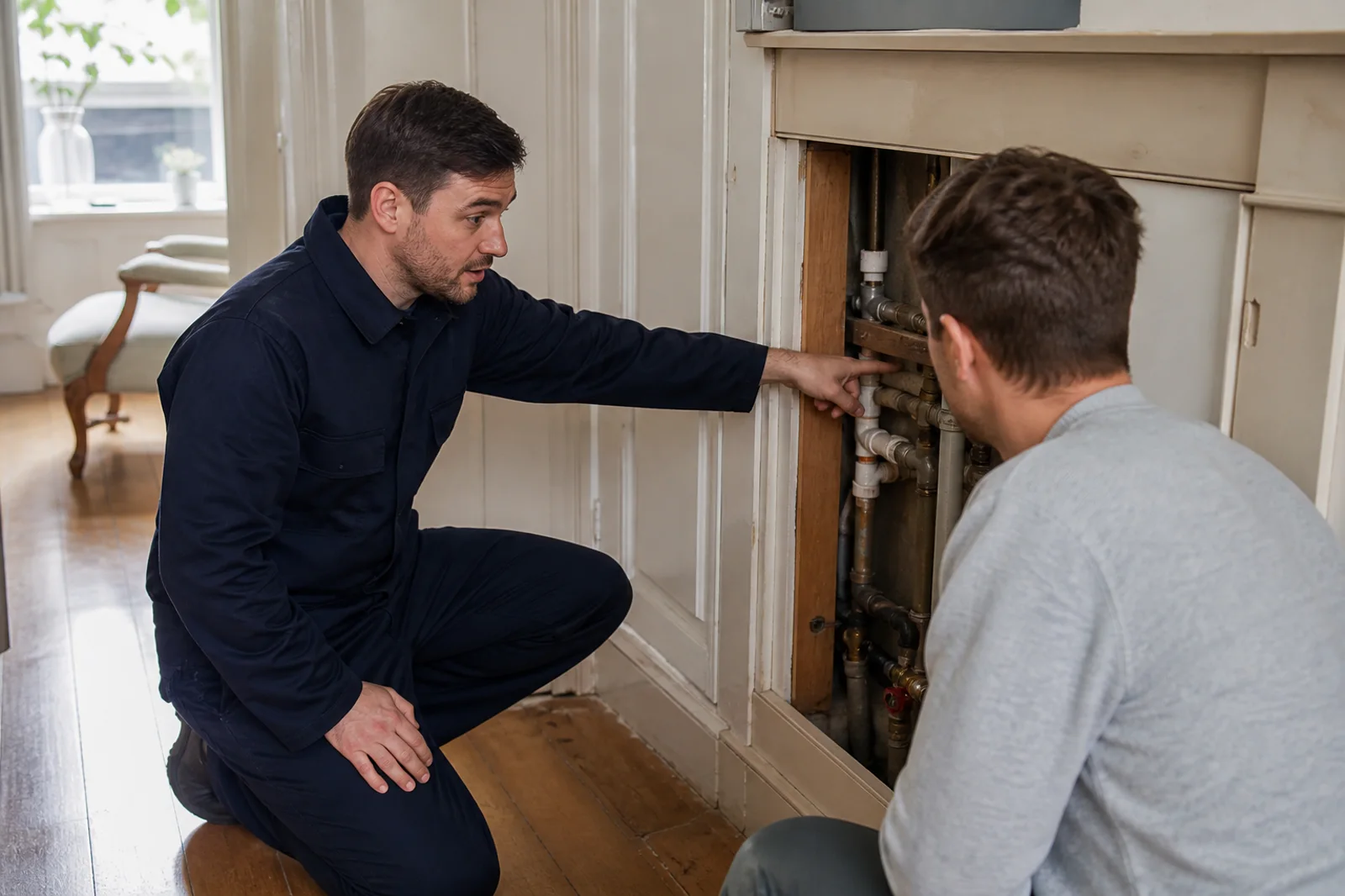
WORK FROM THE UPPER FITTING DOWN
Deal with the confirmed flat connection first. Shared drainage, locked risers and shop-side access retain their own approval routes.
Remake accessible seals and confirm the fall. Deal with the confirmed flat connection first. Shared drainage, locked risers and shop-side access retain their own approval routes. Relate the upstairs outlet to the lower stair mark: renew the branch when damage or poor alignment prevents a sound seal.
Repair the proven waste or supply connection. Deal with the confirmed flat connection first. Shared drainage, locked risers and shop-side access retain their own approval routes. Relate the upstairs outlet to the lower stair mark: separate failed sealant or tray movement from pipe repair.
Adjust or renew the worn internal component. Deal with the confirmed flat connection first. Shared drainage, locked risers and shop-side access retain their own approval routes. Relate the upstairs outlet to the lower stair mark: replace the isolation valve only after condition is assessed.
Repair within the flat’s authorised side. Deal with the confirmed flat connection first. Shared drainage, locked risers and shop-side access retain their own approval routes. Relate the upstairs outlet to the lower stair mark: pass communal riser findings to the managing party.
ANGEL · REGISTER WORKFLOW
Name water at the foot of a stair after an upstairs fitting is used and its triggering use.
Open the lawful Angel working route.
Prove which Angel outlets the valve serves.
Relate a compact kitchen mixer that turns at its base to accessible evidence.
Name the Angel part and exclusions.
Operate the repaired fitting normally, check for leaks and explain what was done.
ANGEL · repair options
Angel choices follow identifying the residential supply above a shop evidence. The register keeps serviceability, compatibility and access visible.
Keep sound Angel pipework around water at the foot of a stair after an upstairs fitting is used.
Match a compact kitchen mixer that turns at its base using the measured register.
Add Angel control only within authorised pipework.
Let map findings set the next access point.
ANGEL · quotation guide
Angel location does not set the figure. The register prices access, isolation, components and testing.
| register stage | Angel evidence | map result |
|---|---|---|
| water at the foot of a stair after an upstairs fitting is used | Timing, route and isolation | Supported source or stated limit |
| a compact kitchen mixer that turns at its base | Reference and adjoining pipe | Included part and operating check |
| a toilet fill valve audible from the managed hall | Relevant sanitary cycle | Stable Angel water state |
| adding a dishwasher coupling in a tight upper-floor kitchen | Dimensions and maintenance route | Approved alteration boundary |
Put keys and panels in the register.
Name the valve and affected outlets.
Match dimensions to actual connections.
List non-plumbing finishes separately.
ANGEL · agreed scope
Angel’s register ties water at the foot of a stair after an upstairs fitting is used to a tested result. Other systems retain separate owners.
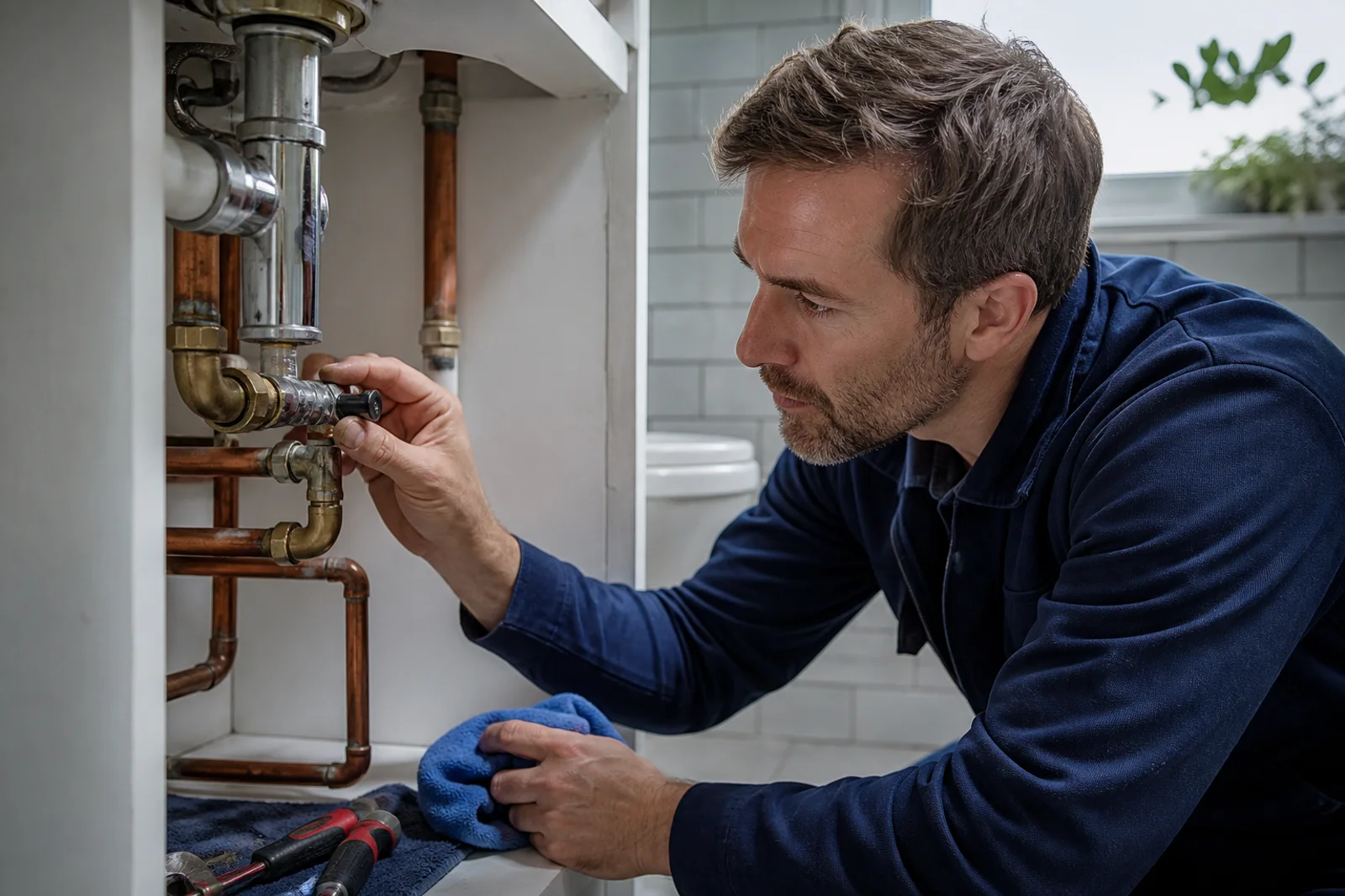
ANGEL · BOOKING REGISTER
Use scale where the register needs it. Keep Angel keys, codes and personal details outside photographs.
BOOKING QUESTIONS
These answers keep the Angel approval tied to plumbing evidence, authority and a testable result.
Give the Angel address, named room, timing and present water state for “water at the foot of a stair after an upstairs fitting is used”. Describe what changed after safe isolation and attach wide and close views without taking a coupling apart.
Stop using the fitting when “a compact kitchen mixer that turns at its base” releases water, will not close or affects a connected fitting. Safeguard the space and plan the appropriate plumbing advice.
No. Water could run along pipework, enclosures and floors. The timing of “water at the foot of a stair after an upstairs fitting is used” and inspection of accessible connections are more practical than proximity alone.
Only when the make, dimensions, fitting type and operating requirements for “a compact kitchen mixer that turns at its base” are established. Concealed preparation at the Angel home may still need measuring on site.
the street frontage might not reveal which supply serves the home. For Angel, establish the owner, freeholder or managing agent assigned before a common valve, riser, stack or service cupboard is altered.
Not necessarily. The Angel valve might be absent, bound, incorrectly labelled or upstream of other fittings. Its actual effect should be examined cautiously before “a toilet fill valve audible from the multi-user hall” is dismantled.
Agree the likely Angel access point, the extent of opening-up and who will reinstate joinery, plaster, tiles or decoration after work on “adding a dishwasher coupling in a tight upper-floor kitchen”.
Yes. At an Angel building, ordered parts, concealed damage, drying, management permission or second trade could require a separately defined return after the primary findings.
Repeat the routine action related to “water at the foot of a stair after an upstairs outlet is used”, check the repaired link, check isolation and adjacent junctions, then record any limit caused by wider Angel access.
Keep the conclusion, authorised scope, sections, isolation used, handover check and exclusions. For Angel, also record the responsible occupier for any shared-service follow-up.
RELATED ROUTES
Use the general plumbing hub for water outlets and pipework, then move to a specialist service when the verified network falls beyond that scope.
OTHER LOCAL PLUMBING PAGES
These local pages help customers record the affected fixture, usable isolation point and any landlord or concierge arrangement before attendance.
ANGEL · MAP REGISTER
Angel mapping supplies orientation only. Diagnosis and pricing come from the register, not the marker.
EVIDENCE FOR THE PRIMARY CALL
For Angel, state the established fitting, normal-use routine, present water state, recognised isolation, property course and contact authorised to confirm the next step.
