
Do I Need a Power Flush? Symptoms, Checks and Alternatives
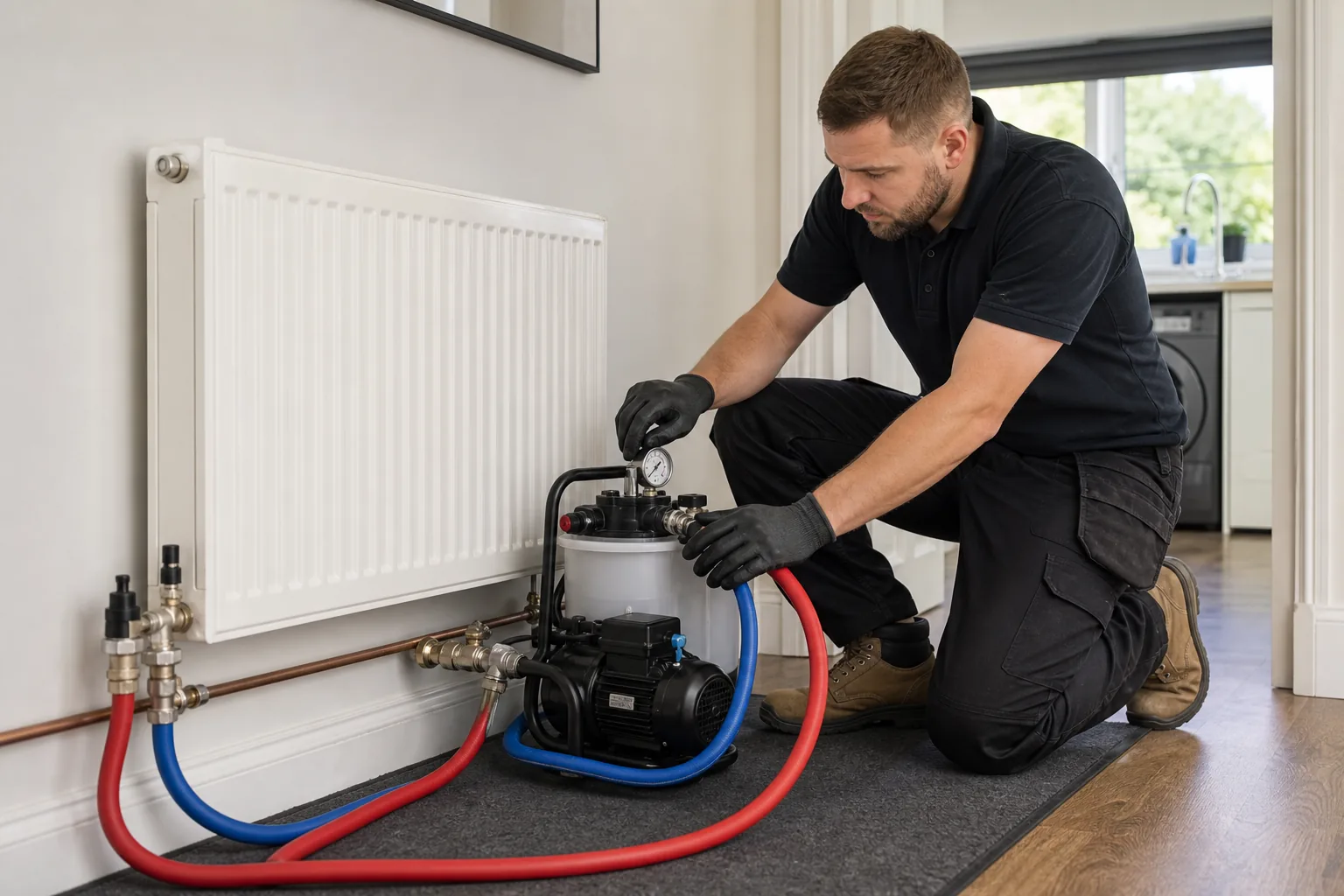
You need a power flush only when evidence points to widespread sludge or corrosion debris restricting circulation. Cold radiator bottoms, dirty system water and repeated valve or pump trouble can support that diagnosis, but one cold radiator may simply contain air, have a closed valve, need balancing or have a local blockage. Test the pattern before paying for whole-system cleaning.
Begin with a map of every radiator
Run the heating from cold and note which radiators warm first, where each remains cool and whether the boiler cycles or reports a fault. Check rooms and zones rather than relying on the least comfortable radiator. Do not touch hot pipework or remove covers from electrical controls.
A radiator cold at the top commonly contains air. One cold at the bottom can indicate settled debris, but it is not proof that the whole system needs flushing. An entirely cold emitter may have a valve or flow problem.
Check controls before blaming the water
Confirm the programmer calls for heating, the room thermostat is above room temperature and thermostatic radiator valves are not at frost setting. If only one zone fails, record its controller and valve behaviour. Do not bridge terminals or force motorised valves.
A boiler error code, failed pump or stuck diverter can imitate poor circulation. A boiler fault diagnosis is more appropriate when the appliance does not create or respond to a heating demand.
What dirty bleed water can—and cannot—tell you
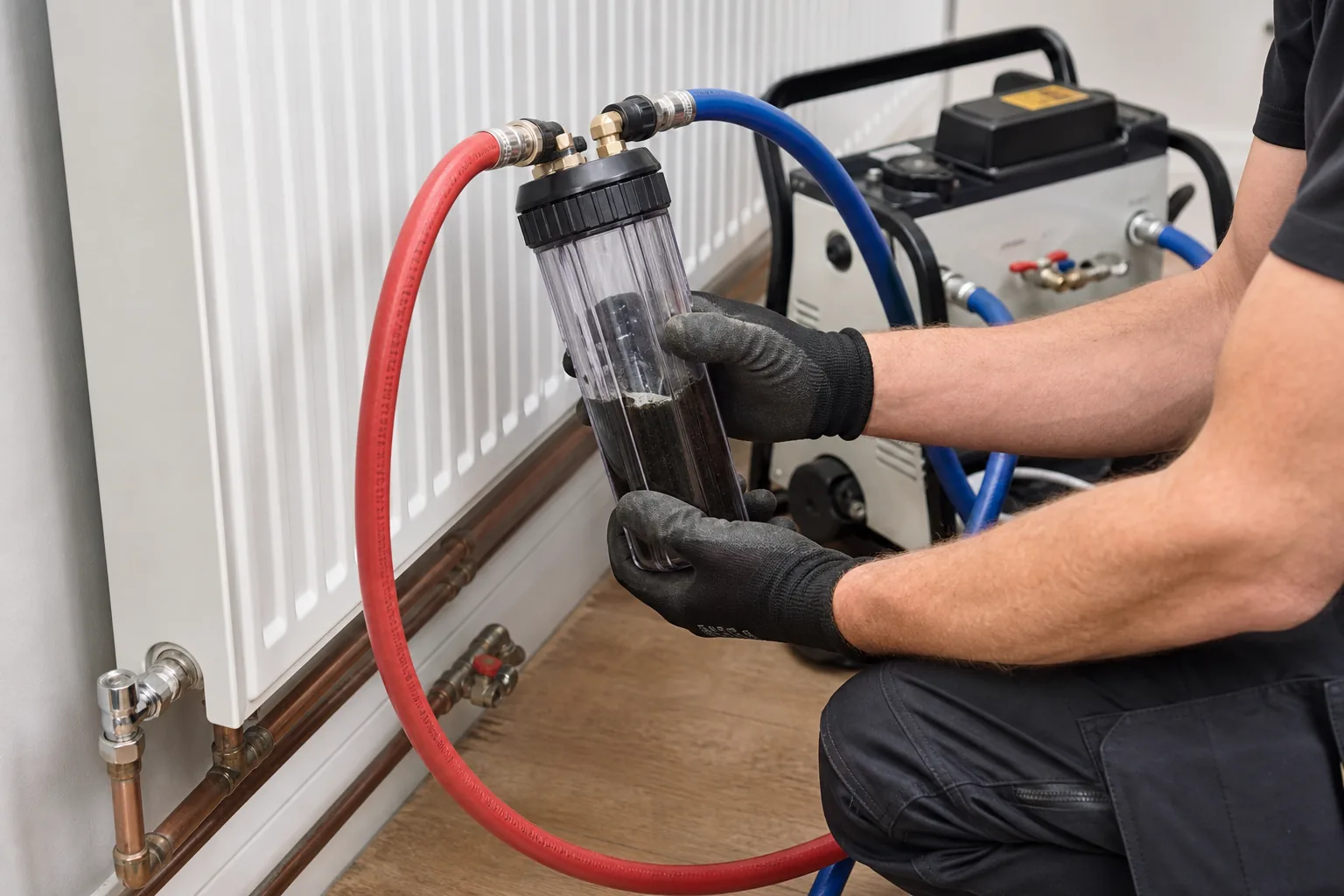
A small sample that is black or contains particles supports contamination, especially when several radiators show the same condition. Colour alone does not measure flow restriction or identify the cause. Clear-looking water can still be chemically unbalanced.
Let an engineer take and interpret a sample safely. Repeatedly bleeding large volumes lowers system pressure and introduces fresh oxygen, which can encourage further corrosion.
Temperature differences give better context
An engineer can compare boiler flow and return temperatures and measure radiator surfaces. Broadly poor heat transfer across many emitters is different from one blocked channel. The readings must be interpreted alongside boiler type, controls, design and outside conditions.
Do not use an infrared reading on reflective metal as a precise DIY verdict. Emissivity, paint and angle affect it. A simple room-by-room pattern remains useful for the booking note.
Local alternatives to a full power flush
If one radiator is affected, valve repair, balancing, targeted removal and cleaning or radiator repair or replacement may be proportionate. Trapped air needs the reason for air entry considered, not endless bleeding.
Light contamination may respond to a suitable chemical clean circulated under controlled conditions. The choice depends on water condition, pipe layout, component strength and fault history.
What power flushing actually does
Specialist equipment circulates water and cleaning chemicals at high flow, with the system worked section by section to mobilise deposits. High flow is not the same as recklessly high pressure; vulnerable components and boiler pathways must be handled for the installation.
The engineer should explain isolation, chemical choice, discharge, rinsing and inhibitor. Ask how they will demonstrate improved circulation. “The water came out black” proves contamination existed, not that every restriction is gone.
Older and microbore systems need assessment
Narrow pipework can be hard to clear, while aged valves, radiators and seals may already be weak. A flush may reveal leaks that corrosion products had temporarily obscured. That risk should be discussed before equipment is connected.
Do not accept the claim that every old system must be flushed or that age makes flushing impossible. Condition, construction and evidence decide. Photographs of pipe routes and radiator types help the survey.
When flushing will not solve the fault
A failed pump, closed valve, incorrectly sized pipe, poor system design, boiler defect or control failure does not become sound because the water is cleaner. Nor can flushing repair a corroded radiator panel or persistent leak.
If the diagnosis names several possible causes, ask which test separates them. Paying for the most expensive possibility first is not a test plan.
Magnetic filters and inhibitor
A magnetic filter can collect circulating ferrous debris, but it does not pull a solid blockage out of every radiator. It needs correct installation, safe servicing and a record of what was found. Inhibitor slows corrosion only at the correct concentration in a sound system.
After any drain-down, ask how water treatment will be restored. Topping up frequently dilutes inhibitor and introduces oxygen; recurring pressure loss needs its own investigation.
Questions before approving a quote
Ask what evidence supports sludge, how many radiators are affected, whether water was tested, what alternatives were considered and which components need protection. Confirm price scope, VAT, chemicals, filter servicing, disposal and what happens if a radiator or valve leaks.
For central-heating power flushing, the written outcome should include the agreed process and completion checks, not a universal promise about fuel bills or boiler life.
Judge the result after the system settles
Compare warm-up pattern, radiator temperature distribution, noise and boiler cycling under similar settings. Keep the commissioning notes and water-treatment information. If one emitter remains poor, the residual fault deserves targeted diagnosis.
The sensible decision is the smallest intervention justified by the evidence. Sometimes that is a full flush; sometimes it is a valve, balance, pump or single radiator.
A practical comparison: one radiator versus the whole ground floor
Suppose one dining-room radiator is cold at the bottom while every other emitter warms evenly. A whole-system flush is not the first conclusion. Check its valves, balancing history and temperature pattern, then consider targeted removal or cleaning. Now change the scenario: most downstairs radiators have cool lower sections, sampled water contains magnetic debris and the pump has suffered repeated contamination. A system clean becomes more plausible because several independent clues agree.
The difference is evidence breadth. Ask the engineer to mark affected radiators on the quote and state which findings would remain unexplained after flushing. If the only support is the age of the boiler, the diagnosis is incomplete.
Planning the day of a power flush
The heating will be unavailable while work proceeds, and the engineer needs access to the boiler, radiators, valves, water and a suitable discharge arrangement. Clear fragile belongings from each emitter and mention pale carpets, vulnerable flooring, pets and anyone who depends on a warm home.
Ask how leaks or failed valves discovered during cleaning will be handled and priced. Photograph existing corrosion marks before work. At completion, obtain the system pressure, inhibitor information, filter-service instructions and any radiator that could not be restored. Those records matter at the next boiler service.
