
Alignment and keeps
Door position, hinges and frame engagement are compared with the mechanism moving freely while open.
Symptom diary · door comparison · multipoint identification
A short operating diary can reveal more than a guess about parts. Record which entrance fails, at which step, under what conditions and whether the same action works on another door.

A useful fault diary
Harrow’s detached and semi-detached houses may have front, side and garden entrances; converted properties may add a shared outer door and separate flat doors. A multipoint complaint needs a clear door identity. Number the entrances if necessary and record one normal operating cycle for each. The diary is not a request to keep forcing a failing lock. Stop if resistance rises, the key bends or the door may become trapped shut.
A single successful test can still help. Note whether the handle moves freely with the leaf open, whether the latch returns, whether hooks or rollers travel and whether the key turns without the frame being involved. Then state what changes in the normal closed position. This comparison informs inspection without declaring a component faulty.
| Diary field | Example of useful detail | Why it matters |
|---|---|---|
| Door identity | House front composite door or first-floor flat entrance | Prevents records and parts being assigned to the wrong opening. |
| Current state | Closed and unlocked, open, locked shut or unable to secure | Changes the safe access plan. |
| First failed step | Handle stops halfway before the key is turned | Narrows the operating sequence for inspection. |
| Open comparison | Mechanism travels freely while open | Shows how frame engagement changes behaviour. |
| Timing | Intermittent for a week, now constant | Describes progression without inventing a cause. |
| What changes it | Gentle pull helps; extra lifting does not | Gives reproducible evidence while discouraging force. |
| Other entrances | Garden door operates normally with a different key | Separates one assembly from a household-wide key issue. |
Converted-property boundary
A converted house can present an outer entrance, shared hall, individual flat door and rear access. The resident’s key ring may operate several of them, but responsibility need not be the same. Record where the symptom occurs and who can authorise work. The freeholder or manager should direct changes to shared hardware; a tenant may need the landlord for a private-door alteration.
Fire-door construction, closers and smoke seals should not be treated as incidental trim. If the entrance is a fire-resisting door, ask for an option that preserves the door set and relevant certification requirements. Do not drill, trim or fit an unverified item simply to reproduce the look of an adjacent flat.
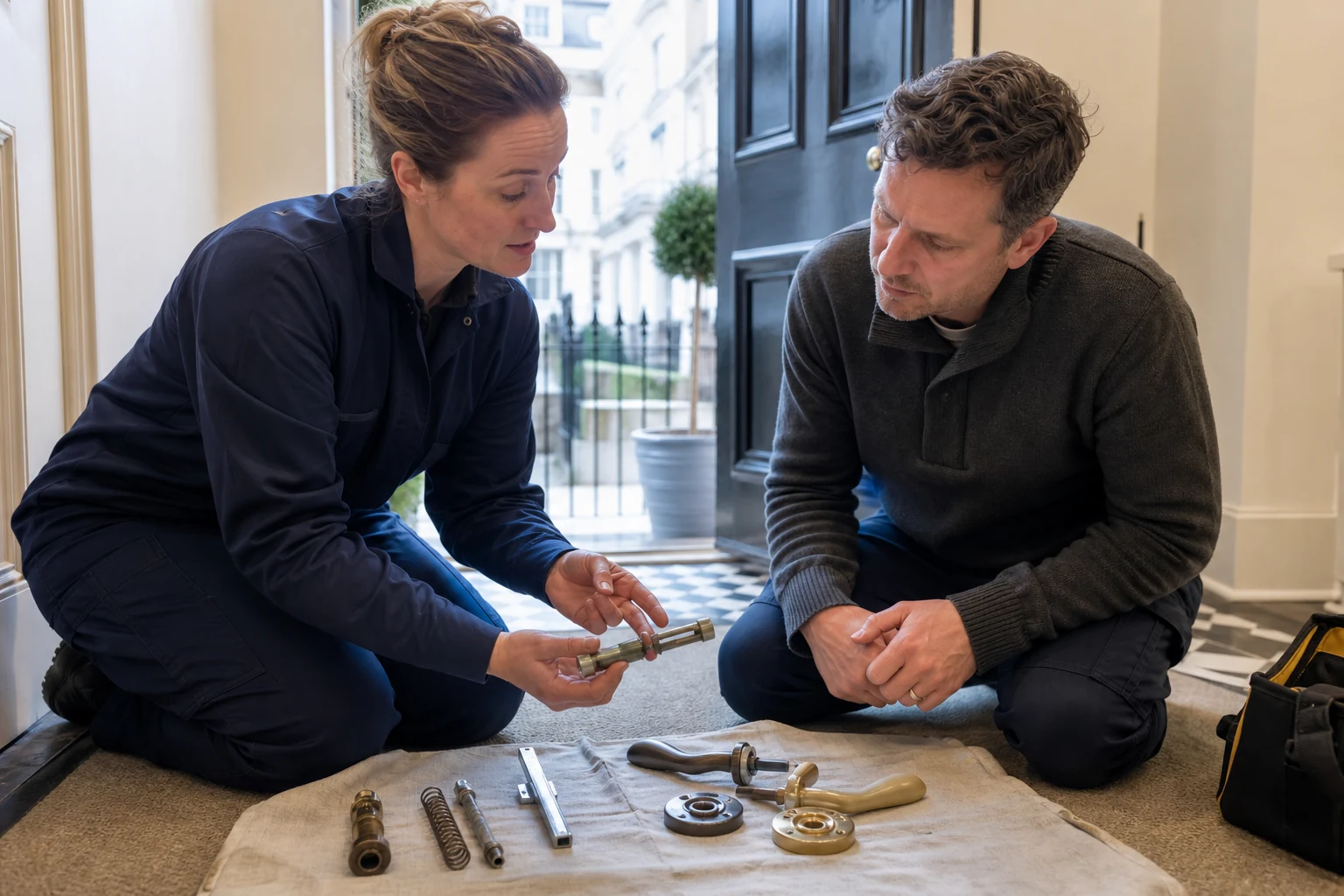
System distinction
| Symptom | Relevant areas | Safe boundary |
|---|---|---|
| Handle lifts open, not closed | Hinges, keeps, leaf position, seal pressure and strip engagement | Do not grind or enlarge keeps before assessment. |
| Handle is loose in both positions | Fixings, springs, spindle, gearbox connection | Reduce use if the door may stop securing. |
| Key will not complete its turn | Key condition, cylinder, handle position and gearbox | Do not use pliers or added leverage. |
| One locking point catches | Individual hook or roller, corresponding keep and strip condition | Record where contact occurs; avoid bending parts. |
| Latch does not return | Handle return, latch case, spindle and frame contact | Keep the door supervised if it will not latch. |
| Shared outer door also fails | Closer, common lock, electric release and management controls | Report the common assembly to its controller. |
Work chosen after inspection
Door position, hinges and frame engagement are compared with the mechanism moving freely while open.
Key condition, cam, length and projections are checked without assuming stiffness elsewhere belongs to the cylinder.
Return action, fixing centres, spindle engagement and backplate dimensions inform repair or compatible replacement.
Centres, backset, case dimensions and markings are recorded before a centre case is proposed.
Length, faceplate, locking-point types and their positions matter when the complete mechanism is involved.
Door condition, proof of authority and the required secure outcome are agreed before locked-shut work begins.
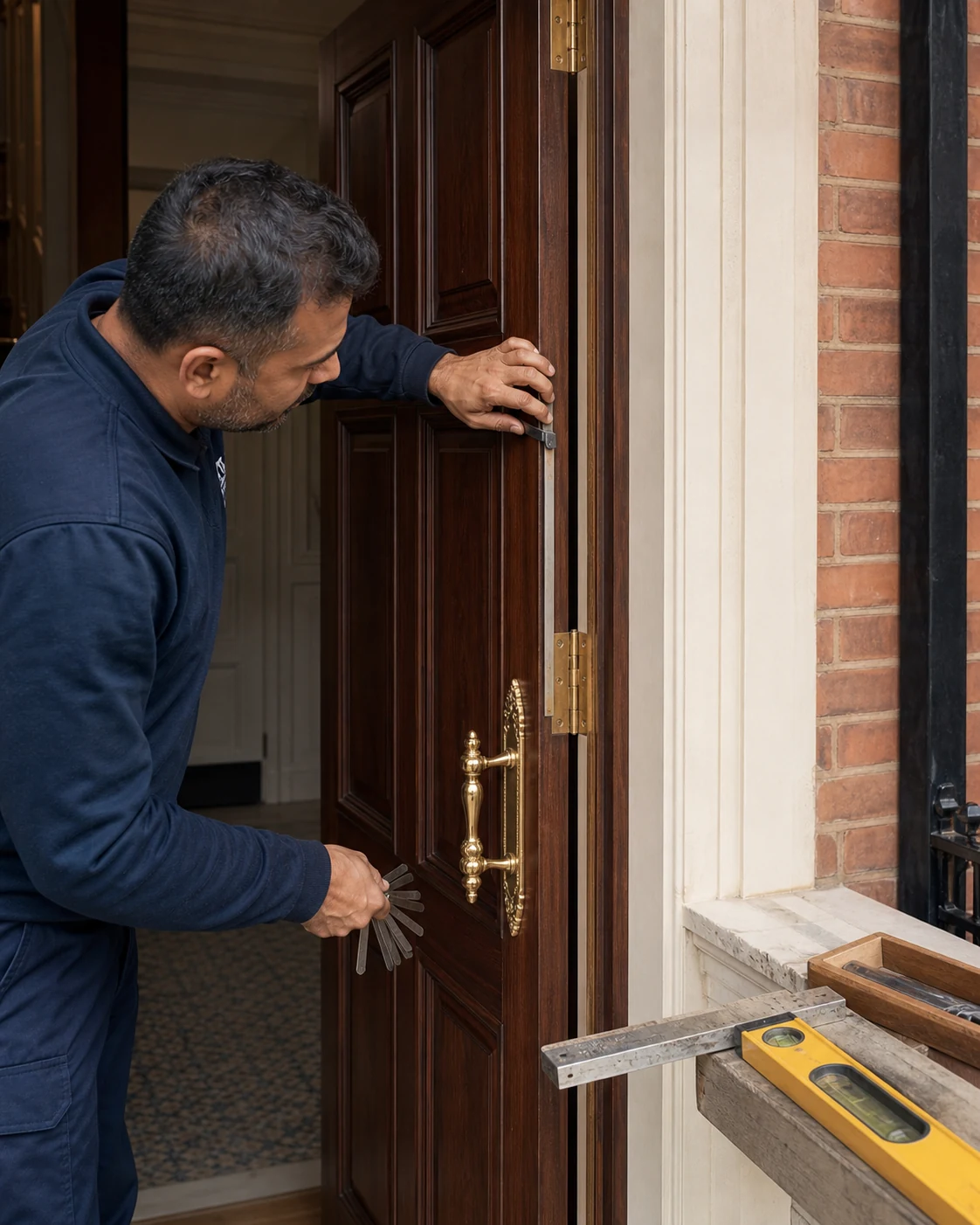
Identification without guesswork
When the door is safely open, photograph the full metal strip on the edge, not only the central gearbox area. Include visible stamps, the cylinder and handles, every locking point and the frame keeps. The relationship between these items matters. A cropped photograph of one hook may omit the measurement that separates two otherwise similar mechanisms.
Do not dismantle a partly working door solely to obtain a code. An assessment can establish what should be removed, what can stay and how the property will remain secure while a part is sourced. If an exact component is not immediately identified, ask for the interim plan and approval point rather than accepting an unexplained substitute.
Close the door without special lifting or pushing, move the handle, lock, remove the key, unlock and reopen. Repeat from every authorised side. Confirm the latch returns and each intended locking point engages. The diary’s original failing step should now have a recorded result, while any structural door issue outside the locksmith scope remains visible.
Measured quotation
Harrow is not a price category. A quotation should identify the affected entrance, the evidence available, the part or adjustment proposed and the test that closes the job.
| Field | Written input | Decision protected |
|---|---|---|
| Attendance | Address, parking, access route, key holder and door state | Whether normal inspection is possible. |
| Assessment | Symptom diary, open/closed comparison and door ownership | Diagnosis before ordering. |
| Cylinder or keys | Measurements, cam, finish, key quantity and access objective | Compatible hardware and controlled handover. |
| Handles or gearbox | Centres, spindle, case, markings and connected resistance | Named part versus associated fault. |
| Multipoint strip | Length, faceplate and locking-point arrangement | Exact-match or approved alternative basis. |
| Door position work | Hinges, keeps, frame and exclusions | Adjustment separated from structural repair. |
| Common entrance | Manager authority and building-system boundary | Private work does not silently alter shared access. |
Ask whether parts, fitting, adjustment, finishing, extra keys and disposal are included. Any change after opening should be explained and approved before the scope grows.
Harrow locksmith FAQ
Even one safe observation is useful. Note the exact step and conditions; do not repeat a risky test merely to build a longer record.
No. Alignment, keeps, handles, cylinder and strip resistance can produce related symptoms. Inspection distinguishes them.
It helps separate free mechanism travel from resistance caused when locking points meet the frame.
Unplanned adjustment can hide the cause or create a security and closing problem. Record contact and seek assessment.
It may be the freeholder or manager. Check ownership and authority rather than relying on who happens to hold a key.
Only when the cylinder is the identified issue and dimensions, cam and access requirements are correct.
Sometimes, depending on the mechanism and condition. Part identification and system testing should guide the decision.
Ask how the door will remain secure, what information is still needed and when a further decision will be requested.
A normal close-lock-unlock-open cycle, key handover and a record of any remaining door or shared-system issue.
Map and nearby live pages
Use the area page that matches the property. These nearby pages are live or belong to this finished group.
Bring the sequence, not a guessed part
Send the door identity, present state, first failed step, safe comparison, photographs and authorising contact.
One final diary entry
After the formal test, write one completion entry using the same fields as the fault report. Name the door, state its closed position, record handle and key movement and note that it reopened normally. This creates a useful baseline for future maintenance and confirms that the original failing step was addressed rather than merely becoming intermittent.
