
Private lock replacement
Measurements, door type, required security outcome and key quantity guide compatible hardware for one authorised entrance.
Access roles · key groups · private door · common entrance
A family house or mansion flat can have several legitimate access groups. Define who needs each door, who may approve changes and which missing keys matter before selecting replacement hardware.

Role-based key control
Golders Green family houses may rely on several trusted people for everyday access, while mansion flats add a common entrance managed for all residents. Start with user roles rather than a pile of keys. A household member may need front and rear doors; a carer may need one reliable entrance; a managing agent may hold a controlled spare; a cleaner or contractor may need temporary access. Do not assume each role should open every door.
Create one row per role and list the relevant doors. Then compare the known keys with the intended access. Record missing or unreturned keys, but do not share key cuts or codes in an open message. The plan should reduce unnecessary distribution while preserving lawful access.
| Role | Possible access need | Control question |
|---|---|---|
| Household resident | Main entrance and normal family access routes | Are all issued keys known and working? |
| Family member or carer | One agreed entrance at relevant times | Does the key serve more doors than required? |
| Tenant | Private dwelling and authorised common route | What does the tenancy say about alterations and landlord access? |
| Landlord or managing agent | Lawful management access and property records | Who approves replacement and holds recorded spares? |
| Mansion-flat resident | Common street door plus private flat | Which key is building-managed and which is private? |
| Temporary contractor | Time-limited route to an agreed work area | Can access be supervised instead of issuing a lasting key? |
Door inventory
List the main timber door, side or garden gate, rear door, garage and any internal controlled room. For a flat, add the common lobby and private entrance as separate lines. Note the lock type if known, normal operation, current number of keys and person controlling duplicates.
A shared common key cannot be changed by one resident simply because their private access list changes. Building management must consider every household and any approved hardware system. A private rear door can be reviewed independently, although its cylinder or multipoint components still need direct measurement.

Control-gap decisions
| Situation | Information to assess | Possible action |
|---|---|---|
| House key is missing | Doors served, address connection and remaining authorised copies | Review private key control for the affected entrances. |
| Carer access changes | Returned keys and the future access plan | Revoke or replace only where current control is uncertain. |
| Tenant changes in a mansion flat | Private keys, common keys and tenancy authority | Coordinate private work while returning building-managed keys. |
| Common key is unaccounted for | Risk, all users and management key system | Freeholder or agent decides for the building. |
| Fob is lost | Credential identity and whether a mechanical key was attached | Ask the administrator to cancel the fob before changing hardware. |
| Existing lock is stiff | Key wear, open-and-closed operation and alignment | Assess repair separately from the access-role change. |
Services supporting the control plan
Measurements, door type, required security outcome and key quantity guide compatible hardware for one authorised entrance.
A serviceable lock may be repaired if its key control remains acceptable. Door alignment and key condition are assessed with the mechanism.
The quotation states supplied quantities and authorised recipients. Informal copying should not replace a clear handover record.
Extraction can be considered without automatically changing all keys, provided the lock remains reliable after direct checks.
The manager controls authority, hardware standards and key distribution. A private locksmith should not alter shared access alone.
If the access review follows a lockout, reasonable evidence of occupancy or management authority is established before entry.
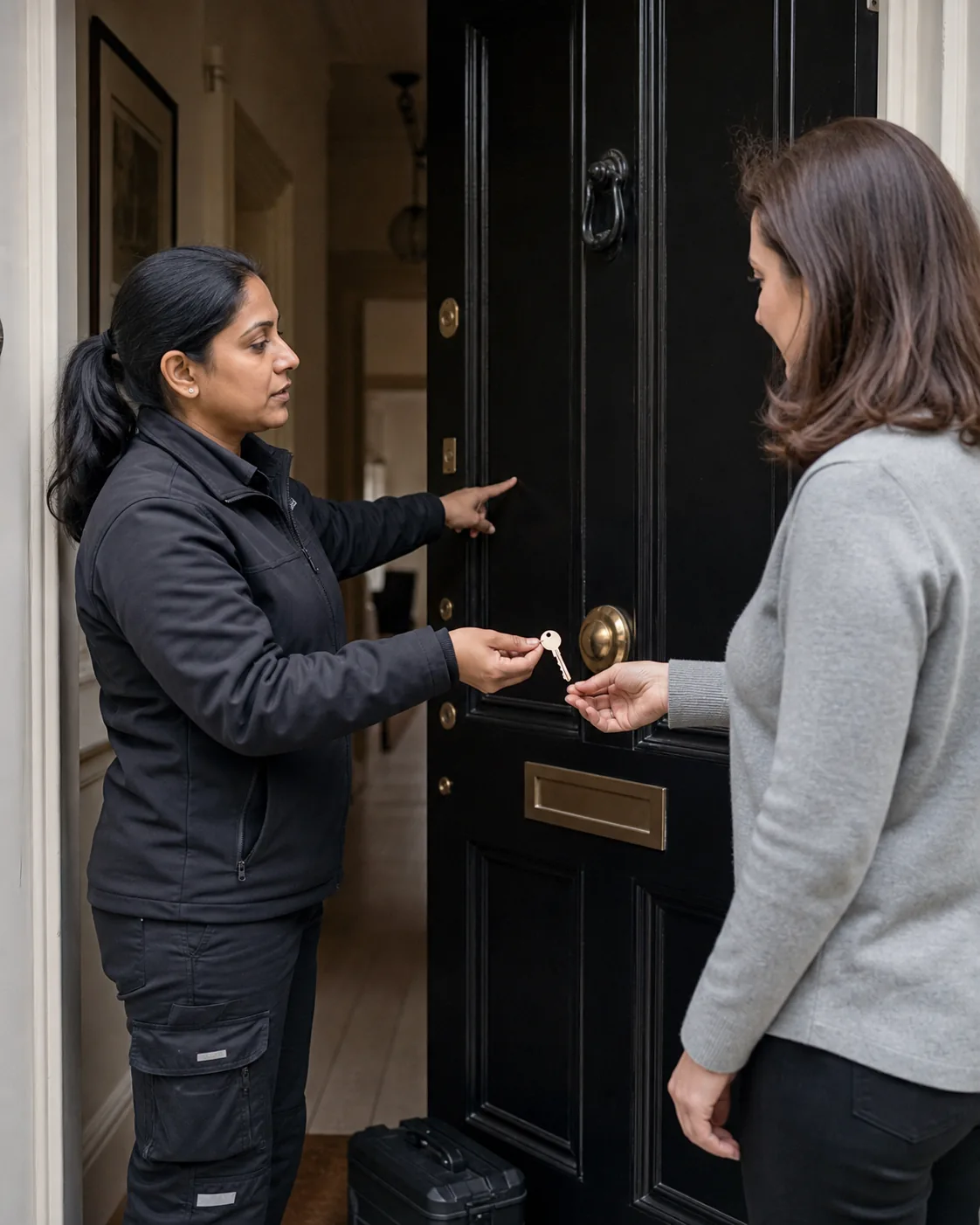
Mansion flats and family homes
In a mansion block, the porter or agent may administer common keys while the resident controls their apartment hardware. Record both systems in the inventory, but issue separate instructions. A common-door change may require keys for every resident and consideration of closer or access-control functions.
In a family house, front, rear and garage doors can form one planned project while retaining different key groups. A timber mortice case and a UPVC cylinder require different measurements. Do not promise one-key operation across unrelated hardware before assessing compatibility and the security implications.
Count keys for each door and give them to the named controller. Record which users receive them and which old keys no longer work. Test each included entrance through normal closing, locking and unlocking. Keep the scope and key count with property documents.
Key-control quotation
Golders Green is not a fixed price input. The quote depends on doors, measurements, condition, access and key quantities. A vague “change all locks” line should be replaced by an entrance-by-entrance scope.
| Line | Input | Written detail |
|---|---|---|
| Access review | Door inventory, roles and control gaps | Entrances and users included in the audit. |
| Replacement | Measurements, construction, desired result and finish | Specified hardware, fitting and normal tests. |
| Keys | Authorised recipients and required spares | Quantity, handover and additional-copy route. |
| Repair | Key, handle, latch and door behaviour | Diagnosis, labour, parts and exclusions. |
| Common entrance | Manager approval, residents and existing system | Building work and distribution responsibilities. |
| Credential administration | Fobs, codes and system owner | Management action outside mechanical replacement. |
If assessment shows that a lock needs additional repair or cannot accept the preferred hardware, ask for a revised scope. Do not add common-door work without building authority.
Golders Green locksmith FAQ
No. Allocate access according to the doors each role genuinely needs and the property owner’s lawful plan.
Potentially, depending on the door systems and agreed access. Define the role before selecting hardware or issuing keys.
The freeholder, porter or managing agent commonly administers shared access. Confirm the actual arrangement before ordering changes.
No. Identify the doors served, connection to the address and remaining control before deciding.
The building administrator may be able to deactivate it. Check whether a mechanical key or code was compromised too.
Possibly where compatible and appropriate, but both doors and the access plan need assessment first.
Not automatically. Key wear, alignment and internal condition should be assessed to choose repair or replacement.
The quotation should state the quantity. Count them at handover and identify their controller.
Keep the door inventory, accepted scope, invoice, hardware description, key count and authorised handover note.
Map and nearby live pages
Use the page matching the actual property. These nearby pages already exist or are included in this final batch.
Give each role only the access it needs
Send the door inventory, user roles, missing keys, permissions and named recipient for replacement keys.
After the handover
A key-control plan is a living household record, not a one-off count. Review it when an occupant moves, a carer’s duties end, a cleaner changes, building management retrieves a common key or a new adult needs independent access. The review may show that no hardware change is needed: a named key can simply be returned and logged. Where a key is unaccounted for, decide which door is affected, who still needs entry and whether a cylinder change is proportionate.
Store the schedule separately from any address-labelled key ring. Record only the information needed to manage access and limit circulation of photographs that reveal key profiles or security arrangements. The purpose is a clear chain of custody, not a detailed public inventory of the home.
