
Private lock replacement
Measurements, door construction, security aim and required key quantity guide a compatible change for the authorised entrance.
Key inventory · household change · private door · common entrance
A move, tenancy change or change in household access is a key-control project before it is a hardware project. List every door, authorised user and accounted-for key, then decide which private locks need action without disrupting common entrances.

Key-control inventory
Stoke Newington terraced homes and family houses can have front, side, rear and outbuilding keys. A converted flat adds the common street door and may include fobs or intercom access. Start an inventory with doors rather than loose keys. Give each entrance a plain function and list the authorised people who need it.
Then count keys known to be present, returned, missing or damaged. Consider whether a missing key can be connected to the address and which locks it operates. Do not photograph key cuts or share codes in a group message. The aim is to understand control, not create another security risk. A change can then be limited to the doors where current access is no longer acceptable.
| Door or credential | Users to record | Control question |
|---|---|---|
| Private house front door | Household, family, carer, cleaner or authorised agent | Are all working keys accounted for? |
| Side or rear entrance | Household and people needing garden access | Does it require outside key access or inside-only use? |
| Converted-flat door | Tenant or owner and any authorised landlord access | Who may approve replacement under the tenancy? |
| Common front door | Every lawful household and building contractor as arranged | Does the freeholder control the lock and duplicate keys? |
| Fob or intercom credential | Named residents and management | Can a lost credential be cancelled by the administrator? |
| Garage or garden building | Owner and authorised users of that space | Is the key linked to valuable property or the home address? |
Household transition
A family move, new tenancy or change in carers and contractors can leave uncertainty about old keys. Write the future access list first. Include people who need regular entry and those who should no longer have it. A landlord or agent may need lawful access under an agreement, but the locksmith should not invent that requirement; confirm it with the responsible parties.
For a common door, one household’s move does not justify unilateral replacement. The freeholder or managing agent needs to consider all residents and distribute keys. Electronic credentials may be cancelled without changing the mechanical override, but only the system administrator can confirm that route.

Transition decision guide
| Situation | Questions to ask | Possible proportionate action |
|---|---|---|
| Moving into a family house | Are previous keys fully accounted for and do existing locks operate reliably? | Retain, repair or change private locks based on control and condition. |
| Tenant moves out | Which private keys were returned and what does the tenancy require? | Landlord or agent decides the authorised private-door scope. |
| One common-door key is missing | Can it identify the building and who still needs access? | Building controller reviews risk and key distribution. |
| Fob is lost | Can management deactivate the credential and is a mechanical key also missing? | Cancel through the administrator before assuming a lock change. |
| Carer or contractor access ends | Was a key returned and did it serve other doors? | Update only the affected authorised access where control is uncertain. |
| Existing lock is unreliable | Is the issue key wear, alignment or internal failure? | Assess repair or measured replacement alongside key control. |
Services supporting key control
Measurements, door construction, security aim and required key quantity guide a compatible change for the authorised entrance.
A reliable existing lock may be repaired where the issue is mechanical rather than control. Alignment and key condition are checked.
The accepted scope states how many keys are supplied and who receives them. Extra copies should not be assumed or distributed informally.
A snapped key can be removed without automatically changing key control, provided the lock remains serviceable after assessment.
Management controls authority, key quantities and distribution. One resident’s private locksmith should not alter shared access alone.
Where a transition coincides with a lockout, reasonable authority and door condition guide entry before a permanent key decision.
Terraces and flat conversions
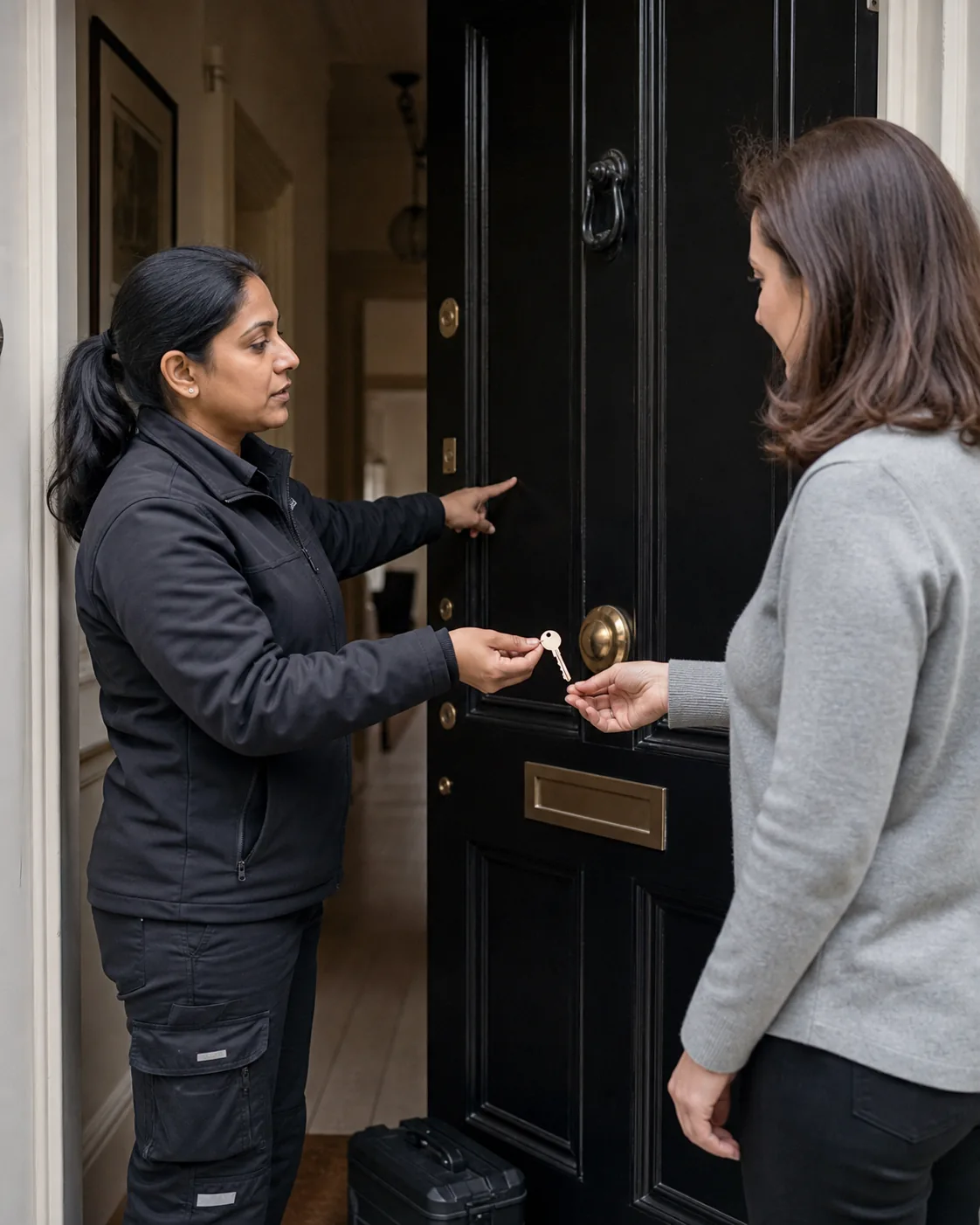
A converted terrace can give each resident a common front-door key plus a separate flat key. When a tenancy changes, return and replacement should be recorded for each function. The incoming occupier’s private change does not cancel other residents’ common keys. If the building operates a master or restricted arrangement, ask management before selecting hardware.
In a whole family house, front and rear access may reasonably form one project, but each door still requires direct measurement. A timber mortice lock and a rear multipoint cylinder have different compatibility rules. Do not order matching-looking parts and assume they create coordinated control.
Count keys by door, identify the recipient and state which old keys no longer work. Test normal locking and unlocking. Keep the invoice, hardware description and key count with the property record; avoid storing security codes in an open household chat.
Key-control quotation
Stoke Newington does not set a fixed price. The quote depends on the number and type of authorised doors, their condition, compatible hardware, access and keys supplied. A transition brief should not conceal repair work inside a vague “change all locks” line.
| Scope line | Input | Written detail |
|---|---|---|
| Access audit | Doors, credentials, users and missing items | Which entrances and control questions are included. |
| Private replacement | Measurements, construction, desired outcome and finish | Specified hardware, fitting and normal tests. |
| Keys | Authorised users and required spares | Quantity supplied, additional-copy route and recipient. |
| Repair | Key, handle, latch and alignment behaviour | Diagnostic work, labour, parts and exclusions. |
| Common entrance | Manager approval, all households and existing key system | Distribution and building-owned responsibilities. |
| Credential administration | Fobs, codes and system controller | Management action rather than unsupported mechanical work. |
If a lock is found incompatible or damaged, ask for a revised explanation before adding parts. Common-door changes and extra keys also require the relevant authority.
Stoke Newington locksmith FAQ
No automatic rule fits every property. Review key control, hardware condition, users and the security outcome you want before deciding.
Record that uncertainty and which doors are affected. The new owner can then consider a measured private lock change.
The tenant should confirm the tenancy, landlord approval and any authorised access requirement before permanent work.
Not alone. The freeholder or managing agent must coordinate authority and keys for every lawful household.
Not necessarily. The system administrator may be able to deactivate it. Check whether a mechanical key was lost too.
Possibly with compatible systems and an agreed security plan, but it should not be promised before both doors are assessed.
Assess key wear, alignment and internal condition. Repair may be more appropriate than replacing it solely because access users changed.
Ask the quotation to state the quantity. Count them at handover and agree how authorised additional copies are obtained.
Keep the approved scope, invoice, hardware description, key count and handover record without storing unnecessary sensitive codes.
Map and nearby live pages
Use the actual property page for its access context. These nearby pages exist or are included in this batch.
Count access before changing hardware
Send the door inventory, current and future users, missing keys, permissions and person receiving replacements.
