
WESTMINSTER · MATERIAL FIRST. METHOD SECOND.
Rug Cleaning in Westminster, Built Around Fibre and Colour
A removable rug used near Whitehall may collect fine city dust while spending most of its life beneath formal seating. That setting does not justify a standard wash. We begin with the wool foundation, border stitching, colour transitions and the worn route between doorway and window, then plan how the piece can be lifted from the sealed timber floor.
- Photograph the complete Aubusson-style rug in daylight, including every border
- Map the pale walking lane separately from abrasion beside chair feet
- Show the woven reverse, corner joins and any conservation stitching
- Confirm Westminster security, lift-booking and reception arrangements
TELL US ABOUT YOUR RUG
Describe what you know; leave uncertain points open
Choose the closest options for the wool Aubusson-style rug; they guide questions for assessment rather than selecting a treatment.
FIBRE + DYE + CONSTRUCTION
Read the textile before choosing the process
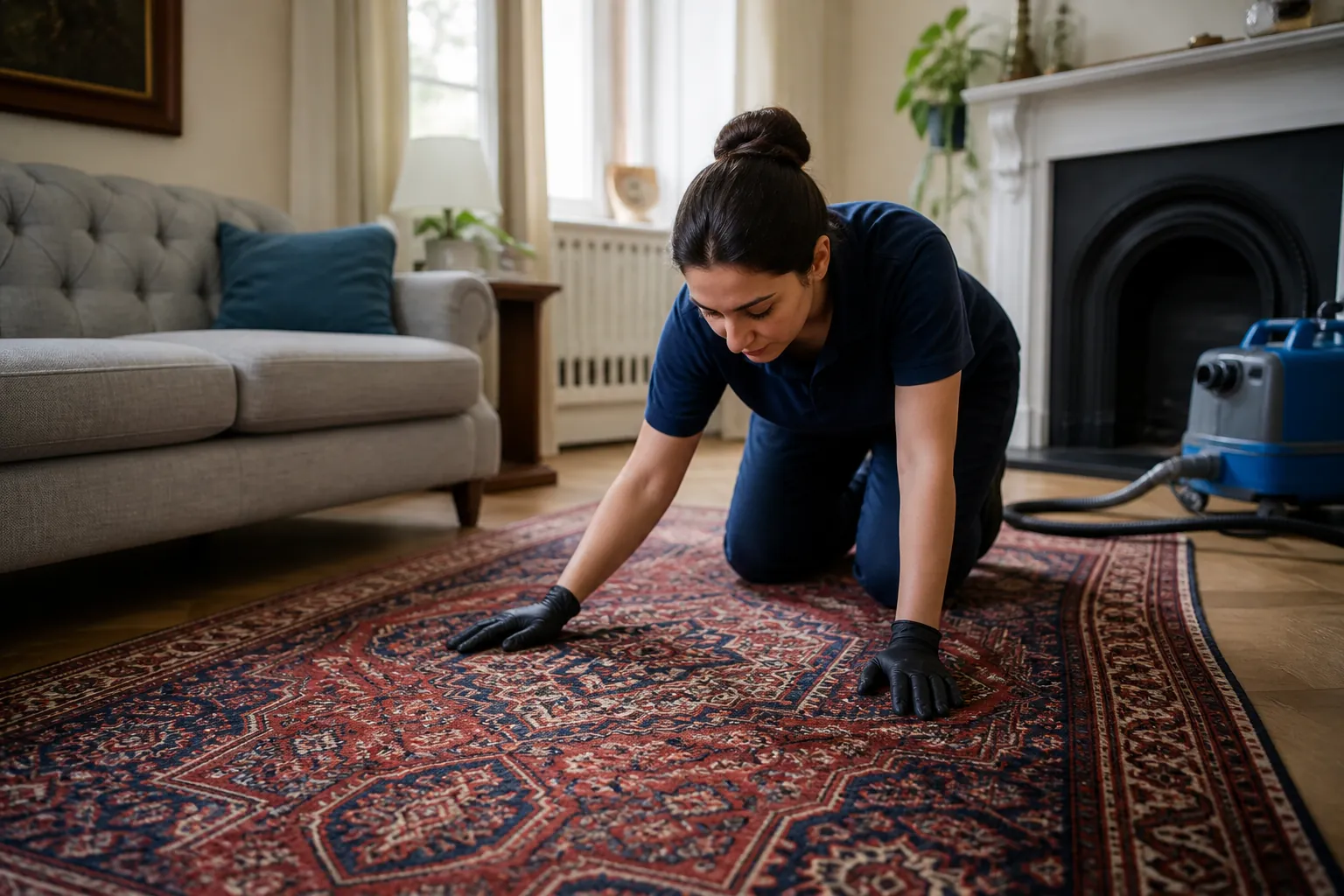
The label is useful, but it never tells the whole story of this wool Aubusson-style rug. Fibre response, dye stability, edge finish and the way the rug was assembled have to be considered together.
Material response
Sets the limits for agitation, solution choice and handling.
Colour stability
A stability check helps identify colours that need a more cautious approach.
Construction
Knots, tufting, foundation and pile density affect moisture and finishing.
Backing, rug fringe, earlier repairs
Edges, backing and old repairs are documented so weakness is not mistaken for new damage.
WESTMINSTER · ROOM AND ROUTE
Plan the rug and the room as one handling problem
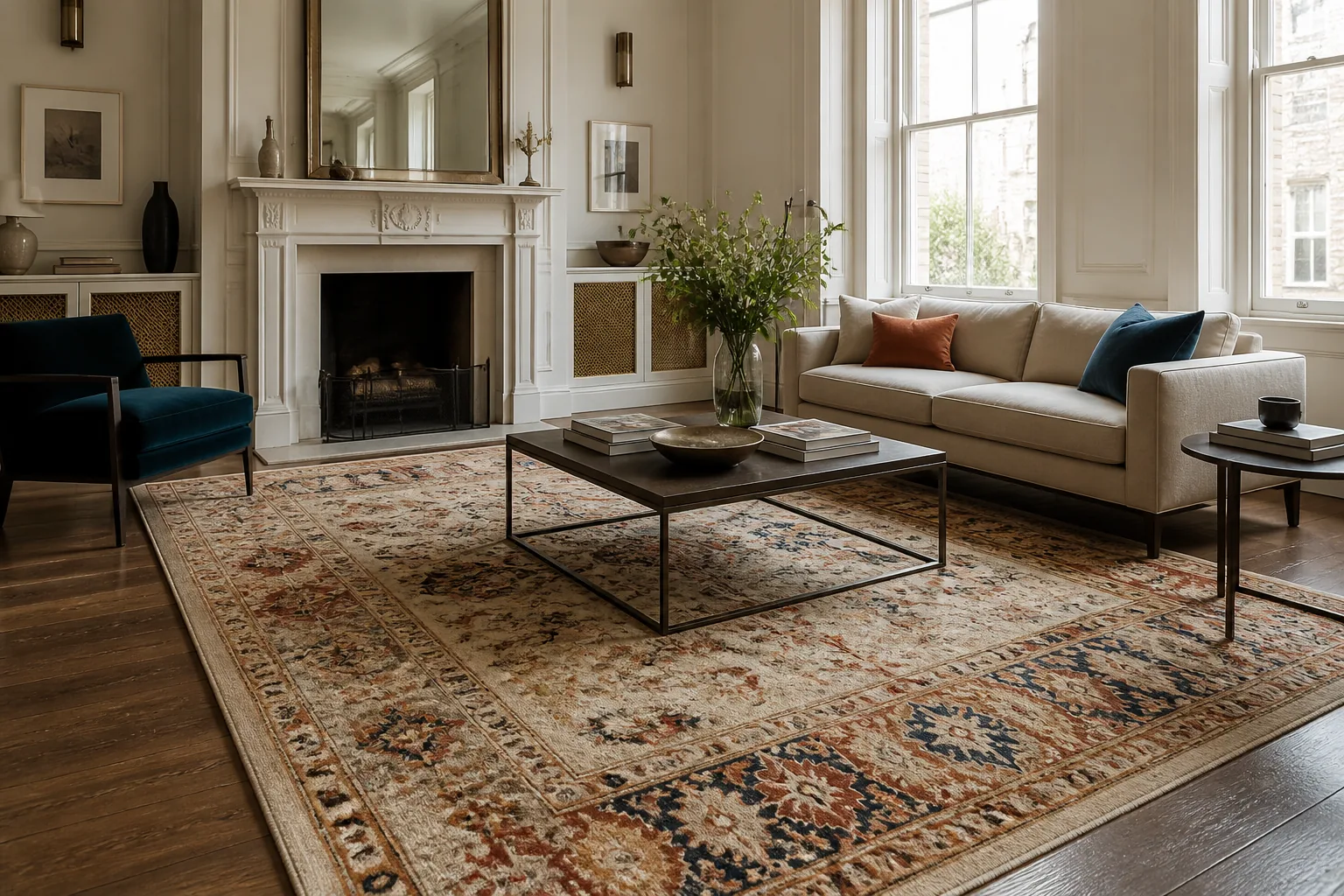
Westminster planning begins in the room where the rug is used. Here, the working example is a government-quarter apartment with a wool Aubusson-style rug over sealed timber; controlled lobby and lift booking affects the carrying plan, while the textile assessment remains centred on fine dust along a formal reception-room walkway.
A realistic Westminster case. The full-room image establishes scale and furniture position. Separate close-ups then distinguish fine dust along a formal reception-room walkway from ordinary loose soil, shading or wear. None of those photographs is treated as proof that a mark can be removed.
Before the visit, the owner notes the rug’s approximate dimensions, known cleaning history and whether the sealed timber can be protected during inspection. The team can then discuss a proportionate route without promising a technique or drying time in advance.
westminster working dossier
Reception-room use: This Westminster example sits in a formal room that is used intermittently but receives concentrated footfall along one line. That pattern can create both loose particulate loading and genuine pile wear, so the two are not described as a single stain.
Whitehall dust: Open windows and busy streets can introduce fine grey matter that settles below the face yarns. The assessor needs a reverse view and a close image taken across the pile, not only a bright overhead photograph.
Aubusson-style construction: The relatively flat face, woven foundation and decorative border require attention at the same time. A familiar design name is not accepted as proof of fibre, dye stability or age.
Chair positions: Occasional chairs standing partly on the textile can leave pressure changes that look different as viewing direction changes. Their locations are marked before furniture is moved.
Colour record: Cream fields, muted blues and warmer border tones are photographed together with a neutral reference. Testing, where suitable, informs the working boundary; a photograph alone cannot do that.
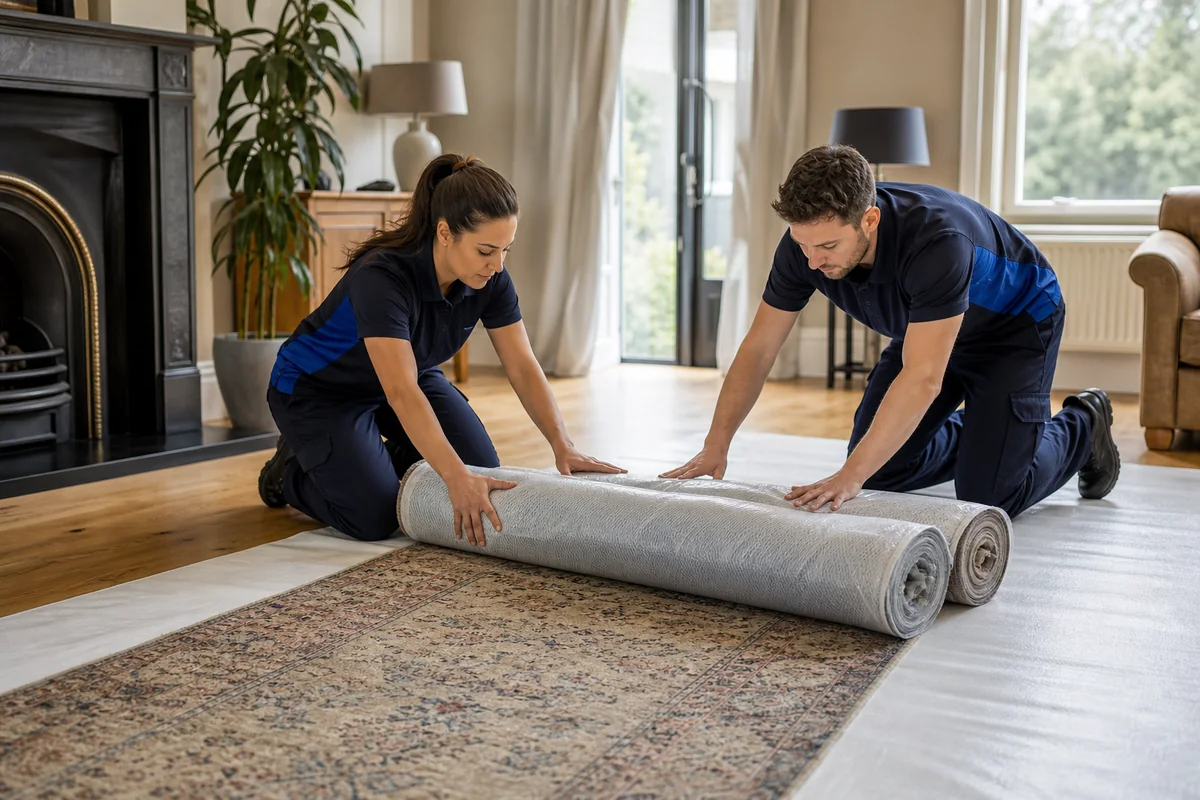
Lift booking: A controlled Westminster entrance changes arrival planning. The quotation records the available loading interval, lift dimensions and whether protective wrapping is needed for the shared route.
Timber contact: The sealed boards beneath the rug are part of the handling note. They need protection during inspection, and furniture return follows actual dryness rather than an assumed number of hours.
Earlier intervention: Any household product, previous professional visit or old repair is listed with its approximate date. Unknown history stays explicitly unknown instead of being filled with a convenient assumption.
Outcome language: Fine dry soil may respond differently from faded colour, abraded fibre or historic staining. The written scope keeps those categories separate and avoids guaranteeing that age-related change will disappear.
Westminster handover: The final conversation compares the recorded walkway, border and corners with their starting condition. It also states how the rug should lie, when chairs may return and which observations remain permanent textile characteristics.
WESTMINSTER TREATMENT ROUTE
Seven checkpoints, not a preset recipe
Drying for this wool Aubusson-style rug is based on absorbency, pile density, backing, airflow and the selected treatment. If fine dust along a formal reception-room walkway includes an odour concern, the affected area and any known source are recorded rather than covered by a standard deodorising promise.
- 01
Record
Measure the wool Aubusson-style rug; map wear, marks and repairs
- 02
Verify
Check material clues and colour response where suitable
- 03
Release soil
Remove accessible dry particles without assuming all dullness is soil
- 04
Work
Apply only the route supported by the assessment
- 05
Control
Manage recovered moisture, pile and edges
- 06
Compare
Review the field, borders and the priority area in Westminster
- 07
Explain
Provide condition-specific drying and furniture guidance over sealed timber
CURRENT WESTMINSTER GUIDE
Start with dimensions; finish with a defined scope
The published size bands are a starting point for Westminster. The confirmed quotation can also reflect the wool Aubusson-style rug’s construction, fine dust along a formal reception-room walkway, access constraints and any optional work agreed after assessment.
QUOTE PREPARATION
Nine details that make the first conversation useful
- Westminster postcode and preferred timing
- Approximate length and width
- One complete-rug photograph
- Close-up of fine dust along a formal reception-room walkway
- Label and reverse if reachable
- Border, fringe and corner images
- Known fibre or construction
- Earlier products or cleaning history
- Notes about controlled lobby and lift booking
Practical answers for Westminster
Can you name the method from a photo?
No. Images improve the brief, but handling and treatment still depend on physical assessment of the wool Aubusson-style rug.
Does a dark patch always mean dirt?
No. In Westminster, shading, fibre wear, dye change and residue must be distinguished from removable soil.
When can furniture go back?
Only after the handover guidance for this rug, its drying condition and the sealed timber beneath it.
Is an odour treatment automatically included?
No. The location, likely source and depth of an odour concern need separate discussion and scope.
INFORMED RUG QUESTIONS
Details to resolve for this particular textile
What is the most useful first image for this Westminster rug?
Stand far enough back to include the entire outline, furniture relationship and direction of the main walking route. Follow with closer views rather than cropping the first image.
Why record the pale lane across the centre?
A pale lane can contain loosened dust, pile-direction contrast, abrasion or colour loss. Classification comes before any claim about removal.
Does an Aubusson-style pattern identify the fibre?
No. Pattern vocabulary describes appearance, not necessarily yarn content, foundation or dye behaviour. Labels and physical observations carry more weight.
Can the chairs stay on the rug during assessment?
Their original positions should be photographed. Movement can then be agreed according to weight, access and the condition of the textile beneath each foot.
Will Whitehall street dust require a stronger product?
Product strength is not inferred from postcode or dust colour. Accessible particles, fibre response and construction guide the decision.
Why show old conservation stitching?
Earlier stitching may mark a vulnerable area or a previous structural problem. Recording it protects the history of the piece and changes how that edge is handled.
How does the Westminster visit minimum apply?
The £68 minimum concerns the booked visit. The measured rug bands remain £27, £37 and £46 starting guides, with eligible combined work discussed before confirmation.
Is same-day furniture return guaranteed?
No. The sealed timber, rug foundation, chosen route and room airflow all contribute to the handover advice.
Can a faded border be restored through cleaning?
Cleaning is not colour restoration. Surface matter may change, but light-related fading or dye loss can remain.
What should the concierge or security desk know?
They should have the agreed arrival window, contractor access requirements and lift arrangement; private customer details need not be shared beyond building procedure.
ASSEMBLE THE WESTMINSTER RECORD
