
Repair or Replace a Dishwasher? A Decision Guide Based on Fault and Age
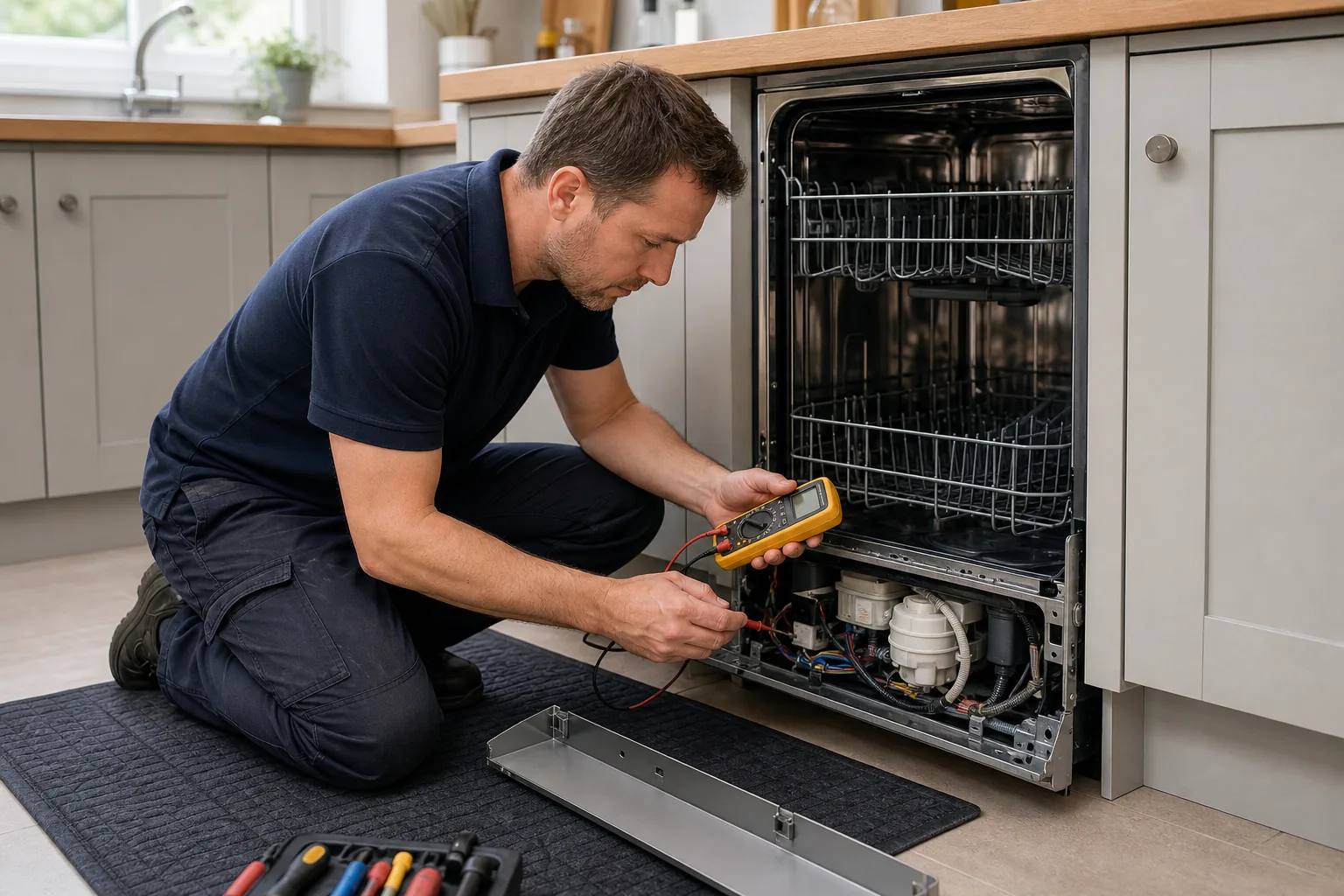
Repair a dishwasher when the fault is identifiable, the machine is otherwise sound, parts are available and the complete repair is comfortably below the value of a suitable replacement. Replacement becomes more sensible when several major components are failing, the cabinet or tub is corroded, parts are obsolete, or repair plus likely near-term work approaches the installed cost of a new machine. Diagnose before deciding: an error code or puddle is not a price.
Stop first if the symptom is unsafe
Isolate a dishwasher that leaks near electricity, trips a circuit, smells of burning or has a damaged cable. Do not reset it repeatedly. Turn off its water valve if safely accessible. A small amount of clean water below the filter may be normal; water on the floor or above the sump is not.
Record the model, full error code and cycle stage. Photographs of water level, door area and hose connections help. Do not pull a built-in appliance from cabinetry alone.
Start with the fault, not the birthday
A five-year-old dishwasher with a blocked filter needs a different decision from the same machine with a leaking tub. An older appliance may merit an inexpensive inlet valve; a nearly new model may be uneconomic if accidental damage has destroyed its cabinet and electronics.
Ask for diagnosis through a dishwasher repair service. The written result should name the failed part or tested system, not merely repeat the symptom.
Faults that often support repair
Door seals, accessible hoses, inlet valves, pumps, heaters, dispensers and some sensors can be replaceable where the tub, wiring and structure remain sound. “Often” does not mean cheap for every model: labour access and part price vary.
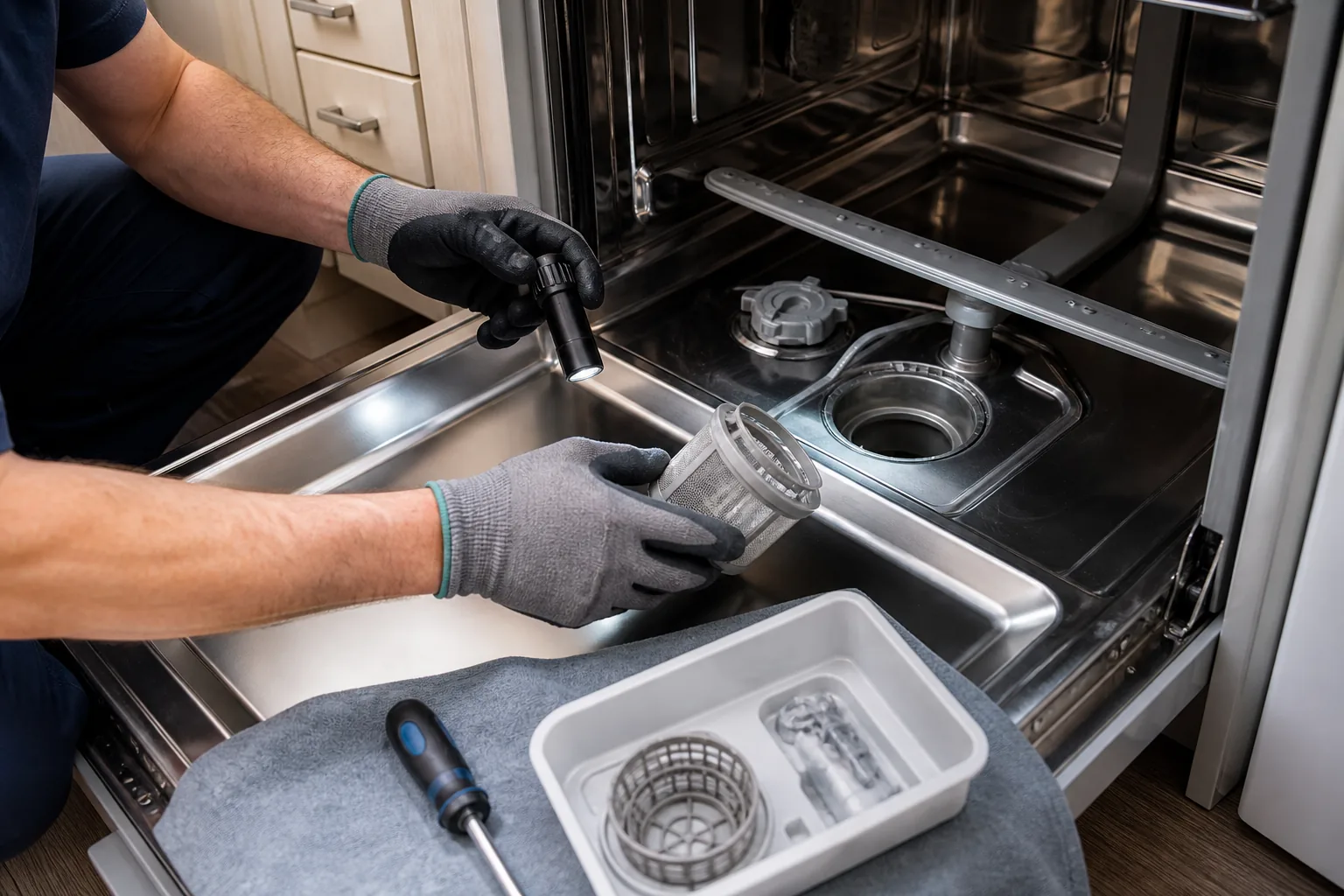
A drainage complaint may be a blocked filter, kinked hose or shared sink waste rather than a failed machine. A door that will not close may be misloaded, misaligned in the cabinet or have a damaged latch. Rule out user-accessible causes from the manual before pricing a new appliance.
Faults that can tip towards replacement
Corrosion through the tub, extensive wiring heat damage, multiple electronic and mechanical failures, or an unavailable control board can make repair impractical. A major circulation-pump assembly on a low-value machine may dominate its remaining value. Repeated repairs within a short period are evidence too.
Ask whether the current fault caused secondary damage. A leaking seal that soaked the base electronics is not the same job as replacing that seal before water travelled further.
Use total installed cost
A replacement price should include delivery, installation, old-machine removal and any cabinetry or plumbing adjustment. Integrated models need door-panel fitting and alignment. A cheaper freestanding unit is not equivalent if the kitchen requires an integrated size and hinge arrangement.
Repair cost should include call-out, diagnosis, part, labour, VAT and warranty. Ask whether the diagnostic charge is credited when work proceeds. Compare both totals on the same basis.
Age matters through context
Manufacturer support, usage, water hardness, maintenance and prior repairs affect remaining life. Find the purchase date and service history if available. A well-maintained model with available parts can justify repair beyond a simplistic age cut-off.
Conversely, an appliance that already has noisy bearings, damaged baskets, failing seals and intermittent controls presents a cluster. List every known issue before approving one part, because the engineer cannot price what has not been disclosed.
Energy and water use: compare labels carefully
A newer dishwasher may use less energy and water on its rated programme, but manufacturing and purchasing a replacement also have cost and environmental impact. Compare the actual capacity and programmes your household uses. An efficient oversized model run half-empty may not deliver the expected saving.
Do not justify an immediate purchase with invented annual savings. Use current product labels, tariffs and your run frequency. The decision may still favour replacement, but it should be based on your numbers.
Parts availability can decide the case
Ask for the exact part number, stock status and lead time. A theoretical repair is not useful if an essential board has no expected supply. Third-party compatible parts may exist; ask what approval, fit and warranty apply.
A broader appliance repair team can help where multiple kitchen appliances are being assessed, but the dishwasher’s model-specific part route remains central.
External plumbing should not condemn the machine
If leakage comes from a fixed service valve, shared trap or household waste pipe, appliance replacement will leave the fault in place. Likewise, sink water backing into the dishwasher points to the drainage arrangement. Use plumbing support for supply or waste leaks when the tested source sits outside the appliance.
Ask the technician to mark which component belongs to the machine and which belongs to the property. That boundary prevents duplicate call-outs.
A practical decision scorecard
- Is the fault confirmed and isolated?
- Are the tub, cabinet and wiring sound?
- Is the part available on a useful timescale?
- What is the all-in repair total and warranty?
- What is the like-for-like installed replacement total?
- Are other faults likely soon based on evidence?
- Will replacement require cabinetry or plumbing changes?
Write the answers rather than assigning arbitrary points. One critical “no”—such as unavailable safety-critical hardware—can outweigh several positives.
After repair
Ask for a complete cycle test or the relevant manufacturer diagnostic. Check filling, heating, spraying, draining, sealing and error memory as appropriate. Keep the part and labour warranty. If the machine leaks during the test, the repair is not complete.
When replacing
Measure aperture, door clearance, connections and integrated-panel arrangement. Check capacity, noise, programme duration and service support. Arrange lawful removal of the old appliance and wipe the exposed cabinet area before installation.
The sensible choice is neither “always repair” nor “replace after a certain birthday”. It is a fault-specific comparison between a tested repair and a genuinely equivalent installed replacement, including the condition of everything that remains.
Downtime has a household value
A part arriving in two days and one on indefinite back-order create different decisions, especially for a large family or accessible kitchen. Ask for a realistic lead time and whether the appliance can remain safely connected while waiting. Do not continue using a leaking or electrically faulty machine merely because hand-washing is inconvenient.
Replacement also has lead time: delivery slots, integrated fitting and panel adjustment may take longer than the advertised next-day appliance. Compare the date of a working, tested result—not only the date a box reaches the door.
Warranty and consumer rights
Check manufacturer, retailer and paid extended cover before commissioning chargeable work. Describe the fault accurately and keep purchase evidence. Unauthorised dismantling can affect warranty routes. A warranty does not make an unsafe appliance suitable for continued use while a claim is processed.
For a repair, obtain written parts and labour warranty terms. For replacement, confirm who handles installation faults, transit damage and removal of packaging.
