
Opening damaged hardware
Authority and the current door state guide a suitable method. Existing impact can make the approach different from an ordinary lockout.
Incident record · pre-existing fault · physical damage · secure outcome
After an incident, distinguish new impact damage from a lock that was already unreliable. Record the sequence, the door’s current security and the responsible property boundary before deciding which locksmith and door repairs are required.

Incident-versus-fault record
Hackney converted houses, estates and new developments can present very different entrance arrangements. In each case, write what was known before the incident. Was the key already stiff, did the common door fail to latch, or was the private lock operating normally? Then record the new visible damage and current function. This protects useful evidence and prevents every symptom being attributed to the same event without assessment.
If danger is immediate or an incident may be active, contact emergency services. When safe, take photographs without dismantling hardware. Avoid cleaning marks, pushing a displaced cylinder back or throwing away fragments where police, insurer or building management may need them. State who has handled the door since the damage was found.
| Question | Factual note | Why it matters |
|---|---|---|
| How did the key and lock operate before? | Normal, stiff, intermittent or already unusable | Separates an earlier fault from new physical effects. |
| What was first observed? | Door position, visible marks, missing items and time found | Creates a chronology without naming an offender or method. |
| What changed afterwards? | Closing, latching, locking, handle and key movement | Defines the present security problem. |
| Which materials are damaged? | Cylinder, case, leaf, frame, glazing, closer or reader | Shows which trades or system owners may be involved. |
| Who controls the door? | Resident, landlord, estate, freeholder or development manager | Determines lawful authority and repair records. |
| What evidence must remain? | Photos, hardware, keys, police or insurer instructions | Avoids accidental disposal or unnecessary disturbance. |
Functional damage check
Without forcing the door, note whether it still meets the frame, whether the latch enters the keep and whether the key can operate. A bent keep can prevent locking while the lock case remains functional. A split edge can leave a new lock without sound fixing. A working mechanical lock can coexist with a broken closer or electronic release.
Do not repeatedly cycle damaged components. If the entrance is locked shut, describe that state and available authority. If open but unsecured, state whether someone can remain safely while work is arranged. A short-term measure should be judged by the actual leaf and frame, not promised from a single close-up image.

Property controller
| Property arrangement | Likely private scope | Shared or specialist scope |
|---|---|---|
| Flat in a converted house | Lock and leaf at the individual flat entrance | Common front door and frame controlled by freeholder or agent. |
| Estate flat | Dwelling door subject to tenancy or housing rules | Block entrance, intercom and common closer under housing provider. |
| New managed development | Private apartment cylinder or lock within approved standards | Lobby credentials, readers, lifts and common access under management. |
| Terraced family home | Owner or occupier controls the private front or rear entrance | Glazing, structural door or alarm work may need another provider. |
| Mixed-use building | Residential unit door under its owner or occupier | Commercial frontage and shared structure may have separate controllers. |
| Rented house or flat | Tenant reports current security and access needs | Landlord or agent may approve permanent replacement and fabric work. |
Locksmith scope after assessment
Authority and the current door state guide a suitable method. Existing impact can make the approach different from an ordinary lockout.
A serviceable component may be restored when direct checks show reliable operation and sound support remain possible.
Dimensions, door construction, current damage and key-control need inform compatible hardware. New parts do not repair weak surrounding material.
A clearly limited measure may reduce immediate exposure while permanent door, frame or glazing work is arranged.
If keys are missing, identify the doors served and authorised users. Common keys require the building controller’s decision.
Closer, intercom, reader, electric release, glazing and structural repairs remain separate when outside the mechanical scope.
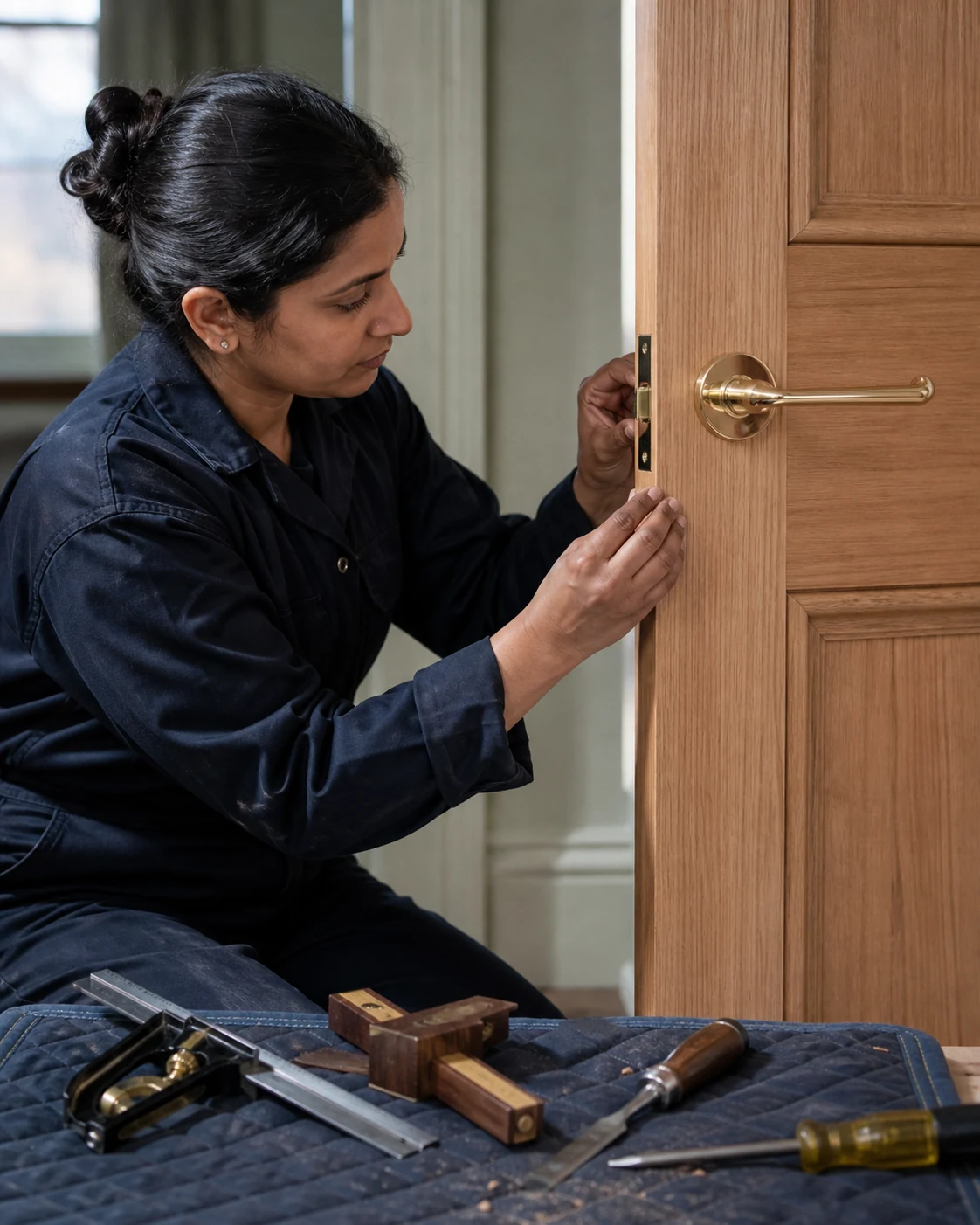
From temporary security to final repair
A temporary measure should state how the door is used, what it cannot do and who will return for permanent work. Do not let it become an undocumented long-term arrangement. When supporting material is repaired, the locksmith can reassess fit, alignment and compatible hardware against the restored entrance.
In an estate or managed development, give the final record to the responsible organisation. It should name the door, work completed, keys supplied and outstanding common-system issues. In a private home, retain the same information with property documents and any insurer correspondence.
Close, latch, lock, unlock and reopen without abnormal force. Check handle return and key withdrawal. A common door also needs its closer and authorised release considered by management. Record any remaining frame, hinge or reader fault rather than compensating with repeated lock adjustment.
Incident quotation
Hackney does not set a fixed locksmith price. The quote should identify present condition, access, method, hardware and related trades. It should not claim to determine causation that has not been established.
| Line | Input | Boundary |
|---|---|---|
| Safe attendance | Incident status, exact door and authority | When routine locksmith work may begin. |
| Opening | Door state, lock damage and proof route | Method, expected effect and security after entry. |
| Temporary security | Stable materials, opening and access requirement | Limitations and permanent follow-on. |
| Lock repair or replacement | Fault findings, measurements, support and key control | Specified mechanical work and tests. |
| Door and frame | Splits, distortion, hinges, keeps and glazing | Other-trade work versus lock fitting. |
| Managed system | Manager, closer, reader, release and records | Referral and responsible completion. |
Ask for a revised explanation if opening reveals hidden damage. An urgent instruction should not automatically authorise permanent hardware, decoration or another provider’s work.
Hackney locksmith FAQ
It helps distinguish a pre-existing symptom from new visible effects without claiming a cause that has not been assessed.
Use them when a crime may be in progress, someone is at risk, fire is involved or the property is unsafe to approach.
Avoid moving damaged components where evidence may matter or more damage could result. Photograph it safely and await authorised assessment.
The housing provider or nominated building controller should coordinate the common door, access system and resident access.
Some limited work may be agreed, but structural timber, metal or door repair can require another specialist before a permanent lock result.
It is a defined short-term barrier with stated limitations, used while compatible parts or permanent fabric repairs are arranged.
Review whether keys are missing, identifiable and linked to the affected doors. The authorised party can then decide proportionately.
Usually the building’s access-control provider handles readers and credentials. Mechanical lock work should not bypass that system.
Keep the incident chronology, scopes, invoices, hardware and key count, temporary limits and remaining door or system work.
Map and nearby live pages
Use the actual property page when reporting damage. These nearby pages exist or are included in this batch.
Record the change before defining the repair
Send the before-and-after operation, damage, current security, property controller and person approving each stage.
Evidence and approval
A police reference does not define the repair, and an insurer may ask for evidence without selecting hardware. Building management may set an approved door standard while the locksmith determines what remains serviceable. Ask each organisation what it actually needs, then pass only the relevant instruction into the work scope. Keep original photographs and invoices with the property record. This separation avoids delaying safe securing because unrelated paperwork and lock decisions have been combined, and it prevents a contractor from being treated as the person who decides insurance, criminal or tenancy questions.
