
Door and keep assessment
Leaf position, hinges, frame keeps and free mechanism travel are compared before adjustment is proposed.
Front door · garden door · driveway gate · shared entrance
Compare how each entrance is built, reached and operated before deciding what needs attention. A composite front door, UPVC garden door and apartment entrance can show similar symptoms for different reasons.
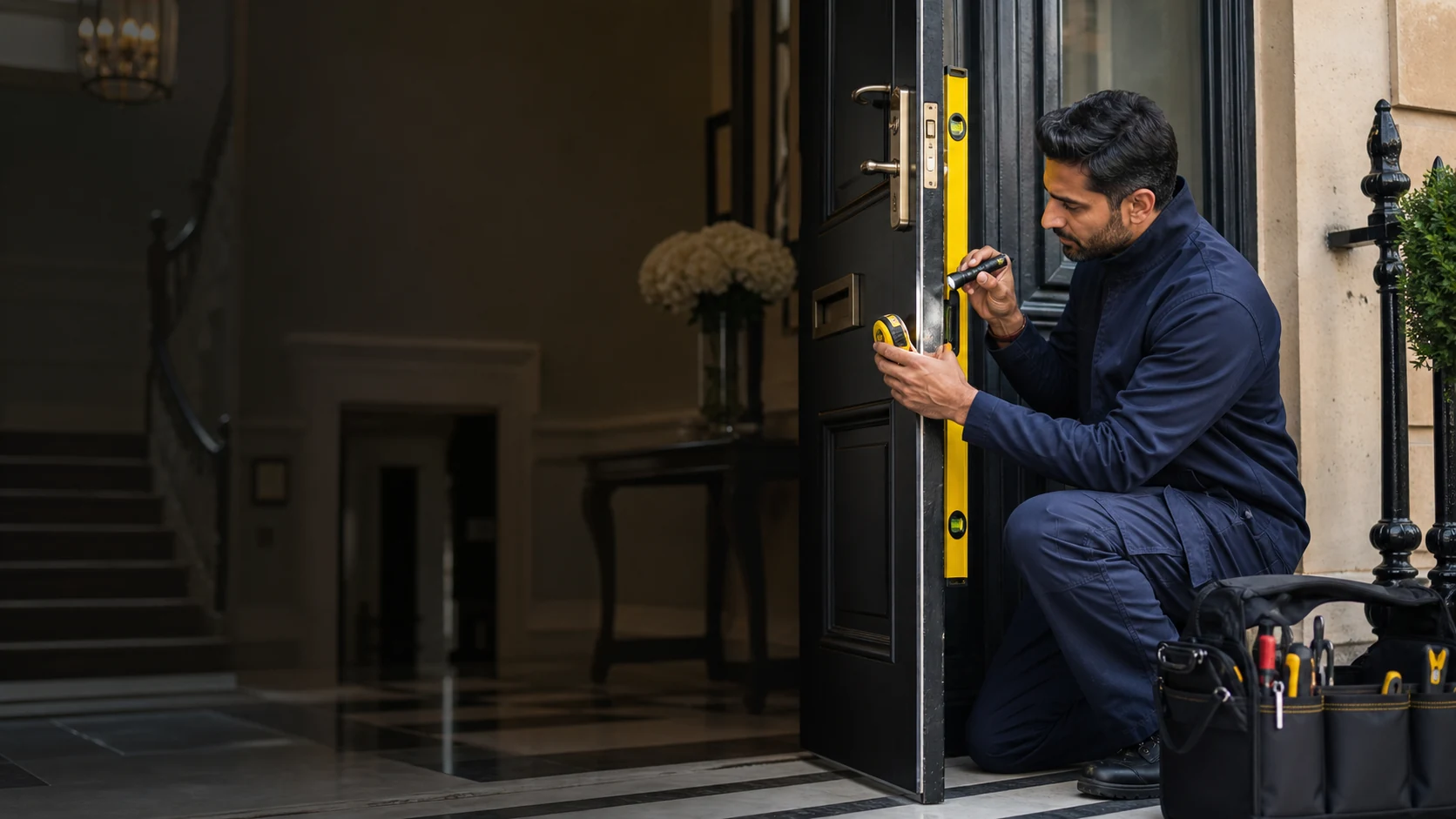
Entrance-by-entrance record
Edgware has family homes with more than one outside door, apartment blocks with shared approaches and driveways that may introduce a separate gate or side route. “The back lock is stiff” is more useful than a general request for new locks, but the best brief goes further: say whether the key enters, whether the handle lifts and whether the fault appears only when the leaf is against its frame.
Do not transfer a conclusion from one entrance to another. A front composite door may use a multipoint mechanism, while a garden door may have different dimensions, handing and exposure. An apartment door may be timber and subject to building rules. Record each as its own assembly.
| Entrance | Useful observations | Do not assume |
|---|---|---|
| Composite front door | Handle cycle, cylinder position, full edge strip and frame contact | Its appearance identifies the internal mechanism. |
| UPVC garden door | Outside access, hinge side, weather exposure and open/closed comparison | The front-door component will also fit here. |
| Side or utility door | Frequency of use, gate access and whether it is an escape route | Low use means low importance. |
| Apartment entrance | Private/common boundary, door construction and management restrictions | Lobby hardware belongs to the resident. |
| Driveway or pedestrian gate | Manual lock, automation, key holder and separate power controls | A door locksmith visit covers powered gate faults. |
| Garage personnel door | Internal access, alarm status and adjoining lock arrangements | It can be tested without the authorised key holder. |
Operating comparison
A multipoint door usually asks the user to close the leaf, lift or move the handle, turn the key, then reverse that sequence to open. Note the first step that changes. If operation is free while open but resistant when closed, frame engagement matters. If the handle is loose in both positions, handles, spindle or gearbox may need attention. If a good key cannot enter fully, do not force it or put objects into the keyway.
Changes after rain, strong sun or a period of non-use should be reported as observations, not diagnoses. They may help the locksmith reproduce the condition and inspect alignment, seals and keeps alongside the locking components.

Evidence before components
| Observed behaviour | Comparison to make | Next step |
|---|---|---|
| Handle lifts open but resists closed | Leaf position, hinges, keeps and seal pressure | Limit use and report the exact contact point if visible. |
| Key turns only while handle is held high | Handle travel, locking-point engagement and gearbox position | Avoid forcing the final turn; arrange assessment. |
| Handle moves but locking points do not | Spindle, handle connection, gearbox and strip | Keep the door attended if it cannot secure. |
| Key is stiff in both open and closed tests | Known sound key, cylinder and internal engagement | Preserve the spare and stop repeated attempts. |
| Latch catches after the door is pulled | Latch return, strike position and closing technique | Do not enlarge the strike without diagnosis. |
| Lobby works but apartment door does not | Private mechanical lock versus common access control | Direct the private issue and shared issue to the right parties. |
Relevant locksmith work
Leaf position, hinges, frame keeps and free mechanism travel are compared before adjustment is proposed.
Internal and external projection, total length, cam and key requirement guide selection for the actual door.
Fixing centres, spindle, backplate and return action are checked alongside resistance elsewhere in the system.
Markings, dimensions, centre cases and locking-point positions support compatible-part identification.
Authority, door state and the required secure result shape the method and any agreed follow-on repair.
Key holders, return duties and desired access are clarified before changing a working cylinder merely for control.

Driveway and garden access
A parked car may block the easiest unloading point; a locked side gate may block the exterior face of a garden door. Tell the locksmith which route is clear and who holds any gate, garage or alarm credential. A driveway gate with an electric operator is a different system from a mechanical entrance lock and may require the gate maintainer or an electrical access-control service.
For an apartment, explain reception arrangements and whether the entrance hardware is privately controlled. Keep communal lobby or fire-door concerns with the responsible manager. The assessment should not alter common equipment on a resident’s sole instruction.
After work, test from both authorised sides where appropriate. Close normally, operate the handle, lock, unlock and reopen. Confirm all issued keys, note any door movement that remains and keep the old component only where agreed. A successful cylinder change is not a substitute for testing the full multipoint action.
Scope and quotation
An Edgware postcode does not determine cost. Door state, authority, access, diagnosis, components and finishing work do. If two entrances are included, the quotation should not hide them under one vague “locks” description.
| Line | Information needed | Completion test |
|---|---|---|
| Attendance and access | Parking, driveway, gate, key holder and apartment entry | Relevant entrance reached safely. |
| Door assessment | Material, position, open/closed behaviour and existing hardware | Cause and boundaries explained. |
| Cylinder and keys | Measurements, cam, finish and authorised key quantity | Keys operate and are counted. |
| Handles or mechanism | Centres, spindle, markings, dimensions and locking points | Full operating cycle tested. |
| Alignment work | Hinges, keeps, seal pressure and structural exclusions | Door closes without abnormal force. |
| Separate gate or common issue | System owner and nominated maintainer | Referral recorded, not folded into private work. |
Ask whether parts, fitting, adjustment, disposal and further door repairs are included. If opening reveals a different mechanism, approve a revised written scope before extra work proceeds.
Edgware locksmith FAQ
No. Similar-looking doors can contain different cylinders, gearboxes, strips and locking-point layouts. Measurements are needed.
That comparison points towards engagement with the frame, including alignment and keeps, but direct inspection is still required.
Repeated force risks breakage and further damage. Use a sound authorised spare only for comparison and arrange assessment.
Not automatically. Gate automation, power, controls and mechanical door locks should be scoped as separate systems.
Only after both openings are measured and the access objective is agreed. Appearance does not prove compatibility.
The owner or authorised occupier may also need to follow tenancy, freeholder or managing-agent requirements.
Not necessarily. The failed or incompatible part should be identified and the rest of the system assessed before deciding.
When safe, include the whole door, both handles, cylinder, edge strip, visible markings and frame keeps.
Test normal closing, every locking point, key turn, handle return and reopening from authorised sides.
Map and nearby live pages
Choose the page matching the property and entrance. These pages are live or form part of this completed batch.
Name the entrance and the sequence
Send the door position, material, current state, operating steps, safe photographs and the person authorised to approve work.
Household continuity
If the affected door is the household’s usual entrance, identify a safe alternative route before inspection and make sure its authorised key holder is available. Do not leave a garden or garage route unlatched merely for convenience. The access plan should preserve normal security while allowing both faces of the problem door to be examined.
