
Damaged lock opening
Authority and condition guide the method. Existing damage, not only lock type, affects how entry and later security are planned.
Damage map · supporting material · lock function · repair handover
A replacement lock cannot hold securely if the door edge or frame has lost suitable support. After visible damage, map the affected materials, confirm private or shared responsibility and decide what must be repaired before normal locking can return.

Entrance damage map
Camberwell converted terraces and purpose-built flats can have damage limited to a private door or spread across a communal frame. Begin only when it is safe. If an incident is active or someone is at risk, contact emergency services. Where police or insurer evidence may be needed, take safe photographs and avoid unnecessary disturbance.
Look at the entrance as zones without dismantling it. Is the cylinder loose, the lock case displaced, the door edge split or the frame keep pulled away? Does the leaf still close into the opening? Is glazing broken or an electric release exposed? These observations determine whether locksmith work can restore security immediately or whether supporting material first needs another repair.
| Zone | Visible condition to record | Why it changes the scope |
|---|---|---|
| Cylinder and external furniture | Rotation, displacement, tool marks and missing pieces | The key-control component may be repairable or require measured replacement. |
| Lock case and door edge | Loose faceplate, split timber, bent metal and bolt movement | A lock needs sound fixing material and free internal operation. |
| Frame and keeps | Cracks, pulled screws, distortion and missing sections | The frame must receive and resist the latch or bolt reliably. |
| Door face or panel | Holes, delamination, broken insert and overall distortion | Door repair or replacement may precede permanent lock fitting. |
| Hinges and closer | Loose fixings, changed gaps and incomplete closing | Alignment can prevent secure engagement even with a working lock. |
| Glazing or electronic release | Broken glass, exposed wiring or failed release action | Another specialist and building management may need to coordinate. |
Safe documentation
Take a wide image of the entire entrance, then closer views of each zone. Photograph both sides only where access is safe and authorised. Do not push a displaced cylinder back, straighten a bent keep or remove splintered material for a clearer picture. Keep loose hardware and key fragments together until the relevant police, insurer, owner or contractor says whether they are needed.
Record whether the door can close, latch or lock and whether someone can remain safely at the property. Do not repeatedly test a damaged mechanism. If a temporary arrangement is already present, describe how it limits access. Do not publish detailed images that expose the building’s remaining security.
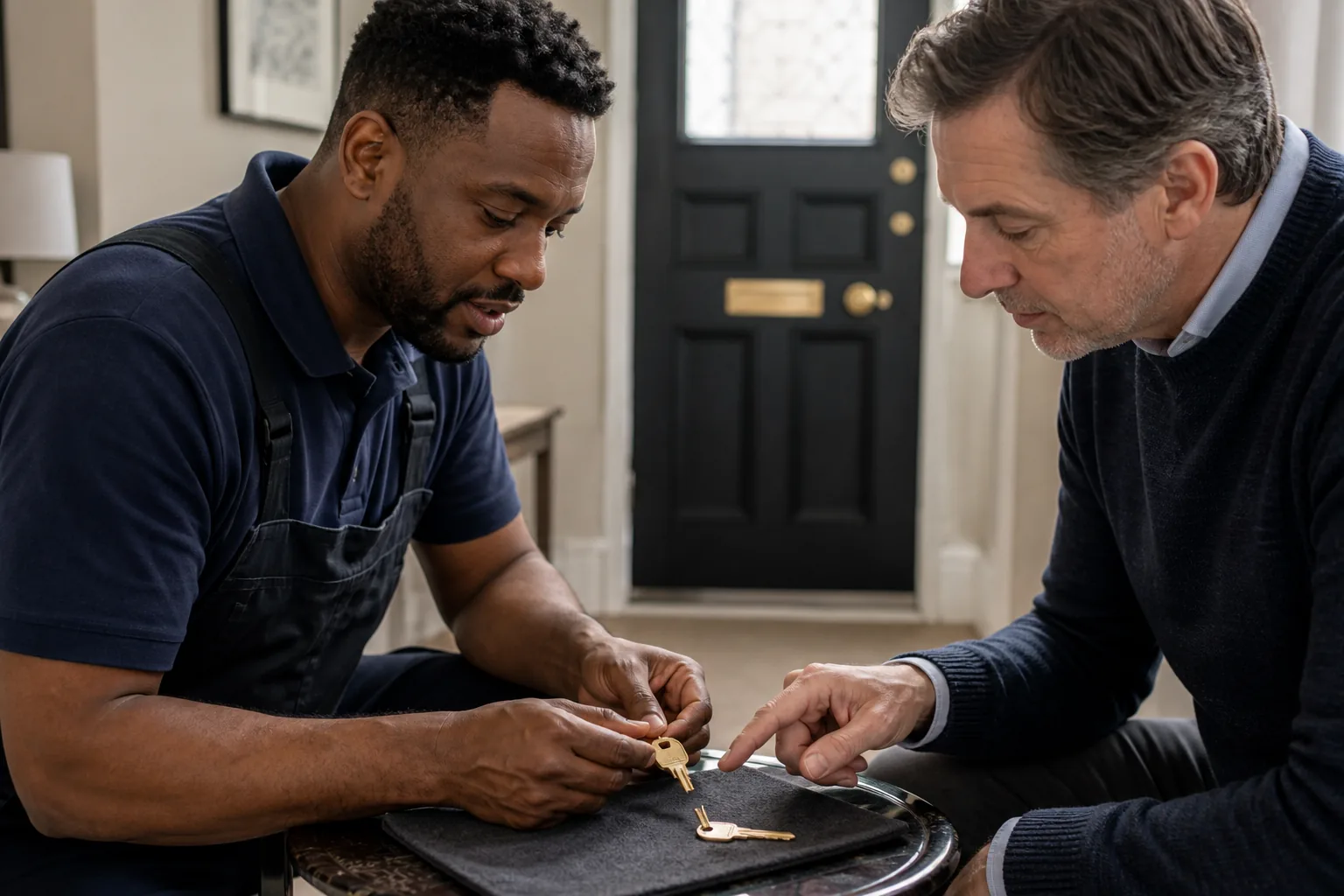
Repair sequence
| Decision | Evidence required | Result to document |
|---|---|---|
| Is emergency attendance required first? | Immediate danger, active incident and safe access | Police, fire or medical release before routine work. |
| Can the door provide temporary security? | Leaf and frame stability, opening size and authorised access needs | Short-term measure and its limitations. |
| Can the lock be repaired? | Case, cylinder, latch, bolt and surviving fixing points | Restored mechanical operation with normal tests. |
| Must supporting material be repaired? | Door edge, frame, keeps, hinges and distortion | Joinery, metal or door work needed before final hardware. |
| Does key control need changing? | Missing keys, doors served and authorised users | Measured replacement and counted keys. |
| Does a communal system remain affected? | Closer, electric release, intercom and common users | Referral and management-owned follow-on action. |
Locksmith work within a larger repair
Authority and condition guide the method. Existing damage, not only lock type, affects how entry and later security are planned.
A surviving cylinder, case or latch may be restored if direct assessment shows it can operate reliably and fix securely.
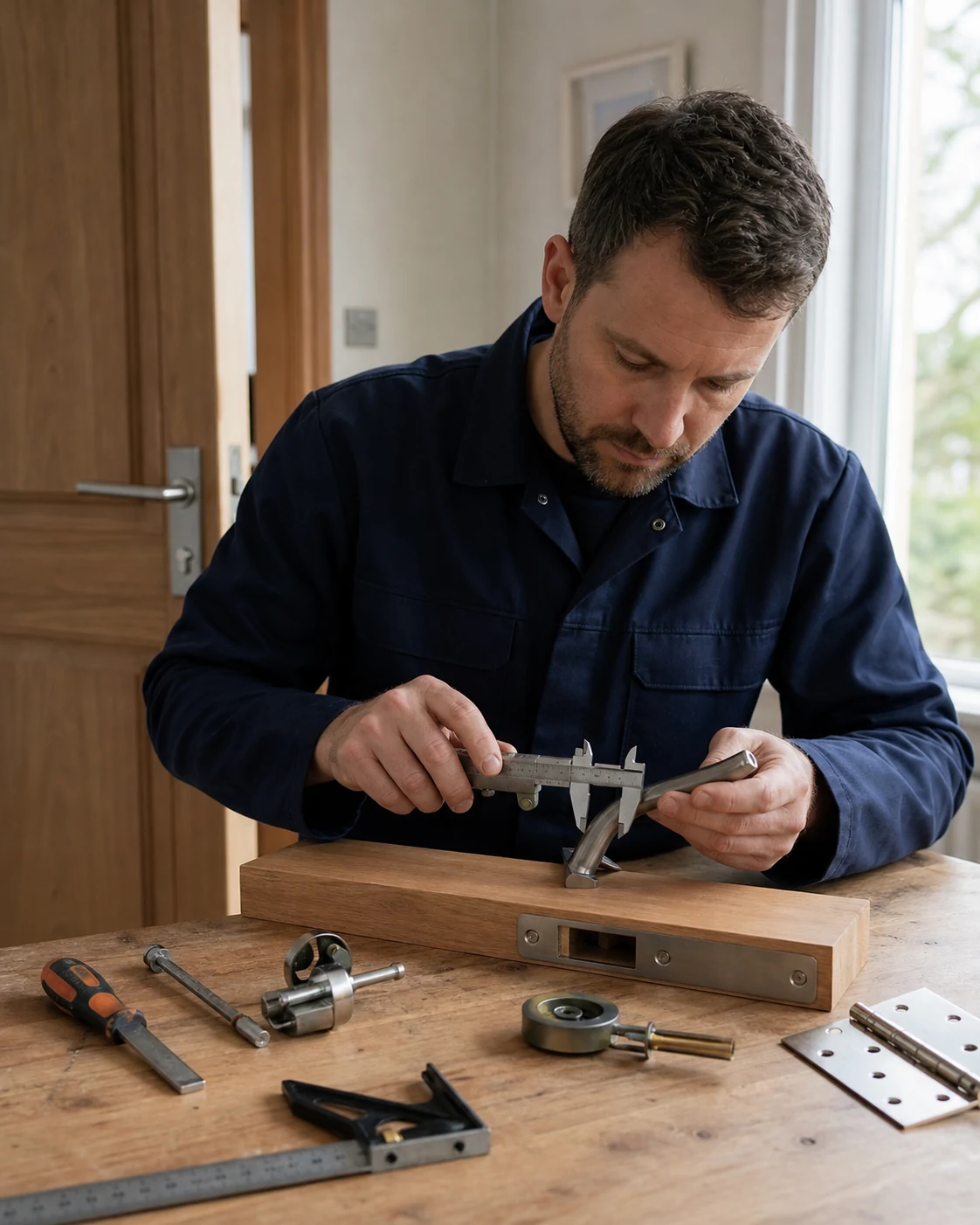
Door thickness, case dimensions, remaining cut-outs and security outcome determine compatible hardware. A larger lock is not a substitute for frame repair.
A short-term barrier or lock arrangement can be agreed where permanent work cannot proceed. Access and limitations must be explained.
Where keys are compromised, identify each served door and every authorised user. Shared entrances require building-level coordination.
After suitable door or frame work, locksmith hardware can be fitted, aligned and tested against the restored keeps and closing action.
Converted terraces and shared blocks
In a converted terrace, the frame around the street entrance usually serves more than one dwelling even if damage is beside one resident’s buzzer. A purpose-built block may place the closer, electric release and main leaf under a housing provider or managing agent. Contact that controller before authorising changes. Private flat-door damage can still require landlord approval under a tenancy.
If damage crosses boundaries, write separate lines: private lock, communal frame, access-control release and decoration. This avoids one emergency instruction being treated as authority for the entire building. It also lets each party supply evidence to an insurer or property record without confusing which entrance was repaired.
After the supporting material and lock are ready, test closing, latching, locking, unlocking and handle return. Verify that the bolt or latch meets the keep without forcing the leaf. Count keys and note any closer, hinge, glazing or electronic issue still awaiting another contractor.
Quotation and trade boundary
Camberwell is not a fixed price category. A useful quotation names damage, access, temporary measures, compatible hardware and other trades. A permanent result should not be implied where only short-term securing is included.
| Scope line | Input | Boundary |
|---|---|---|
| Safe attendance | Incident status, exact door, authority and controlled route | When locksmith work may lawfully begin. |
| Opening | Lock state, existing damage and proof route | Method, additional effect and security after entry. |
| Temporary measure | Opening, stable material and required access | Operating limits and later permanent work. |
| Door or frame repair | Splits, distortion, hinges and keeps | Joinery or door work outside lock fitting. |
| Lock hardware | Measurements, supporting material, key control and finish | Repair or named replacement with tests and keys. |
| Shared and specialist systems | Manager, closer, glazing and electronic release | Referral, responsibility and separate completion record. |
If a cover is removed or the door opens to reveal more damage, request a revised written scope. Urgency should not be used to hide permanent repair, decorative or specialist costs.
Camberwell locksmith FAQ
Not reliably if the supporting material cannot hold the keep or fixings. Frame or door repair may be needed before a permanent lock result.
Make sure the area is safe, contact emergency services where necessary and take safe photographs. Avoid moving parts needed as evidence.
The freeholder, managing agent, housing provider or nominated building contact should authorise and coordinate work for all residents.
Securing can be a short-term measure that reduces immediate exposure. Reinstatement restores suitable door, frame, lock and related functions for normal use.
Possibly, if it remains undamaged, compatible and reliable after assessment. The case, cylinder, latch and fixings should be tested directly.
Only if specifically stated. Glazing normally forms a separate workstream alongside lock, door and frame repair.
Yes as a separate key-control decision. Identify the doors served and authorised users before replacing private or communal hardware.
Report it to building management. Mechanical and electronic systems may need coordinated providers and should not be bypassed.
Keep photographs where appropriate, accepted scopes, invoices, hardware and key counts, temporary limitations and outstanding specialist work.
Map and nearby live pages
Choose the actual property page when reporting damage. These nearby pages exist or form part of this batch.
Secure the supporting material as well as the lock
Send the entrance boundary, damage zones, current security, evidence needs and the contacts responsible for permanent repair.
