
EARL’S COURT · FROM BEDROOM FLOOR TO ARRIVAL ROUTE
Rug Cleaning Planned for an Earl’s Court Flat
A rippled cotton flat-weave needs more than a size and a postcode. We record how its edges sit, what lies beneath it and how it can leave the room before proposing a workable cleaning scope.
- Frame the whole rug, including every corner and nearby furniture
- Photograph the raised edges side-on so their shape is clear
- Turn back a safe corner for a view of the underside and label
- Describe the staircase, stopping point and bare-board floor

A SHORT DESCRIPTION TOOL
Sort what you know from what still needs inspection
Use the choices as prompts for your message. They organise evidence; they are not a remote diagnosis or treatment selector.
READING A FLAT-WEAVE
Four clues shape the handling conversation
A cotton label is a starting clue. The interlaced structure, colour behaviour, distorted margins and any earlier repair can each narrow what is sensible for the actual piece.
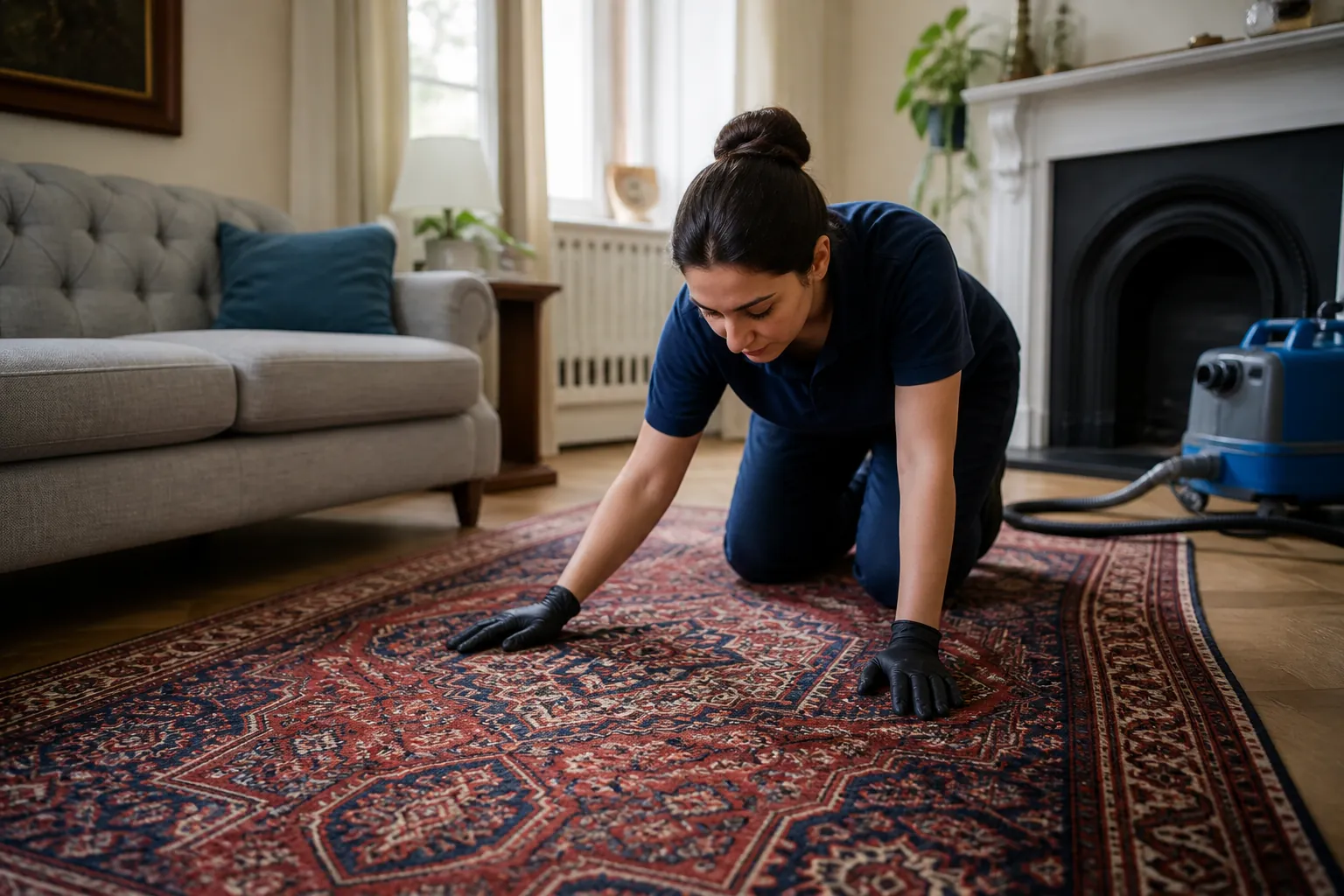
How the yarn behaves
Absorbency and surface strength influence handling and moisture control.
Where tones meet
Contrasting bands may warrant checks before a wider area is worked.
How shape is held
A thin woven body can show ripples, pulled rows and uneven tension.
Ends, corners and old stitching
Existing weakness is mapped before lifting so its condition stays traceable.
THE MANSION-FLAT SCENARIO
The route downstairs is part of the job description
Our Earl’s Court example starts in a bedroom with old softwood boards. A light flat-weave has developed uneven edges and gathered routine dust; the communal staircase and short stopping window determine how it can be handled without confusing logistics with textile care.
What the photographs should establish. A doorway view shows clearance and scale; a lower angle records the curl; detailed frames capture stitching and discolouration. Images help distinguish deposits from changes in the weave but cannot promise correction.
The resident measures both axes, lists anything previously applied and clears a safe path to the landing. Protection for the timber can then be considered alongside the assessment rather than improvised after arrival.
Notes for this Earl’s Court bedroom
Position: Mark which sides disappear under the bed and whether the rug can be viewed without dragging furniture across it.
Shape: Record each lifted margin independently; a curled corner, stretched side and woven irregularity are not interchangeable.
Dust pattern: Show the zones beside the bed and doorway so ordinary accumulation is not presented as one isolated stain.
Dimensions: Take the longest and widest readings while the textile lies naturally rather than pulling it square.
Identification: Copy wording from the care label and photograph the back; leave uncertain fibre claims explicitly uncertain.
Palette: Point out dark borders against pale fields, especially where a previous damp wipe may have crossed both.
End finish: Include hems, selvedges and tassels in close view, noting loose threads without trimming them.
Earlier care: Name household sprays, powders or hired equipment and say whether they altered feel, colour or smell.
Board surface: Mention wax, varnish or unfinished timber where known, plus any sensitivity to contact or moisture.
Room contents: Identify heavy pieces resting on the rug; removal is agreed rather than assumed in the estimate.
Smell report: If relevant, locate it by edge or motif and explain when it appears instead of labelling the source.
Ageing: Sun fade, abrasion and an out-of-square outline remain on the condition record even when soil is also present.
Air conditions: Window opening, heating and seasonal humidity inform later advice, so no stock completion hour is supplied.
Quotation: Area selects a guide band; unusual handling, condition and separately requested work refine the written scope.
Return: Furniture only goes back according to the final advice for both the textile and underlying boards.
Boundary: A proposed outcome follows inspection. Photographs alone cannot establish colourfastness, reversibility or finish.
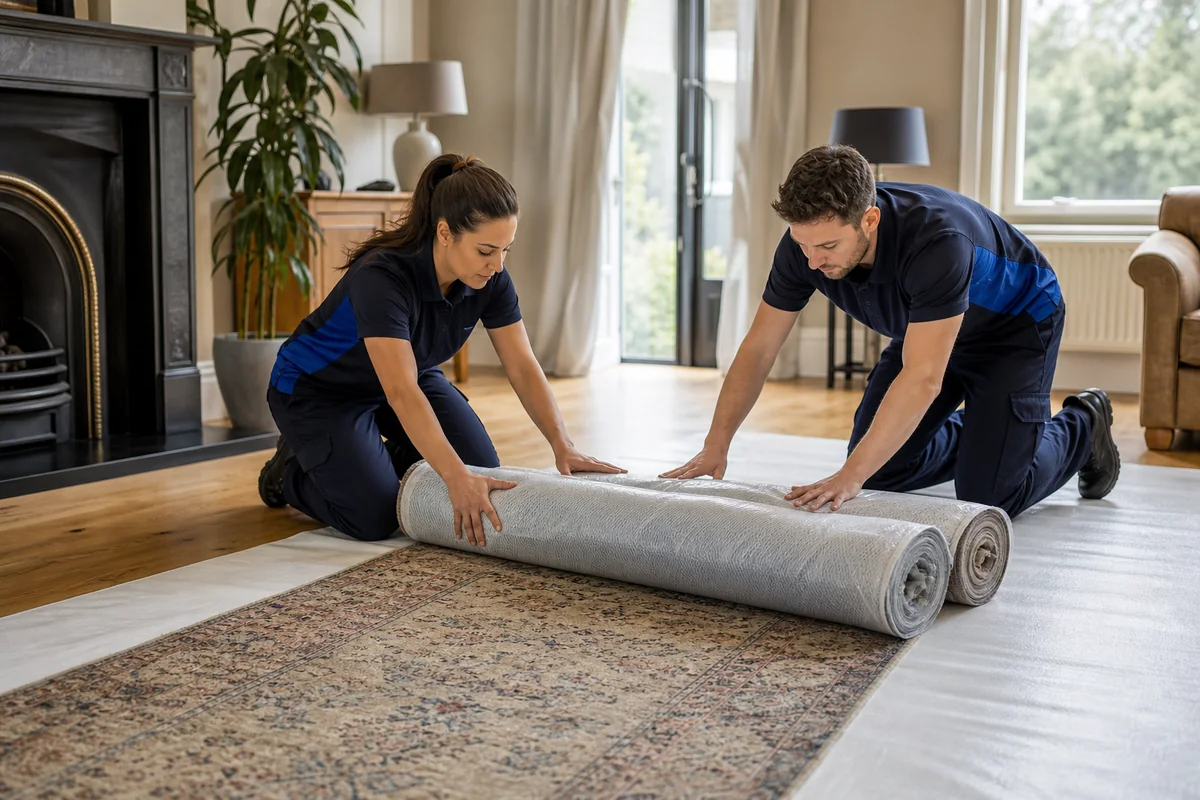
FROM LANDING CHECK TO ROOM RETURN
A sequence that can change after inspection
The plan follows what the weave, colour and existing distortion permit. Drying advice reflects the chosen work and bedroom conditions; a reported smell is mapped and discussed separately rather than folded into a generic add-on.
-
01
Meet and map
Confirm the route, dimensions, ripples and pre-existing flaws
-
02
Read the textile
Compare label evidence with the back, weave and colour joins
-
03
Address loose matter
Work accessible dry debris while preserving the shape record
-
04
Follow the scope
Proceed within the limits agreed for this particular flat-weave
-
05
Watch the margins
Monitor colour, moisture and the already-buckled sides
-
06
Revisit the record
Compare the bedroom zones with the opening photographs
-
07
Set the room back safely
Give board protection, airflow and furniture-return instructions
GUIDE BANDS FOR EARL’S COURT
Measurement opens the estimate; the brief completes it
Length and width place the rug in an initial band. The written figure may then account for a delicate edge, the staircase carry, prior residues or another separately approved requirement.
BEFORE ASKING FOR A FIGURE
Send one coherent room-and-rug account
- Full Earl’s Court address and useful appointment windows
- Longest and widest measurements in centimetres
- Doorway photograph with the rug fully visible
- Low-angle images of every raised or wavy edge
- Readable label plus safely accessible underside
- Close views of hems, tassels and prior stitching
- Any verified material or manufacturing information
- Names of products used and approximate dates
- Stair turns, entry restrictions and stopping conditions
Four points to settle early
Will the pictures determine the process?
They make preparation better, but touch, construction and colour checks may still alter what is appropriate.
Are the grey-looking margins simply dirty?
Not necessarily. Dust, abrasion, faded yarn and old product can produce different appearances.
May the bed be replaced immediately?
Follow the final instructions for dryness and the protected timber rather than a fixed waiting period.
Does the quote automatically cover a smell?
No. Its position, history and likely depth need their own assessment and explicit scope.
QUESTIONS FROM AN EARL’S COURT BEDROOM
Details that prevent an incomplete estimate
Which first photograph is most useful?
Stand at the bedroom doorway and capture the complete outline, furniture overlap and route toward the landing in one frame.
Why mention that the rug lies on old boards?
The finish below influences lifting and protection arrangements. It does not by itself select a cleaning technique for the textile.
Will cleaning flatten the curled sides?
No correction can be promised. Distortion may arise from tension, wear, storage or construction rather than surface contamination.
What access information should a mansion-flat resident give?
Count flights, describe narrow turns and doors, and explain the nearest legal stopping option so carrying requirements can be planned.
Is a cotton label enough to approve the work?
It is useful evidence, not a complete specification. Weave, colours, finishes, repairs and present condition also matter.
Should I dampen the dusty edge before taking pictures?
Leave it as found. Adding water or another product can change the evidence and introduce residue or colour movement.
Why photograph a loose hem before the visit?
It distinguishes existing weakness from handling damage and may call for a different lifting plan or reduced scope.
How should I describe a bedroom odour?
Say where and when it is strongest and disclose any known event. Smell alone cannot reveal the source or how far it travelled.
Can the bedroom be used the same evening?
That depends on the selected work, textile response and room conditions. Use follows the specific handover guidance, not a universal clock.
Why might my written quote differ from the size band?
The band starts with area. Fragile details, access, condition and separately requested tasks can change the confirmed scope, subject to the minimum.
READY TO DESCRIBE THE BEDROOM RUG?
