
PURLEY · READ THE RUG’S HISTORY BEFORE ITS SURFACE
Rug Cleaning in Purley for Older and Hand-Knotted Pieces
An inherited rug may arrive without a label yet reveal plenty through its knots, fringe, repairs and uneven fading. For Purley enquiries, we assemble those clues alongside the room position and carrying route, then decide what further checks are needed.
- Photograph the front and back without filters or flash glare
- Show where fringe loss ends and the woven body begins
- Mark the tea spill separately from old repairs and sun fading
- Describe sloping paths, entrance steps and tight hallway turns
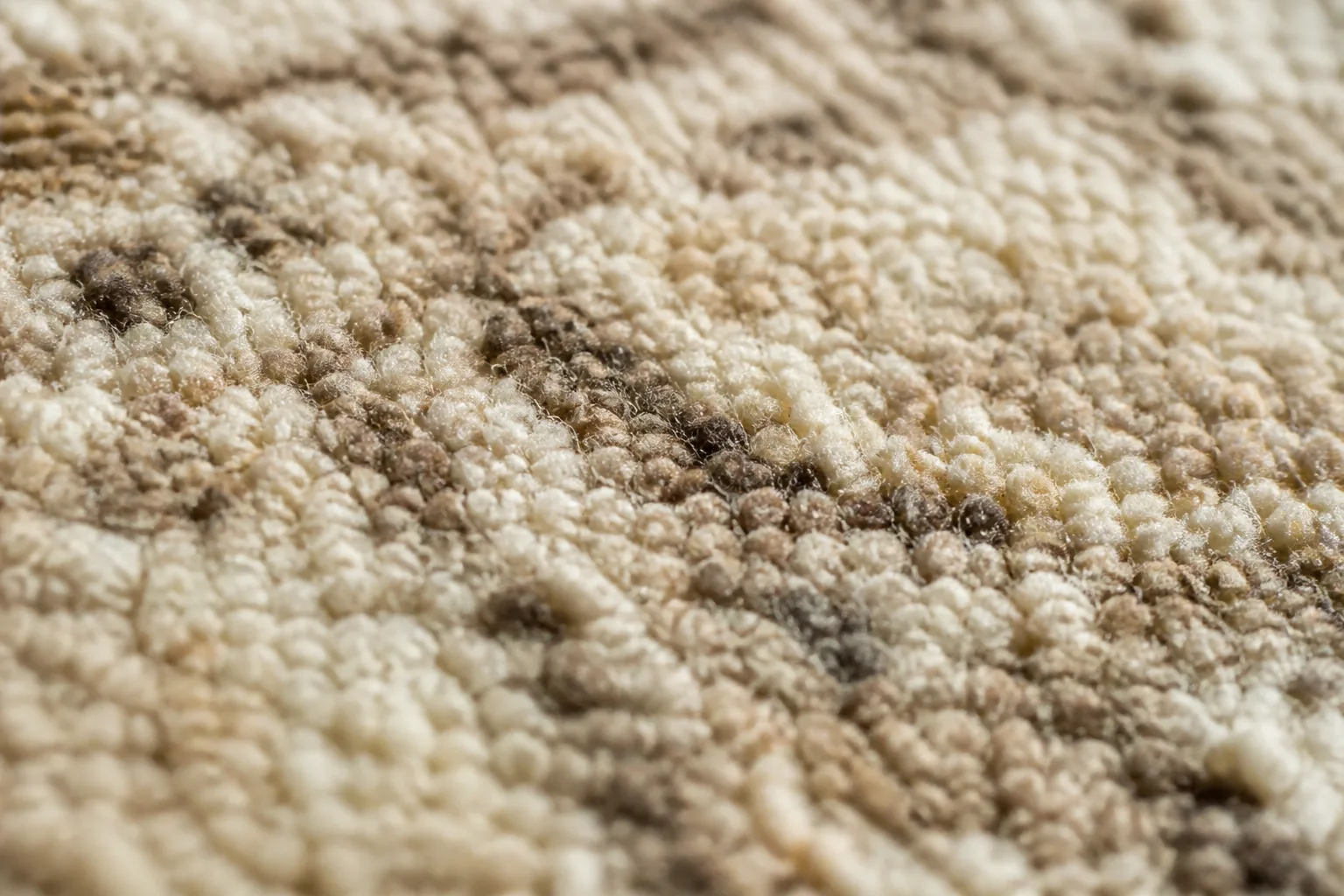
SORT THE CLUES
Create a descriptive record, not a remote diagnosis
Choose only what can be seen or documented. Unknown origin is more useful than an unsupported fibre claim.
FROM RECEPTION ROOM TO FRONT DOOR
Protect fragile details during the carry
A hillside address can add steps before the rug even reaches the hallway. We ask about the gradient, thresholds, internal turns and whether a long roll can pass without bending. The route is planned around the textile rather than forcing an older foundation through an unsuitable gap.
A Purley scenario. A patterned rug inherited with the house sits in a formal front room. One fringe end has shortened, a rectangular repair is visible from behind, and a tea ring crosses two colours near an armchair.
The useful evidence. The owner measures both axes, photographs each corner and includes a ruler beside the repair. A wide image shows afternoon light entering from the bay window, clarifying which changes may be fading rather than soiling.
Purley provenance file
Outline. Exact dimensions replace labels such as “large Persian”.
Front. Motifs are photographed square-on for colour comparison.
Back. Knot structure and patched sections are shown clearly.
Fringe. Ends, attachment and missing areas remain distinct.
Repair. Location, scale and looseness are recorded without judging age.
Spill. Tea is noted with date and any action already taken.
Fading. The window edge is compared with the sheltered centre.
Odour. Storage smell is described by location and conditions.
Floor. Polished boards beneath need their own protection plan.
Furniture. Castors and legs are mapped before lifting.
Thresholds. Steps and narrow turns shape handling choices.
Uncertainty. Missing fibre or dye information stays openly unknown.
Testing. Contrasting colours and repairs may need separate checks.
Expectation. Conservation concerns are not confused with routine soil removal.
Timing. No return date is inferred from postcode alone.
Estimate. Labour reflects size, delicacy, condition and access together.
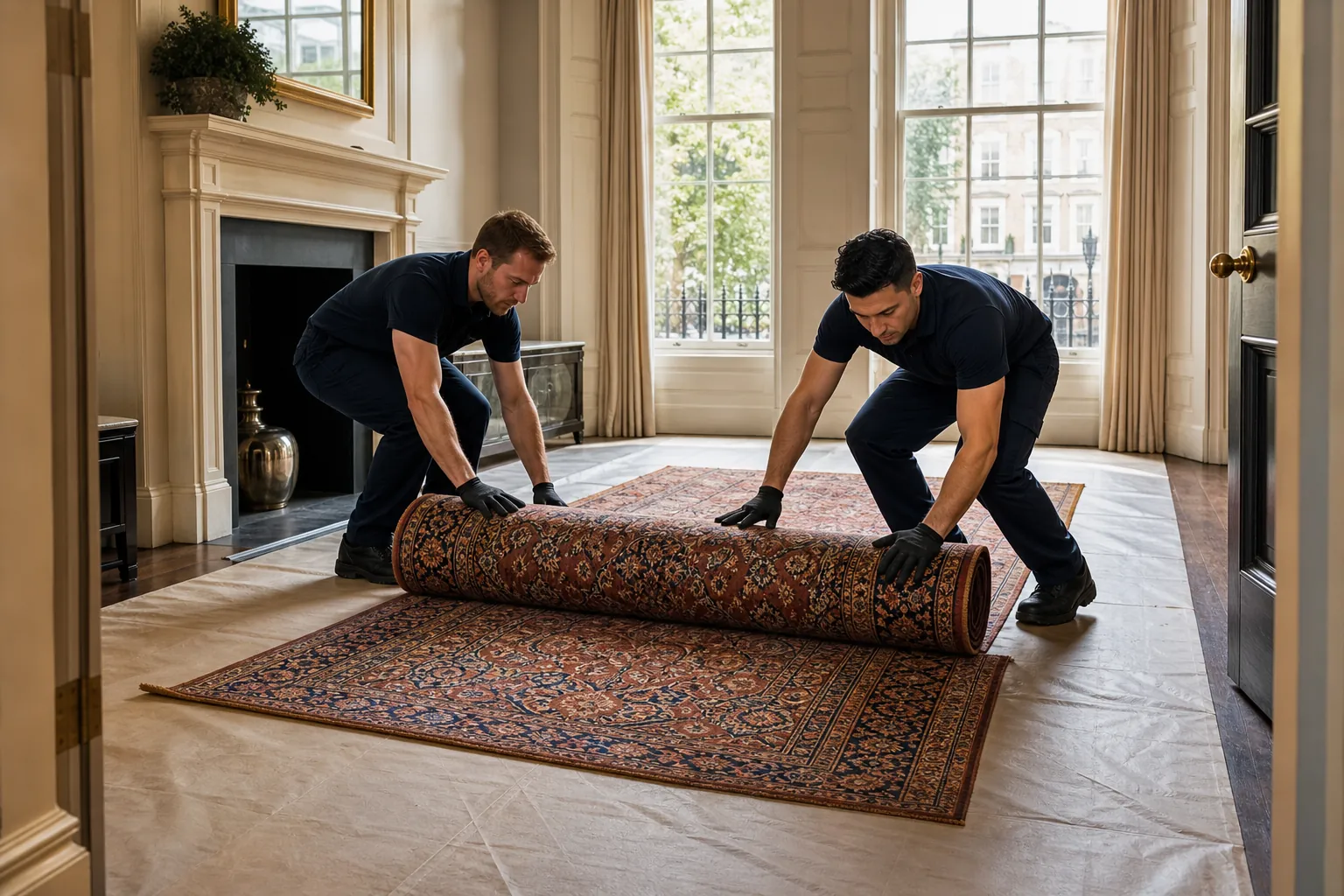
TEA ACROSS TWO COLOURS
One spill may present several risks
The liquid, sugars, previous blotting and natural dye variation can all affect the boundary. Images of the stained and unaffected motifs help frame testing without promising complete removal.

FRINGE IS STRUCTURE, NOT DECORATION
Weak ends can set the handling limit
On many knotted pieces the fringe continues from the foundation. Scrubbing or pulling can worsen an already shortened end.
- Lay the fringe naturally for the photograph
- Do not trim uneven fibres
- Point out replaced or secured sections
- Keep repair and cleaning expectations separate
PURLEY SUBMISSION CHECKLIST
Send the clues in a useful order
The quotation can then reflect both conservation boundaries and practical access.
- Address and contact preference
- Edge-to-edge dimensions
- Full front image without colour filters
- Complete reverse and knot close-up
- Every fringe end and corner
- Tea mark beside an unaffected reference
- Known purchase, storage or repair history
- Floor and furniture arrangement
- Path gradient, steps and doorway width
Questions worth settling first
Can a photograph identify an antique rug?
No. It can document construction clues, but this service does not provide valuation or authentication.
Should loose fringe be taped down?
No. Leave it visible and undisturbed so its attachment can be reviewed accurately.
Does a repaired area prevent cleaning?
Not automatically; its strength, materials and position influence what scope may be sensible.
Why include the front path?
A steep or stepped approach changes how a rolled textile can be carried safely.
A PROVENANCE-LED SEQUENCE
Seven stages for the Purley piece
Each stage protects documented history while testing present-day suitability.
- 01
Inventory
Log dimensions, motifs and supplied history
- 02
Examine
Read knots, backing, ends and repairs
- 03
Test
Check contrasting colour behaviour
- 04
Secure
Set boundaries around weak construction
- 05
Work
Address soil within agreed limits
- 06
Review
Compare spill, field and repaired area
- 07
Handover
Explain support, drying and return
GUIDE FIGURES BY AREA
Size sets a baseline; delicacy completes the scope
Fringe weakness, repairs, dye behaviour and hillside handling can affect the final Purley quotation.
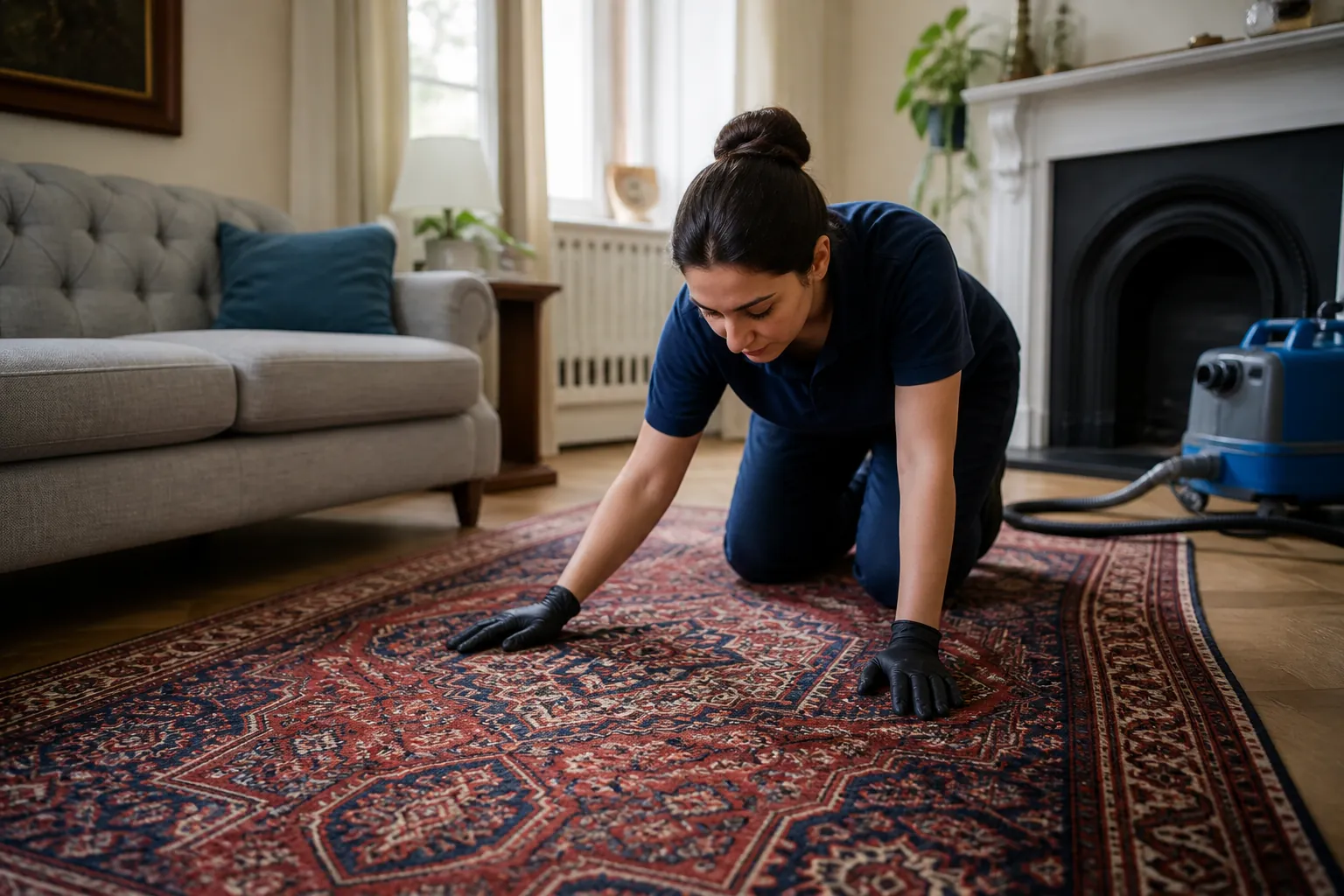
READ FOUR LAYERS OF EVIDENCE
The reverse can explain the face
Knot pattern, repair thread, end structure and dye arrangement reveal constraints that a room photograph cannot.
Construction rhythm
Irregularity may be original rather than damage.
Contrasting response
Strong neighbouring shades deserve careful checks.
Different materials
Later threads may not behave like the original.
Foundation continuity
Fringe condition can limit manipulation.
PURLEY RUG QUESTIONS
Answers for an older, partly documented textile
Do you value inherited rugs?
No. We document cleaning-relevant construction and condition, not market value or authenticity.
What if there is no care label?
Provide detailed front, reverse, edge and knot photographs and leave the fibre recorded as unknown.
Can worn fringe be rebuilt?
Cleaning is not restoration; missing or weakened structure requires a separate specialist discussion.
Will the tea mark vanish?
That cannot be guaranteed before the fibres, dyes, age and earlier treatment are understood.
Why photograph old repairs?
Repair yarns and adhesives may react differently and can establish a handling boundary.
Is fading removable soil?
No. Light-related dye change may remain even when accessible soil is reduced.
Can the rug be folded for the stairs?
Do not fold it by assumption; construction, age and repair position inform the carrying method.
What causes a storage smell?
Several sources are possible, so describe storage conditions and affected depth rather than masking it.
When can the rug return to polished boards?
Only after item-specific guidance confirms readiness and the supporting floor is suitable.
How is the £68 minimum applied?
It is the current minimum visit guide, subject to the confirmed combined scope at the address.
BEGIN WITH WHAT THE RUG REVEALS
Prepare a documented Purley quotation request
Measurements, provenance, close photographs and route notes create a responsible starting point.
