
Leaves
Wet leaves can settle into layers and slow water moving towards an outlet.
Rainwater routes · access · clear scope
A useful gutter service starts with the channels that need attention and the parts that can be reached. For Kingston properties, routine cleaning covers agreed accessible runs containing leaves, moss, silt and similar debris, plus reachable outlets where included. Pipe restrictions below that point, damaged components and underground drainage require separate consideration.

Structured service guide
| Component | Position |
|---|---|
| Named accessible channels | Cleaned |
| Leaves, moss, silt | Removed from named channels |
| Reachable outlet opening | Cleared if included |
| Inside of deeper downpipe | Outside routine scope |
| Underground connection | Outside routine scope |
Structured service guide
| Finding | Cleaning or repair |
|---|---|
| Loose material in channel | Cleaning |
| Surface debris at agreed outlet | Cleaning |
| Split channel | Repair assessment |
| Loose bracket | Repair assessment |
| Misaligned run | Repair assessment |
Structured service guide
| Information | What it clarifies |
|---|---|
| Affected side of property | Required scope |
| Number of roof levels | Access conditions |
| Structures beneath eaves | Potential restrictions |
| Visible debris or overflow | Likely cleaning need |
| Shared access | Necessary arrangements |
Structured service guide
| Where the issue appears | How it is treated |
|---|---|
| Within an accessible channel | Routine cleaning may apply |
| At a reachable outlet | Can be included by agreement |
| Deeper in a downpipe | Separate assessment |
| Below ground | Underground drainage assessment |
| At a broken connection | Repair assessment |
Common causes
Accumulation often develops unevenly. Wind and water can move light material towards bends, ends and outlets, while silt settles beneath it. The relevant question is whether the obstruction sits within the accessible gutter scope or farther down the rainwater route.
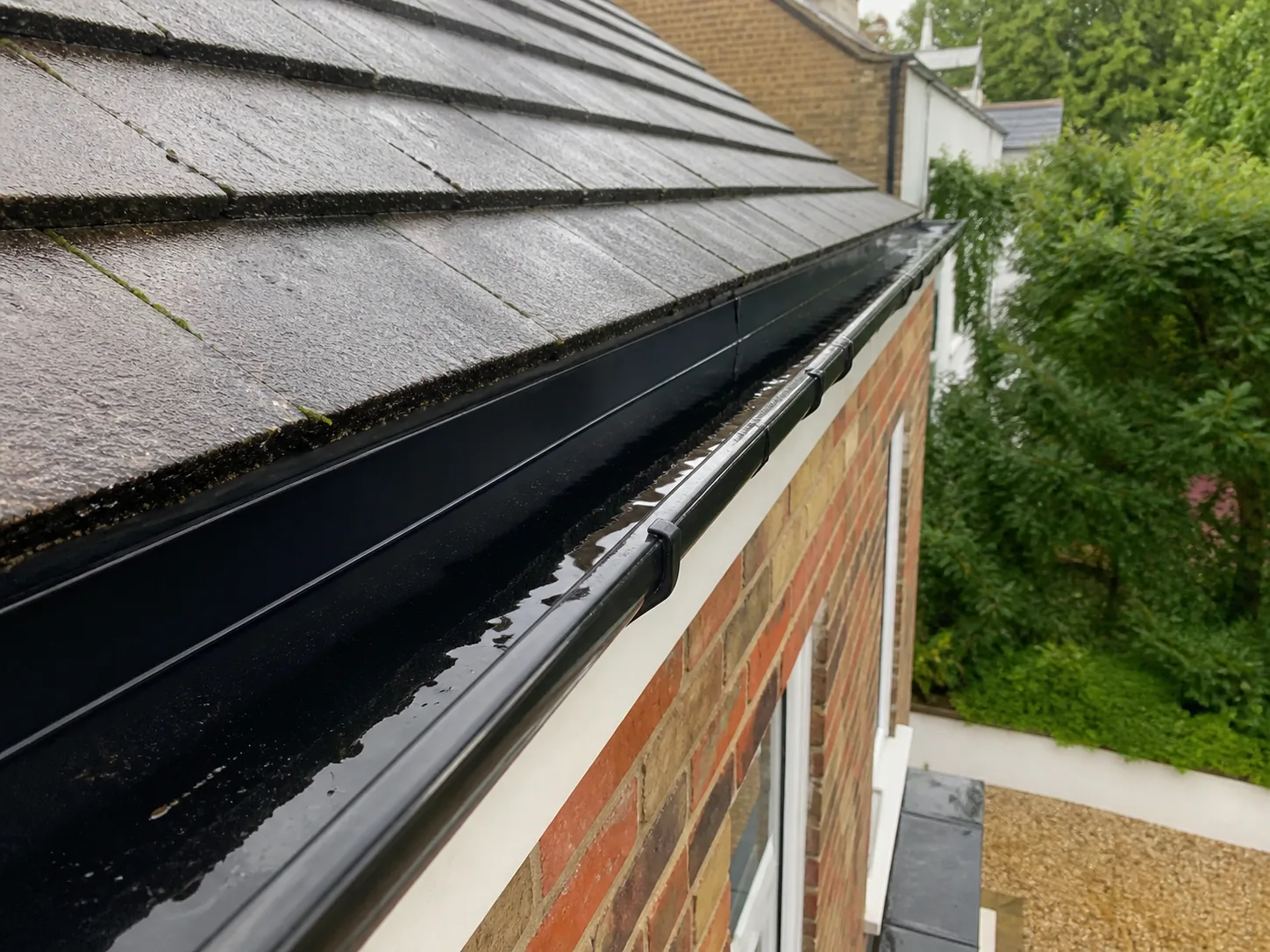
Wet leaves can settle into layers and slow water moving towards an outlet.
Loose roof moss can collect in the channel and hold other material in place.
Small twigs can bridge narrow points and trap lighter debris behind them.
Loose surface material may wash down from the roof during wet weather.
Older material can become dense and reduce the channel available for runoff.
Fine deposits can gather beneath larger debris and close to an outlet.
Local property context
At a Kingston property, an overflow point may be visible at the front while the main accumulation sits farther along the run. On another home, the trouble may be close to an outlet above a rear addition. Property form, roof levels and the surrounding space can therefore matter as much as the amount of debris. A helpful description of the symptom and affected elevation gives a better starting point. The proposed work can then focus on accessible sections without implying that every roof edge or connected pipe is automatically included.
Routine gutter cleaning has a deliberately limited role: it creates space for rainwater by removing leaves, moss, silt and ordinary loose material from accessible agreed channels. Where a reachable outlet is included, build-up at that point can also be cleared. The work is different from resealing joints, replacing sections, correcting alignment or tracing restrictions inside downpipes and drains. That distinction matters when a home has more than one issue. Cleaning may address the visible accumulation while a damaged component or concealed obstruction still requires an appropriate separate assessment.
Each elevation needs its own access consideration. One run may be unobstructed while another sits beyond an extension, narrow gap or enclosed yard. Building levels, boundaries, parked vehicles and fragile features nearby can also affect the sections that are reasonably included.
| Property situation | Access or gutter consideration |
|---|---|
| Mid-terrace property | Access to rear runs may depend on an internal route, side agreement or another suitable arrangement. |
| Home with several roof pitches | Debris may collect differently across each channel and access can vary between levels. |
| Bungalow | Lower height does not remove the need to consider additions, ground space and surrounding features. |
| Converted property | Occupier responsibility and permission for shared exterior elements may need clarification. |

Seasonal context
Heavy leaf fall can rapidly add material, but settled residue may remain after leaves break down. Roof moss and wind-blown debris create different patterns. Checking after known accumulation or a new overflow is often more meaningful than choosing a date solely by season.
Nearby trees, roof moss, gutter shape and exposure can all affect how quickly material accumulates. A visible symptom is more useful than applying one fixed timetable to every address.
Quick answers
Yes, a specific accessible run can form the agreed scope. It is worth considering whether connected sections also contain debris, but work should remain limited to the elevations arranged for the visit.
Typical material includes loose leaves, moss, silt and similar wind-blown or roof-borne build-up. Objects, hardened deposits or concealed obstructions may fall outside routine cleaning and need separate consideration.
Debris around the joint can be removed within an agreed accessible channel, but a joint that leaks because it is displaced, worn or damaged is a separate repair issue.
Rear access may differ from the front because of additions, enclosed spaces, boundaries or entry arrangements. The work involved depends on whether that run is reachable and included.
No. Underground drains sit outside routine gutter cleaning. The covered area ends with accessible agreed channels and any reachable outlet work specifically included in the arrangement.
Consider previous debris levels, vegetation near the roof, recurring moss and any overflow seen in rain. Those signs provide a better guide than applying the same interval to every property.
A clear service sequence
Kingston service area
Nearby gutter-cleaning pages
Before booking
Note the affected side, whether the issue appears only in rainfall, any visible debris and features beneath the gutter such as an extension. Photographs can add context where available, while the final reachable scope still depends on the property.
The outlet is the opening where water leaves the gutter. Material at a reachable opening may be included by agreement. A restriction farther inside the vertical pipe is deeper downpipe work and requires a separate assessment.
Silt can reduce channel capacity and create a base on which other debris gathers. Whether it causes visible overflow depends on its depth, the gutter fall, rainfall and outlet condition, so removing it may be one part of resolving the symptom.
The reachable portion can be defined, but leaving material in a connected inaccessible section may limit the benefit. That constraint should be explained before work proceeds, with any different access requirement considered as a separate matter.
No. A channel can hold settled debris without material showing above its edge, and a restriction near an outlet may be hidden from view. Behaviour during rainfall or a closer assessment may reveal an issue that dry ground-level viewing misses.
Cleaning removes debris; it does not realign a channel or correct supports. If water remains in a section because of its fall or condition, that points to a repair question outside the routine cleaning scope.
The person booking should establish the relevant permission and practical access with the responsible owner, occupier or manager. Shared areas and exterior elements can have different arrangements, so responsibility should not be assumed from occupancy alone.
Material frequently gathers where water exits the channel. Confirming whether reachable outlets are included avoids uncertainty about the agreed scope and helps distinguish surface build-up from a suspected restriction deeper within the connected rainwater pipe.
No permanent guarantee is sensible. New debris can accumulate, exceptional rainfall may exceed capacity and defects can develop. Cleaning restores space in the agreed channels but cannot prevent every future change in the wider rainwater system.
The condition can be raised for separate assessment. Clearing material may expose a crack, loose joint or worn section that could not previously be seen, but the discovery does not make repair part of the original cleaning scope.
Discuss the actual roofline
The quote reflects the defined job: how many runs require cleaning, their level and length, the workable space around them, expected accumulation and any reachable outlets included. A suspected repair or downpipe problem should not be folded invisibly into a routine cleaning price.
