
Leaves
Wet leaves can settle into layers and slow water moving towards an outlet.
Rainwater routes · access · clear scope
A useful enquiry starts by naming the roof edges that need attention. Gutter cleaning in Leatherhead covers leaves, loose moss, silt and routine debris within accessible channels agreed for the visit. Loose material at a reachable outlet mouth may also be included. Repairs, concealed downpipes, underground drainage and any section needing a different access arrangement require separate assessment.

Structured service guide
| Part | Cleaning scope | Separate scope |
|---|---|---|
| Named accessible channel | Remove leaves, moss and silt | Repair or realign components |
| Reachable outlet mouth | Lift loose material when agreed | Investigate the hidden pipe |
| Underground connection | No routine cleaning action | Drainage assessment |
Structured service guide
| Observation | Cleaning may help by | Another need may be |
|---|---|---|
| Leaves packed at a bend | Removing the accessible obstruction | None if normal flow returns |
| Drip from a clear joint | Offering no fitting repair | Seal or component work |
| Water in an empty low spot | Removing no further debris | Fall or support assessment |
Structured service guide
| Detail | Why it matters |
|---|---|
| Elevations requested | Defines the work boundary |
| Separate roof levels | Creates individual access decisions |
| Walls, planting and lower roofs | May affect the approach |
| Loose or compacted contents | Changes the clearing task |
Structured service guide
| Feature | Point to clarify |
|---|---|
| Projecting bay | Whether its short gutter is included |
| Rear addition | Access to both lower and upper runs |
| Detached garage | Which garage edges are requested |
| Shared passage | Whether permission is arranged |
Common causes
Loose leaves can settle at bends and outlet areas, then catch moss fragments and fine roof grit. Repeated rain compresses the mixture into silt that occupies useful channel depth. Routine clearance removes that build-up from included accessible runs, without extending into unseen pipework.
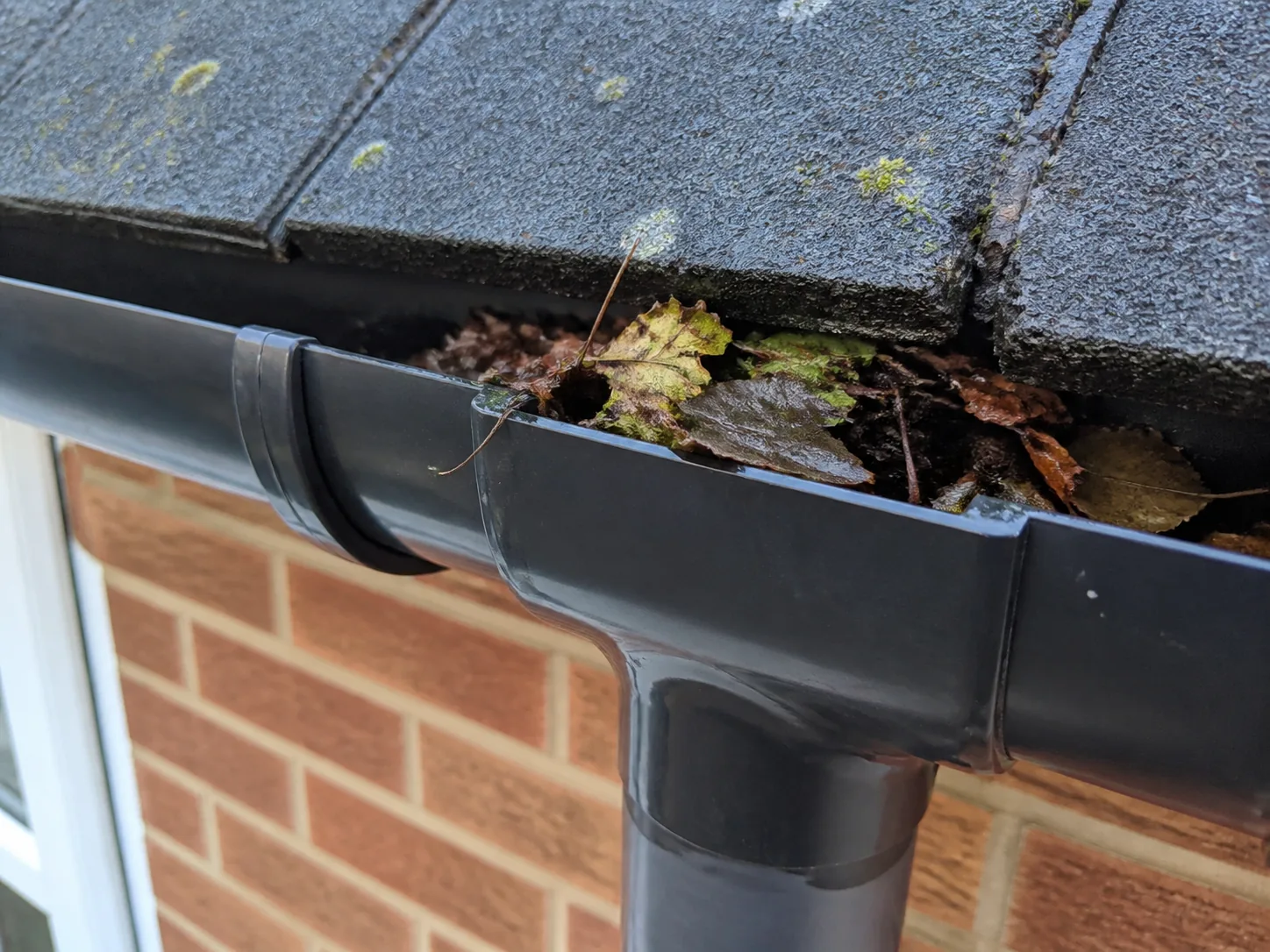
Wet leaves can settle into layers and slow water moving towards an outlet.
Loose roof moss can collect in the channel and hold other material in place.
Small twigs can bridge narrow points and trap lighter debris behind them.
Loose surface material may wash down from the roof during wet weather.
Older material can become dense and reduce the channel available for runoff.
Fine deposits can gather beneath larger debris and close to an outlet.
Local property context
A Leatherhead property may combine a main roof with a porch, rear addition, bay or garage, but the arrangement at the actual address decides the scope. Say which elevations show build-up or overflow and whether any smaller structure is wanted. A channel seen from ground level is not necessarily accessible: planting, walls, narrow side space, lower roofs and changes in ground can affect the approach. Listing each run gives a much clearer basis for agreement than asking for every gutter without describing the layout.
The position of a symptom can help separate routine cleaning from another problem. Water crossing the rim beside a clump of leaves may improve when that reachable material is removed. Drips from a joint, persistent pooling in an empty channel or slow discharge after an outlet entrance is open may instead point to damage, poor fall or a concealed restriction. The clean concerns ordinary contents in the selected channels. It does not mend components or trace water through the downpipe and below-ground connection.
Access is considered for each requested elevation. An open driveway does not establish the position behind an extension or through a side passage. Mention locked gates, shared routes, sloping ground, conservatories and detached structures so the practical boundary can be agreed before attendance.
| Property situation | Access or gutter consideration |
|---|---|
| Homes with projecting bays | The short bay channel may have a separate outlet and should be named if it needs attention. |
| Properties with rear additions | The lower addition gutter and original upper run may present different access conditions. |
| Houses beside narrow boundaries | Working space can change between elevations even when all roof edges are visible. |
| Homes with detached garages | Garage rooflines are considered only when their required sides are included in the request. |
Seasonal context
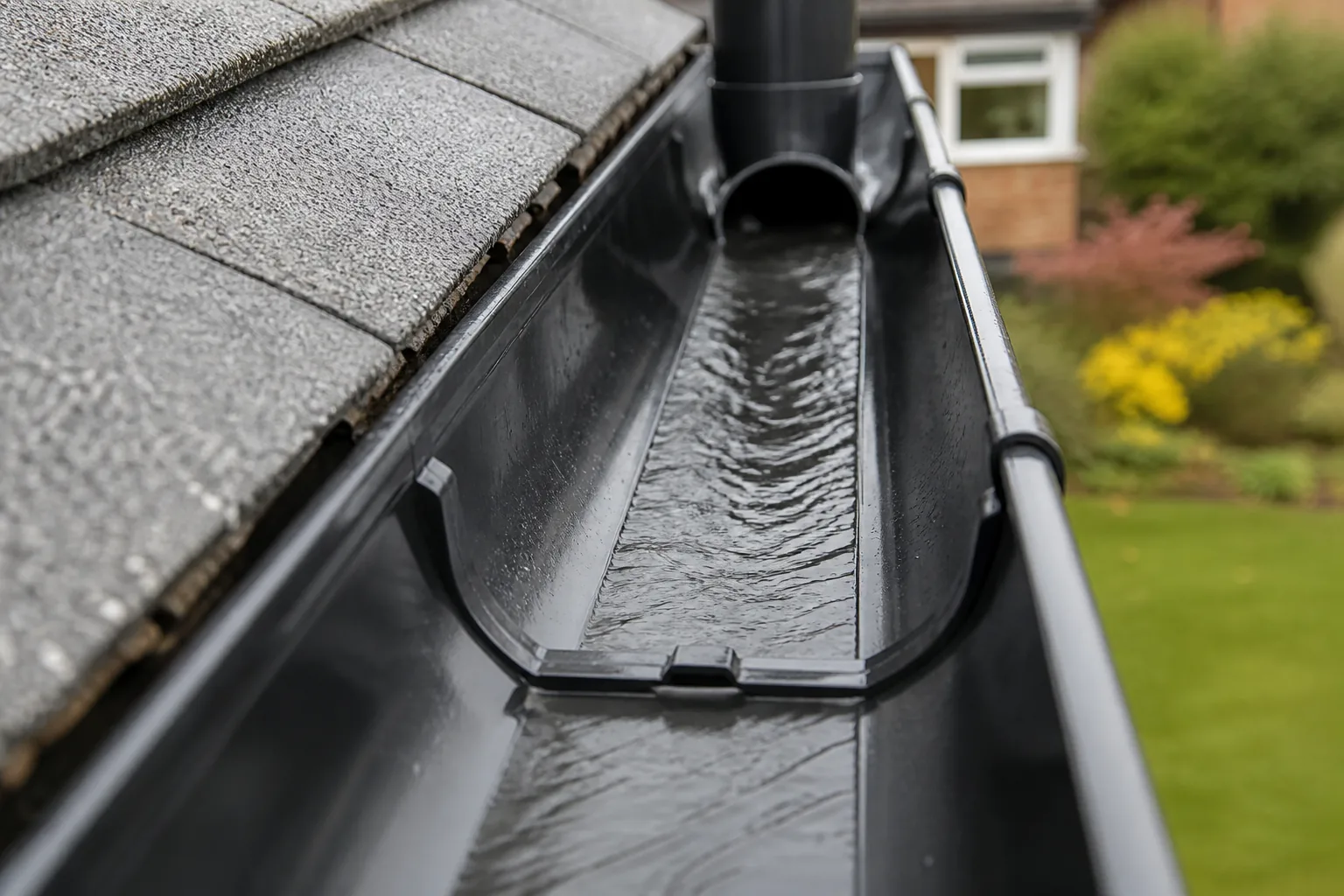
Leaf fall is an obvious prompt, but seeds, loose moss and wind-carried grit can accumulate in other months. Sheltered corners and exposed edges may collect material at different rates. Use visible build-up and the way rainwater behaves at this property to guide future checks.
Nearby trees, roof moss, gutter shape and exposure can all affect how quickly material accumulates. A visible symptom is more useful than applying one fixed timetable to every address.
Quick answers
It covers leaves, loose moss, silt, seeds and similar everyday debris inside agreed accessible channels. Fixed objects, damaged parts and restrictions hidden within pipework need a different assessment.
Yes. Identify the exact elevation and any connected short section wanted. Other sides, garages and lower rooflines are not included automatically, even when they appear to form one system.
Loose debris at a reachable outlet mouth can be removed when that point is agreed. The service does not continue through the concealed downpipe, bends or underground drain.
No. Removing a nearby build-up may reduce backed-up water, but it cannot renew a seal, close a crack or secure a loose fitting. Those are repair tasks.
The available width, gates, boundaries and changes in ground may determine whether a requested run is reachable. A description helps set expectations before the actual address is assessed.
List the required elevations, building levels, smaller roofs, visible debris and surrounding obstacles. Also mention shared access or known defects so cleaning and separate concerns are not confused.
A clear service sequence
Leatherhead service area
Nearby gutter-cleaning pages
Before booking
Routine work excludes repairs, realignment, concealed downpipe clearance, underground drainage and any roofline that is unnamed or inaccessible under the agreement. It is limited to ordinary debris in selected accessible channels and reachable outlet mouths specifically included.
Yes. A shallow bed can reduce the open depth and hold moisture even when few leaves are visible. Accessible settled material can be removed during the clean, although slow flow afterwards may indicate another cause.
Not necessarily. Leaves near the corner may be responsible, but a damaged fitting, unsuitable fall or restriction lower in the rainwater route can create a similar symptom. Cleaning cannot guarantee correction of those separate issues.
No. The extension's depth, position and surrounding space all matter. Its roof must not be assumed to provide an approach. Describe both the upper channel and lower roofline so each can be considered on its own.
Persistent water may relate to the channel fall, supports, outlet position or an obstruction farther down. Once the agreed channel and reachable entrance are open, these possibilities require a separate inspection or repair scope afterwards.
Guards change how debris collects and how the channel can be reached. Mention their type and location in advance. Inclusion depends on the actual arrangement and should not be assumed from an ordinary open-channel cleaning request.
Yes. A porch often has its own short runs and outlet, so it can gather material independently of the main roof. Naming the relevant edges makes clear whether it forms part of the agreed work.
No. Permission and route availability must be settled before the visit. State which elevation depends on adjoining or communal space. Without an agreed approach, that section may need to remain outside the proposed cleaning scope.
No interval suits every address. Exposure, surrounding planting, roof condition and individual catch points influence accumulation. Watch for visible contents, delayed discharge and overflow, then arrange future checks around the behaviour of the particular roofline.
No. Clearance removes the weight of routine debris but does not reposition brackets or restore the intended fall. A visibly bowed run or recurring pool in an empty channel should be considered for separate repair.
Discuss the actual roofline
The likely charge depends on the total channel length requested, the number of distinct levels, the space around each run and the amount and density of debris. Short separated gutters can require individual consideration. Repair work and investigation beyond a reachable outlet are scoped independently.
