
Leaves
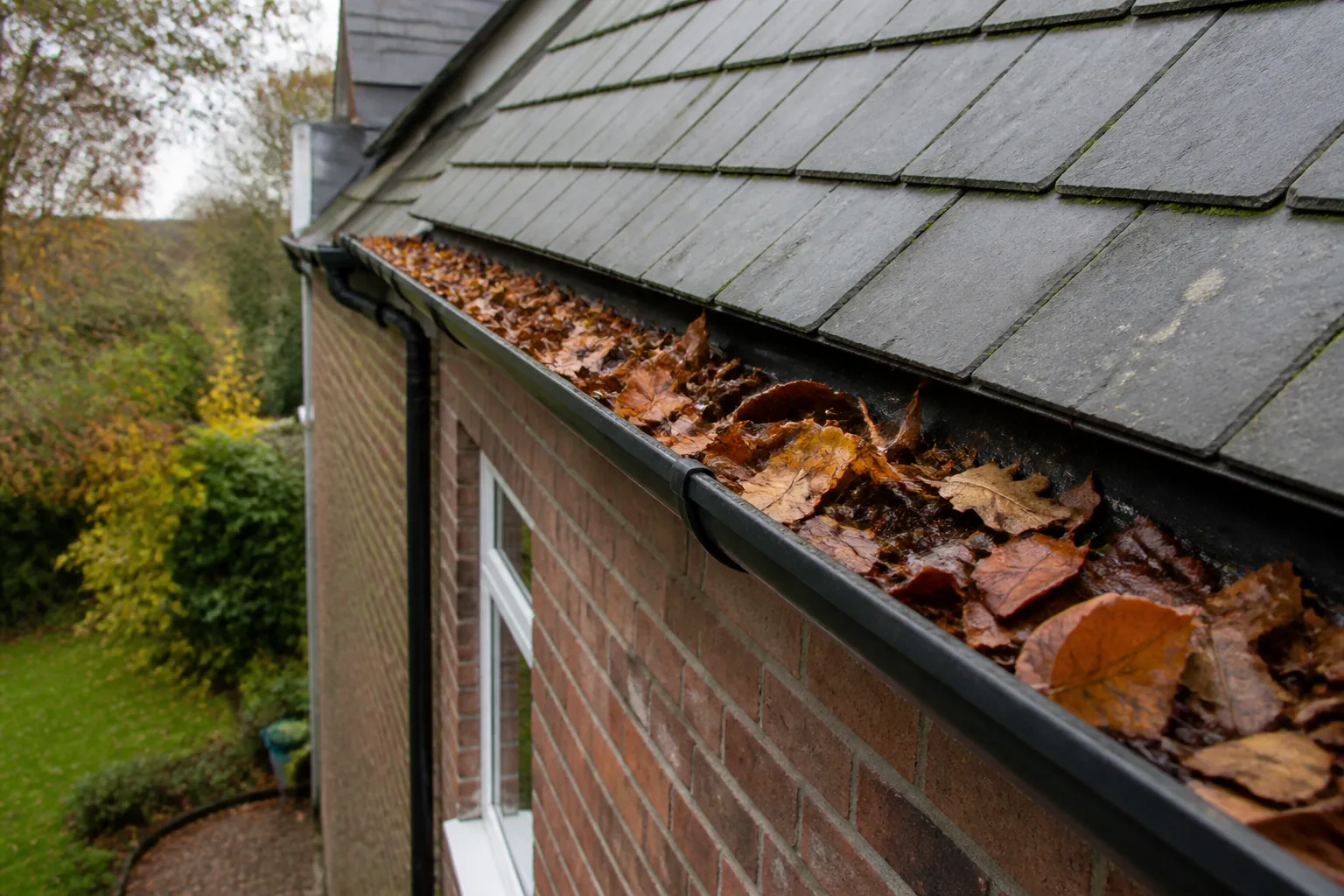
Wet leaves can settle into layers and slow water moving towards an outlet.
Rainwater routes · access · clear scope
Blocked gutters can send rainwater over the edge or leave damp marks around vulnerable areas. Our gutter cleaning service in Richmond focuses on accessible, agreed channels, routine debris and reachable outlets where included. The visit is scoped around the actual property, with any repair, deeper downpipe issue or specialist access considered separately.

Common causes
Leaves, moss, silt and small pieces of routine debris can reduce the space available for rainwater. Build-up often gathers near outlets or in sections where material settles. Cleaning is intended to remove that accessible accumulation; a blockage farther inside a downpipe needs separate assessment.

Wet leaves can settle into layers and slow water moving towards an outlet.
Loose roof moss can collect in the channel and hold other material in place.
Small twigs can bridge narrow points and trap lighter debris behind them.
Loose surface material may wash down from the roof during wet weather.
Older material can become dense and reduce the channel available for runoff.
Fine deposits can gather beneath larger debris and close to an outlet.
Local property context
Homes in Richmond may differ in height, roofline, extensions and the amount of room available around the building. Some properties may have conservatories, side returns or planted areas that affect how an agreed section can be reached. Others may have straightforward channels but an outlet hidden by accumulated leaves or moss. The useful starting point is the individual address, not a general assumption about the area. We consider the sections requiring attention and explain whether they fall within routine cleaning before work is arranged.
Rainwater problems do not always begin in the visible gutter channel. Water spilling at one point could be caused by local debris, an outlet restriction, a displaced fitting or a deeper downpipe concern. Routine cleaning covers accessible agreed channels, leaves, moss, silt and similar build-up, plus reachable outlets where agreed. It does not automatically include repairs, concealed pipework or underground drainage. Keeping those boundaries clear helps homeowners understand what can be dealt with during a standard visit and what needs a separate assessment.
Access depends on the building rather than the postcode. Height, roofline, extensions, neighbouring boundaries, conservatories and ground conditions may all affect which sections are safely reachable. Any part requiring specialist access is discussed separately instead of being assumed within routine cleaning.
| Property situation | Access or gutter consideration |
|---|---|
| Terraced home | Rear access, shared boundaries and roofline continuity may affect which gutter runs can be reached. |
| Semi-detached property | Side access and extensions can make one elevation simpler to reach than another. |
| Detached house | Multiple elevations and roof levels may increase the number of sections requiring assessment. |
| Flat or converted building | Responsibility, permission and access arrangements should be confirmed before a visit is booked. |
Structured service guide
| Item | Routine position |
|---|---|
| Accessible agreed channels | Included |
| Leaves, moss and silt | Included within those channels |
| Reachable outlets | Included where agreed |
| Deeper downpipes | Separate assessment |
| Repairs or underground drainage | Not part of routine cleaning |
Structured service guide
| Situation | Likely route |
|---|---|
| Loose debris restricting a channel | Routine cleaning |
| Moss gathered around a reachable outlet | Cleaning where agreed |
| Leaking or separated joint | Repair assessment |
| Cracked or displaced gutter section | Repair assessment |
Structured service guide
| Factor | Why it matters |
|---|---|
| Total gutter length | Changes the cleaning scope |
| Height and roof levels | Affects access assessment |
| Extensions or conservatories | May restrict an elevation |
| Debris amount | Influences the work involved |
| Outlet attention | Must be included in the agreement |
Structured service guide
| If the home has | Confirm |
|---|---|
| A rear extension | Whether it sits beneath an affected run |
| Shared side access | Whether entry and permission are arranged |
| Several rooflines | Which channels need cleaning |
| A suspected pipe blockage | Whether the issue is below the reachable outlet |
A clear service sequence
Seasonal context
Fallen leaves can make autumn an obvious time to check gutters, while moss and silt may accumulate gradually at any point in the year. A practical schedule reflects nearby vegetation, roof condition and previous build-up rather than relying on one fixed interval for every home.
Nearby trees, roof moss, gutter shape and exposure can all affect how quickly material accumulates. A visible symptom is more useful than applying one fixed timetable to every address.
Quick answers
It covers accessible, agreed gutter channels containing leaves, moss, silt and routine debris. Reachable outlets can be included where agreed, while repairs, deeper downpipes and underground drainage are considered separately.
No. Debris is a common cause, but overflow can also relate to a fitting, gutter alignment, a deeper pipe restriction or connected drainage. The cause determines whether separate work is needed.
That depends on access and the arrangements agreed beforehand. Gates, parking controls, shared areas or permission requirements may need attention, so it is best to confirm the practical details when booking.
Repairs are outside routine cleaning. If a joint, bracket, channel or fitting appears damaged or displaced, that issue can be identified for separate consideration rather than treated as included debris removal.
There is no single interval for every home. Nearby trees, roof material, previous moss build-up and the way rainwater flows can all influence when another check would be sensible.
Building height, roof levels, extensions, conservatories, boundaries, planting and ground conditions can all matter. The reachable scope is based on the actual address and agreed before routine cleaning proceeds.
Richmond service area
Nearby gutter-cleaning pages
Before booking
Routine cleaning is intended for leaves, moss, silt and similar loose build-up within accessible, agreed channels. Reachable outlets may also be cleared where included. Hardened material, concealed obstructions or anything beyond the agreed scope may require another assessment.
Material may have collected near an outlet or at a low point, but a displaced joint, channel alignment or a restriction below the outlet could create a similar result. Looking at the affected section helps distinguish routine debris from a separate fault.
A reachable outlet may be included when agreed, but a blockage deeper inside the downpipe is not automatically part of routine gutter cleaning. Its position and accessibility need to be assessed before any separate work is proposed.
An extension can change access to that elevation, particularly where it projects beneath the channel or limits the usable space nearby. The property layout should be explained beforehand so the reachable sections and any specialist access need can be considered.
Staining can follow repeated overflow, but it may also relate to a leaking joint, a damaged fitting or another water source. Cleaning helps when routine build-up is responsible, while defects and unrelated moisture causes need separate attention.
No. Clear gutters support normal rainwater flow, but damp can have many causes involving the roof, walls, plumbing, ground conditions or ventilation. Cleaning should not be presented as a cure unless gutter overflow is actually contributing to the problem.
The amount and arrangement of guttering, property height, access around the elevations and expected debris all influence the work involved. Details about extensions or restricted areas help define the scope, so a general area price would be misleading.
Shared or continuous rooflines may require responsibility and permission to be clarified before work begins. The agreed sections should be unambiguous, especially where a channel crosses a boundary or access depends on a neighbouring area.
A check can be useful after substantial leaf fall or when overflow has appeared during rain. Properties near vegetation or with recurring moss may need attention at different times, so previous build-up is a better guide than a universal calendar date.
The inaccessible section remains outside the routine scope and should be discussed clearly. If specialist access might be appropriate, that requirement is assessed separately rather than promised as part of the original gutter cleaning arrangement.
Discuss the actual roofline
The likely cost depends on the amount of guttering, building height, access around each elevation, debris level and whether outlets need attention. A simple run is different from several rooflines or awkward sections, so the actual property details matter more than a generic figure.
