
Leaves
Wet leaves can settle into layers and slow water moving towards an outlet.
Rainwater routes · access · clear scope
Water appearing below a roof edge does not always reveal where its journey was interrupted. For Enfield properties, gutter cleaning covers routine debris in accessible agreed channels and reachable outlets where included. We distinguish that work from failed fittings, obstructions deeper in a downpipe and underground drainage concerns, so the next step matches the likely part of the route.
Structured service guide
| Stage | Treatment |
|---|---|
| Accessible agreed channel | Loose debris cleared |
| Reachable outlet mouth | Cleared when included |
| Concealed downpipe length | Further assessment |
| Below-ground drainage | Separate service |
| Broken rainwater component | Repair assessment |
Structured service guide
| Possible cause | Route |
|---|---|
| Leaves blocking a channel corner | Routine cleaning |
| Moss across an included outlet | Routine cleaning |
| Joint pulled apart | Repair consideration |
| Channel visibly out of position | Repair consideration |
| Restriction inside the pipe | Separate blockage assessment |
Structured service guide
| Input | Effect on planning |
|---|---|
| Affected run and elevation | Defines the requested area |
| Total included channel length | Shows the cleaning quantity |
| Height and structures below | Shapes access assessment |
| Likely debris concentration | Indicates work involved |
| Outlet openings requested | Sets the endpoint of routine scope |
Structured service guide
| If you notice | Ask whether |
|---|---|
| Water crossing the gutter edge | Debris is restricting the nearby run |
| Dripping beneath a connector | Cleaning or repair is appropriate |
| Little flow at the pipe base | A deeper assessment is required |
| Overflow only on one roof level | That specific channel is accessible |
Common causes
A channel may look open yet still contain a compacted ridge beside the outlet. Conversely, a full-looking gutter may not explain water emerging lower down. Cleaning removes the agreed accessible accumulation; it does not confirm the condition of concealed pipework or drains beyond view.
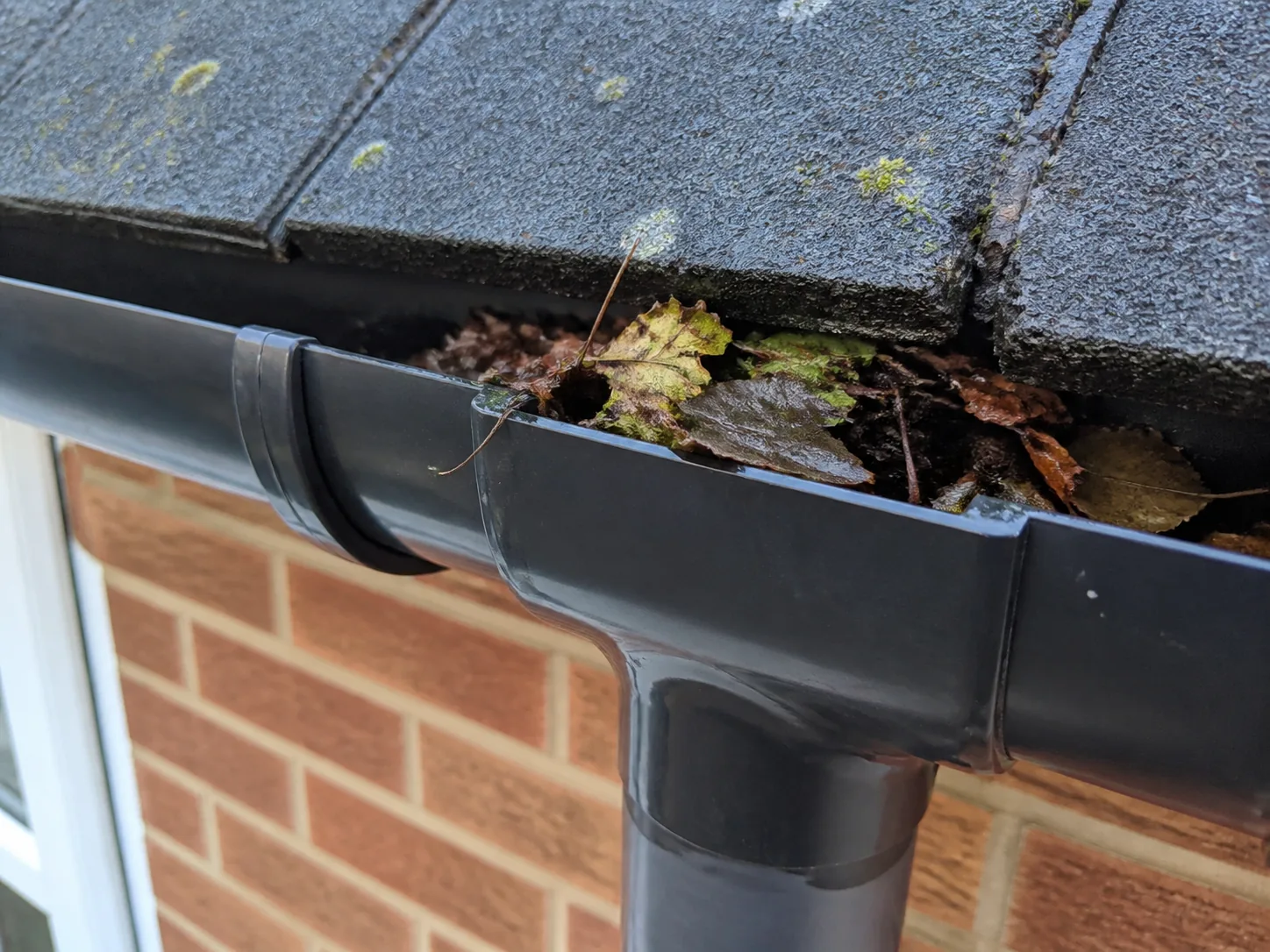
Wet leaves can settle into layers and slow water moving towards an outlet.
Loose roof moss can collect in the channel and hold other material in place.
Small twigs can bridge narrow points and trap lighter debris behind them.
Loose surface material may wash down from the roof during wet weather.
Older material can become dense and reduce the channel available for runoff.
Fine deposits can gather beneath larger debris and close to an outlet.
Local property context
At an Enfield home, rainwater may spill over a channel, drip at a connection or appear near the base of a downpipe. Each observation points to a different part of the route but does not establish the cause by itself. Loose material could be restricting the channel or reachable outlet, while a displaced fitting or deeper obstruction may create a similar result. Describing when and where the symptom appears, together with the affected elevation and roof level, gives a more useful starting point than simply reporting that the gutters seem blocked.
Routine cleaning is deliberately limited to material that can be addressed within accessible agreed channels. Leaves, moss, silt and wind-blown residue can be removed, and an outlet opening can be included if reachable and named. The service does not extend automatically through a downpipe or below ground. Nor does it include resealing a joint, correcting a fall or replacing a damaged component. Keeping the rainwater route in stages allows homeowners to understand which part is being cleaned and why a continuing symptom may call for a separate investigation afterwards.
To assess reachability, consider the affected side as well as building height. Locked gates, narrow routes, neighbouring boundaries, lower roofs and additions beneath the channel can change the available approach. A different elevation may therefore have a different agreed outcome at the same address.
| Property situation | Access or gutter consideration |
|---|---|
| Home with several downpipes | Identify which outlet serves the overflowing run rather than assuming every pipe needs attention. |
| Mid-terrace property | Rear entry and continuous neighbouring rooflines may need clarification before defining the channel section. |
| House with a low roof addition | The lower channel and the main eaves can have different access and flow arrangements. |
| Managed flats | The responsible party should confirm the affected elevation, permission and entry to communal areas. |

Seasonal context
Stormy periods can move loose roof material, while autumn may bring a sharper concentration of leaves. Fine deposits and moss can gather gradually between those events. Checks are most useful when based on past behaviour, surrounding vegetation and any new overflow rather than a universal month.
Nearby trees, roof moss, gutter shape and exposure can all affect how quickly material accumulates. A visible symptom is more useful than applying one fixed timetable to every address.
Quick answers
Note the affected elevation, the point where water escapes and whether it occurs only during heavier rain. Mention visible debris, nearby joints and the connected downpipe without assuming which one is responsible.
Leaves, loose moss, silt and similar debris are removed from the accessible channels agreed for the appointment. A reachable outlet opening is included only when that work has been specified.
Water can back up and spill over when debris restricts an outlet, but alignment, rainfall intensity, damage or a deeper pipe problem can also contribute. The symptom needs to be considered carefully.
No. Routine gutter work may cover loose material at an agreed reachable opening. The pipe below that point is concealed, and any suspected obstruction within it requires another assessment.
Not always. Backed-up water can escape near a connection when debris interrupts flow, but a worn seal or separated fitting may be responsible. Cleaning and repair remain separate possible responses.
Water appearing near the base of a pipe may relate to the pipe, its connection or drainage below. That description helps avoid treating an issue outside the gutter channel as routine debris removal.
A clear service sequence
Enfield service area
Nearby gutter-cleaning pages
Before booking
State which side and roof level are affected, where the water crosses the edge and what lies below. If possible, explain whether it occurs in ordinary or only heavier rain. These details support assessment without requiring you to identify the fault.
Yes, when the outlet opening is reachable and included in the agreed scope. This covers loose material at that point only. A blockage farther inside the connected pipe remains outside routine cleaning and needs separate consideration.
A joint may sit there, material may cause local backing-up, or the channel could be damaged or poorly aligned. Cleaning is appropriate for accessible debris, while a defective connection or channel needs a repair assessment.
It suggests organic matter and moisture have remained in the channel, making a check worthwhile. The growth can be removed with routine build-up where accessible, but its presence does not show whether fittings or the downpipe are sound.
A restriction lower along the connected route can contribute to poor discharge, although the visible symptom alone cannot confirm that. Underground drainage is not included in gutter cleaning and should be assessed under a separate, suitable scope.
Explain which area overflows and where both outlets are positioned if known. Reachable openings can be included by agreement, but the cleaning plan should not assume that every connected pipe needs work without a reason.
No. Flow may be difficult to hear, rain may be light, or the channel could direct water elsewhere. Treat it as one observation alongside overflow and visible debris, not as proof of a concealed obstruction.
Requested gutter length, roof levels, practical access, structures below the eaves, accumulation and agreed outlet openings all matter. A separate pipe investigation or repair has a different scope and should not be hidden inside the cleaning quotation.
Yes, if that accessible run is clearly identified and a partial service is appropriate. The homeowner should understand that other channels and outlets remain outside the visit, even when they form part of the same building.
Observe from ground level during rainfall and note where water behaves unexpectedly. There is no need to attempt work at height. Repeated symptoms, visible growth or known accumulation can then guide a sensible request for another check.
Discuss the actual roofline
Cost follows the defined cleaning job: how many channels are requested, their length and level, what lies beneath them, the available entry route, expected debris and included outlet attention. Investigating a hidden restriction or arranging corrective work is priced separately because it is a different task.
