
Door leaf and hinges
The leaf has to meet the frame consistently. Report dropping, rubbing or a changed gap, but leave adjustment to an assessed scope.
Close · lift · turn · test
A UPVC or composite door works as a connected sequence. Describe what happens as the leaf closes, the handle lifts and the key turns so alignment, cylinder, handles and multipoint mechanism can be assessed separately.
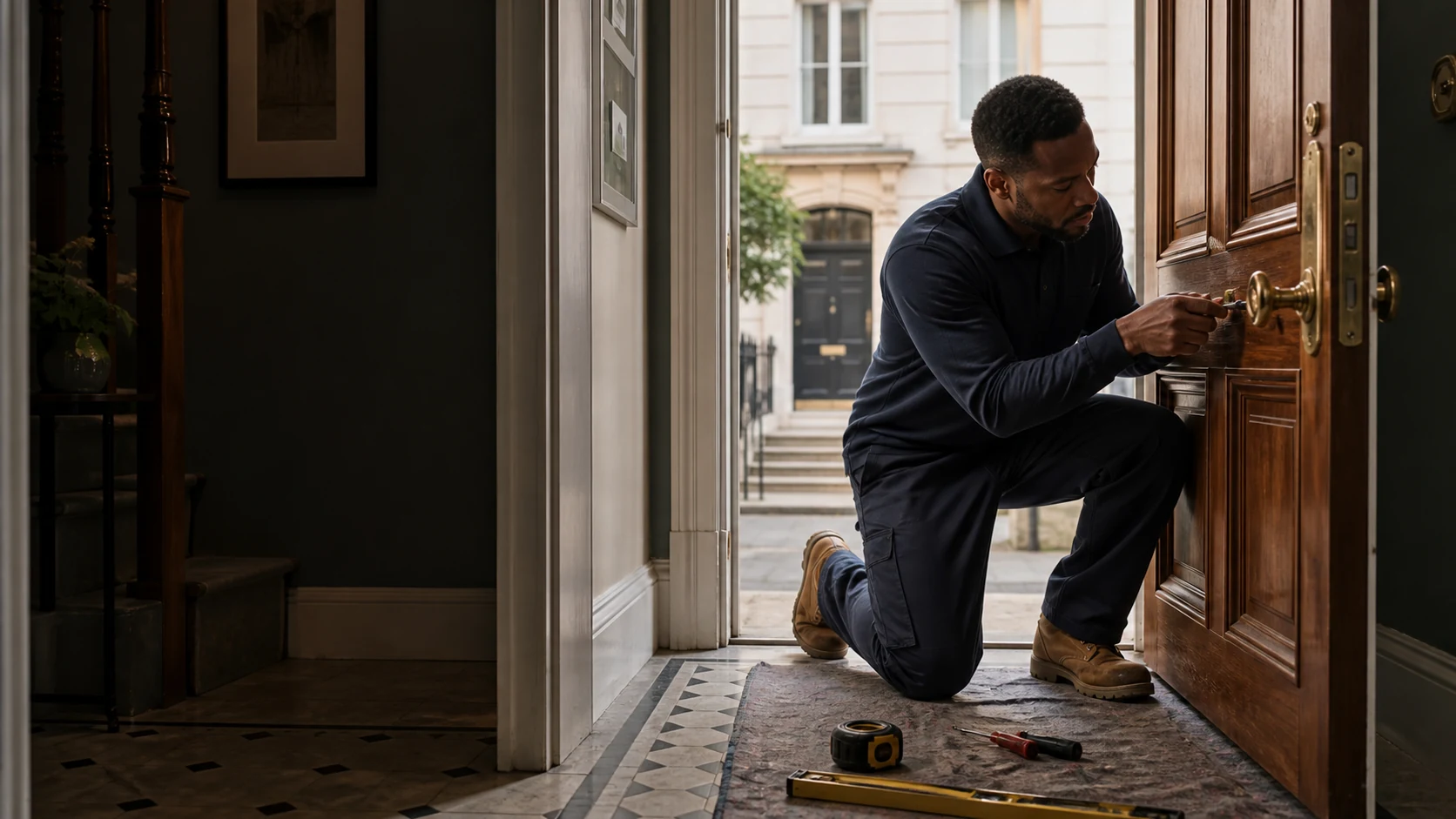
UPVC system triage
Many UPVC and composite entrance or garden doors use a cylinder, lever handles and a multipoint strip with several locking points. The frame contains keeps that receive those points. If the door position changes, the handle may become difficult even though the visible cylinder remains serviceable. Conversely, a key problem can exist while the door and mechanism are aligned. The user’s operating sequence helps the locksmith choose the first checks without pretending to diagnose concealed parts remotely.
If the door is already open and can remain safely open, report whether the handle lifts and the key turns away from the frame. Do not shut an unreliable door simply to perform this test, and do not operate exposed hooks or rollers with fingers. Leave handles, cylinders and faceplates assembled. Safe observations preserve evidence and reduce the chance of turning a serviceable issue into a broken key or failed mechanism.
| What you observe | Useful comparison | Why one part cannot be assumed |
|---|---|---|
| Handle lifts when open but not when closed | Where the door first contacts the frame and whether gentle pressure changes it | Alignment, keeps and mechanism operation interact |
| Handle will not lift in either position | Whether it moves partly, feels loose or stopped suddenly | Handles, spindle, gearbox and strip can produce different limits |
| Handle lifts but key will not complete the turn | Spare-key condition and whether the cylinder turns before engagement | Cylinder, pressure and incomplete locking-point travel need distinction |
| Key turns but the door remains insecure | Latch position, handle return and visible locking-point movement from a safe distance | The key action does not prove every connected point has engaged |
| Door has gradually become harder to close | Recent adjustment, seasonal change, hinge movement or new frame contact | A progressive door-position issue may overload otherwise repairable hardware |
| Outdoor handle or cylinder is visibly damaged | Whole-door photograph and whether the entrance can be kept unused | Visible damage may extend beyond the component shown |
Component boundaries
The leaf has to meet the frame consistently. Report dropping, rubbing or a changed gap, but leave adjustment to an assessed scope.
Hooks, rollers or other points meet fitted keeps. Loose, damaged or badly positioned keeps can affect the locking sequence.
Handles transfer movement through a spindle. Looseness, poor return and restricted lift are useful observations, not proof that the handles alone have failed.
The key operates the cylinder, but a turning cylinder can still be connected to a mechanism that is not completing its travel.
The central case and extended mechanism coordinate the locking points. Identification normally needs dimensions and markings from the actual system.
Contact at the bottom or resistance around the leaf can change closing pressure. Do not cut or remove seals as a lock-fault experiment.
Repair without parts guessing
Long faceplates can look alike while dimensions, locking points and gearboxes differ. A useful part enquiry includes the door material, full edge view, handle centres, backset, cylinder dimensions and legible markings where these can be gathered safely. The locksmith may still need to inspect and measure on site before confirming compatibility.
Do not remove the strip or buy a gearbox from a generic photograph. If the door cannot be secured, explain that state during booking and keep the entrance supervised. A temporary security measure and a permanent compatible repair may be separate decisions. Where the door leaf or frame is damaged, a door-repair scope may sit alongside the locksmith work.
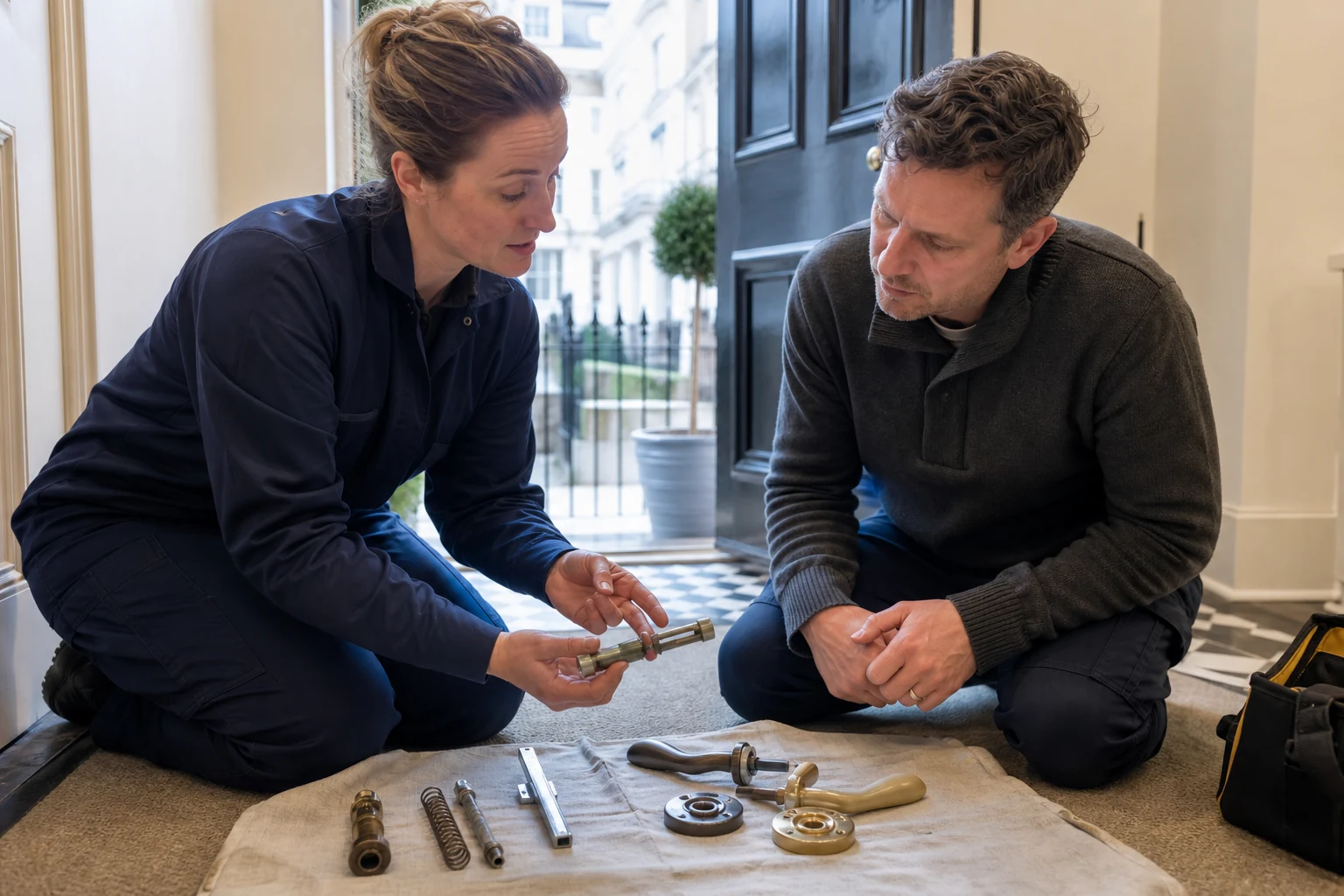
Repair, adjust or replace
| Assessment finding | Work that may be considered | Quotation boundary to state |
|---|---|---|
| Door position prevents locking points meeting keeps | Suitable alignment or keep adjustment after hinges and frame are reviewed | Locksmith adjustment versus wider hinge, frame or door repair |
| Handle set is damaged but connected mechanism is serviceable | Compatible handle replacement and full operation test | Handles only, including finish and fixing assumptions |
| Cylinder is faulty while mechanism travels correctly | Compatible cylinder change with agreed keys | Cylinder specification, dimensions, key count and fitting |
| Gearbox or strip has an identifiable failure | Repair or compatible component replacement where viable | Identification, labour, parts and alignment correction |
| Several components are worn or no compatible route is confirmed | A broader replacement proposal supported by on-site evidence | What remains, what changes and any door preparation or making good |
No reliable price follows from the area name or the words “UPVC lock”. Access, timing, fault identification, compatible parts, adjustment and any emergency securing all affect scope. Compare quotations only after they cover the same door state and outcome.
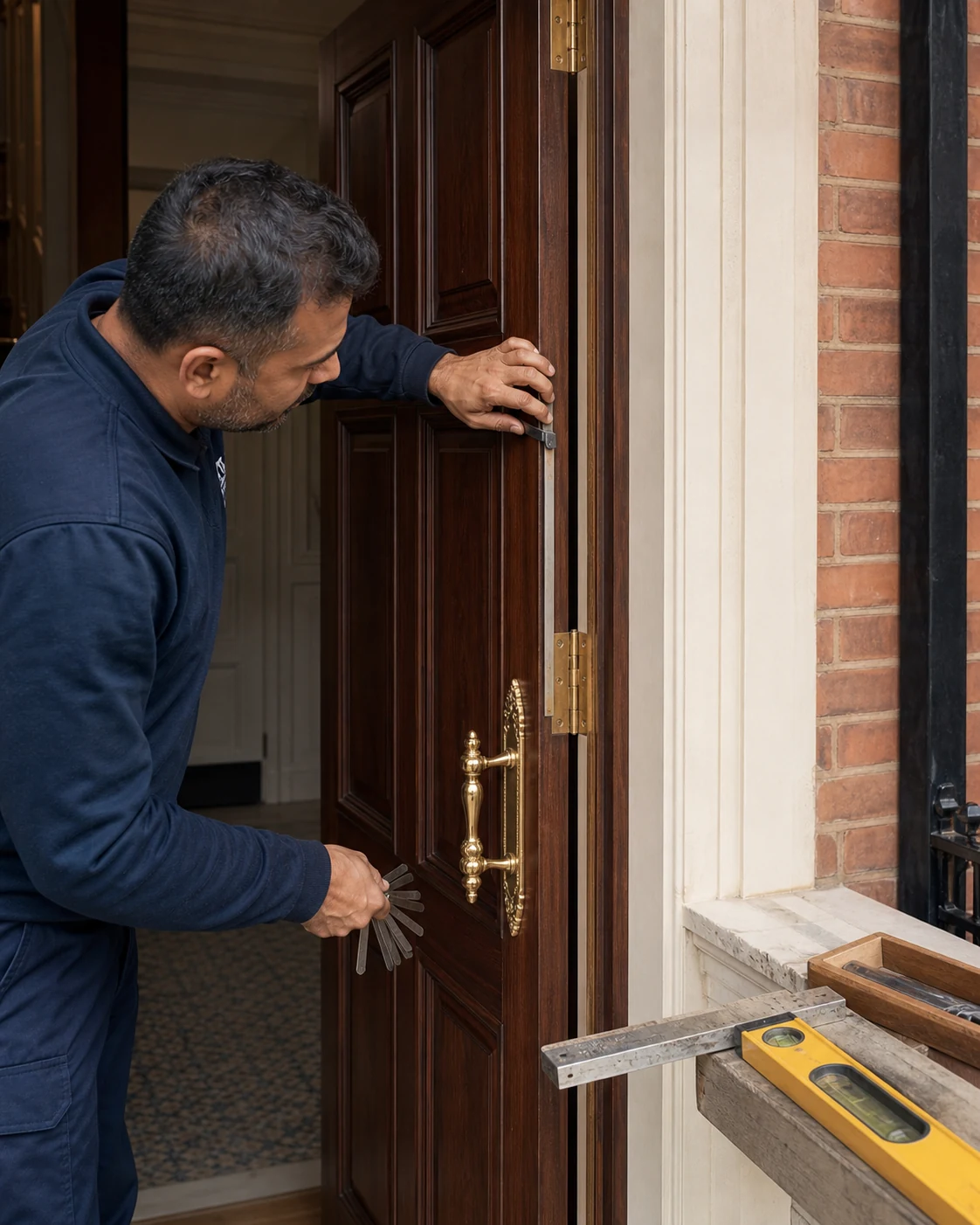
Chiswick property context
Chiswick enquiries can involve family terraces, homes with rear additions, converted flats and apartment developments. UPVC or composite doors may sit at the street entrance, open from a kitchen into the garden or secure a later extension. This context guides the visit but does not identify the mechanism or fault.
For a rear door, explain whether the locksmith can reach both sides without operating the failed entrance. A side passage may be locked, narrow or controlled by another key holder. Move ordinary garden items and furniture from the approach without taking off handles or trim. If the garden door is the only usable route to an outbuilding, include that dependency in the booking.
For a flat, distinguish the private multipoint door from a communal entrance. Managing-agent approval may be needed for common hardware, fire-door decisions or powered access systems. Provide the floor, buzzer, lift or stair route and any contractor procedure so the correct private door can be assessed without changing building-controlled components.
| Door setting | Access detail | Why it matters |
|---|---|---|
| Terrace front entrance | Street approach, internal space and alternative authorised entry | Opening and safe operation need both sides where lawful |
| Rear extension door | Kitchen access, side passage, steps and furniture beside the leaf | The working route may be longer than the garden photograph suggests |
| Garden or patio multipoint door | Exposure, threshold contact and whether the issue changes after closing | Door position and connected hardware should be reviewed together |
| Converted flat | Private entrance, common front door and responsible person for each | One occupier may not authorise shared-door work |
| Managed apartment | Reception process, door records and any access-control boundary | Mechanical private work stays distinct from building systems |
A careful service sequence
Give the door state and the order of handle, key and closing behaviour without choosing a component.
The locksmith checks the leaf, frame, keeps and operating parts within the authorised access.
Adjustment, repair, parts or another door scope is explained before the instruction expands.
Closing, handle lift, locking, unlocking and return are tested through normal safe cycles.
The completion note should identify fitted parts, keys supplied, adjustments made and any remaining door or frame concern. If a suitable component is not confirmed at the first visit, ask for the identification evidence and next proposal rather than an improvised substitution.
Chiswick locksmith FAQ
The difference makes the relationship between door and frame relevant, but it does not prove one cause. Stop forcing the handle and arrange assessment of alignment, keeps and mechanism operation.
Not always. Key condition, cylinder condition and pressure from incomplete mechanism travel can feel similar. The operating sequence should be checked before a part is selected.
A keep change can affect how several locking points engage. Avoid trial adjustments that hide the original position or overload another part; ask for the whole door to be reviewed.
Explain that the entrance cannot be secured and whether another safe barrier or supervised route exists. Do not keep forcing the mechanism or leave the area accessible to others.
Sometimes a compatible component can be identified while the rest remains serviceable. Dimensions, strip operation, alignment and availability need confirmation before that scope is promised.
No. Correct measurement, cam type, door and handle arrangement, desired key control and documented specification matter. A photograph is useful but not a complete order.
The freeholder, managing agent or responsible building party should authorise changes. Powered release, fire-door and shared-key matters may sit outside a resident’s private instruction.
Only when the quotation says so. Ask whether it covers keeps, hinges, mechanism parts, testing and any separate door or frame repair.
Send the whole door, handles, cylinder, complete edge strip and frame keeps from safe positions. Add the side-passage or rear-route view where it affects access.
Nearby coverage
Use the service links for the fault itself and nearby pages that exist in the current editorial set.
Do not let one symptom choose the part
Send the Chiswick address, exact door, access route, safe images and what the leaf, handle and key do in order.
