
Droppings or tracks
Droppings or tracks need their current discovery location.
PEST CONTROL / REIGATE
Keep the old account, but give
the new finding its own date.
After a quieter period, signs should not be dismissed or automatically treated as the same problem. Describe the first new observation and changes to rooms, belongings or access before discussing reassessment.
REIGATE / PROPERTY CONTEXT
For a Reigate coverage enquiry, separate the earlier concern from the event that prompted you to make contact again. The new account should say what changed, not merely repeat the previous pest name.
A useful comparison pairs the old location with the current one: the original kitchen cupboard versus a newly reported hallway mark, for example. This is a way to organise information, not a claim that either location is affected without evidence.
Describe any changes during the interval: different occupants, furniture brought in, rooms brought back into use or repairs already completed. Include only what actually happened and distinguish it from a suspected cause.
If the earlier programme had review instructions, keep those available. Ask whether the present report belongs under that guidance or requires a fresh scope; do not assume either answer before the current circumstances are considered.
03 / OBSERVATION CHECKLIST
A gap in observation is not proof of either clearance or continued activity.
Avoid disturbing suspected waste or concealed spaces to recreate the history.
Droppings or tracks need their current discovery location.
Scratching should have its own date and position.
Damaged packets retain their storage reference.
Bed spotting or shed material differs from skin irritation.
Repeated insects need current dates and product details.
External or nesting activity needs safe description and suitability checked if unknown.
06 / SIGNS → LOCATION → NEXT STEP
| Pest problem | Signs to describe | Areas to mention | Next step |
|---|---|---|---|
| Mice | New cupboard signs | Current storage location | Distinguish old remaining material |
| Rats | Possible rodent evidence | Present indoor or outside area | Supply earlier history separately |
| Bed bugs | Physical bed traces | Current sleeping room | Describe the new finding |
| Cockroaches | Repeated appliance insects | Named equipment | List intervening changes and products |
08 / THE CONTROL PLAN
The earlier account is useful context, not a predetermined conclusion.
Current accessible findings are considered alongside the gap and changes.
The proposed method addresses the supported present problem.
Later observations follow the new review guidance.
09 / FROM FIRST CONTACT
Give the first new observation a clear place in the record.
Supply postcode and the new finding date.
Retain old records without merging the timelines.
Disclose changes and agree reassessment scope.
Follow current preparation and restrictions.
Report later findings accurately.
Keep separate property recommendations explicit.
01 / START WITH THE EVIDENCE
An earlier pest label does not automatically identify a later finding.
Newly noticed droppings or packet damage.
Mice controlPossible rodent evidence at a precise location.
Rats controlPhysical traces around sleeping furniture.
Bed bug treatmentRecurring kitchen insects.
Cockroaches controlMouse enquiries should distinguish new observations from old material that remained visible.
Rat concerns need the current location and separate exterior information, not only the earlier diagnosis.
Bed bug reports require relevant physical signs; symptoms alone cannot settle whether activity has returned.
New appliance-side sightings need dates and details of changes or products since the previous concern.
07 / SCOPE BEFORE A QUOTE
An old quotation does not define new work automatically. Confirm coverage, current findings and the scope proposed now.
from £120
See published service pricingfrom £150
See published service pricing| Service | Pricing basis | Price |
|---|---|---|
| Mice control | Activity, access and programme | Quote after assessment |
| Rat control | Internal / external routes and visits | Quote after assessment |
| Proofing / repairs | Surveyed openings and separate work | Quoted separately |
Guides checked 27 August 2026. Clarify total, review arrangements and separate tasks directly.
05 / PROPERTY BRIEF
Identify whether new signs occur in the same flat rooms.
Name any floor now involved that was not previously mentioned.
Share current resident observations with the authorising contact.
Communal reports remain separately sourced and authorised.
The residential scope should reflect present occupants and access.
Discuss your homeCommercial suitability needs separate confirmation.
Check the premises requirements04 / AT A GLANCE
MAKE THE ENQUIRY SPECIFIC
The incoming resident may know the current observations but not the earlier programme. Keep those sources separate rather than asking them to confirm a history they did not witness.
Name the new room and its use. The old treatment boundary may not describe the current question, so provide the location before asking for the same work again.
State what was altered and whether the relevant area can now be examined. A changed opening or panel is background to assessment, not proof that the repair caused the new concern.
Provide the records that exist and label gaps. A fresh, accurate description is more useful than reconstructing product names or dates from uncertain memory.
10 / PROBLEM → TREATMENT → CONTROL
The review should consider actual observations and the current programme, not a blanket assumption about what happened during the gap.
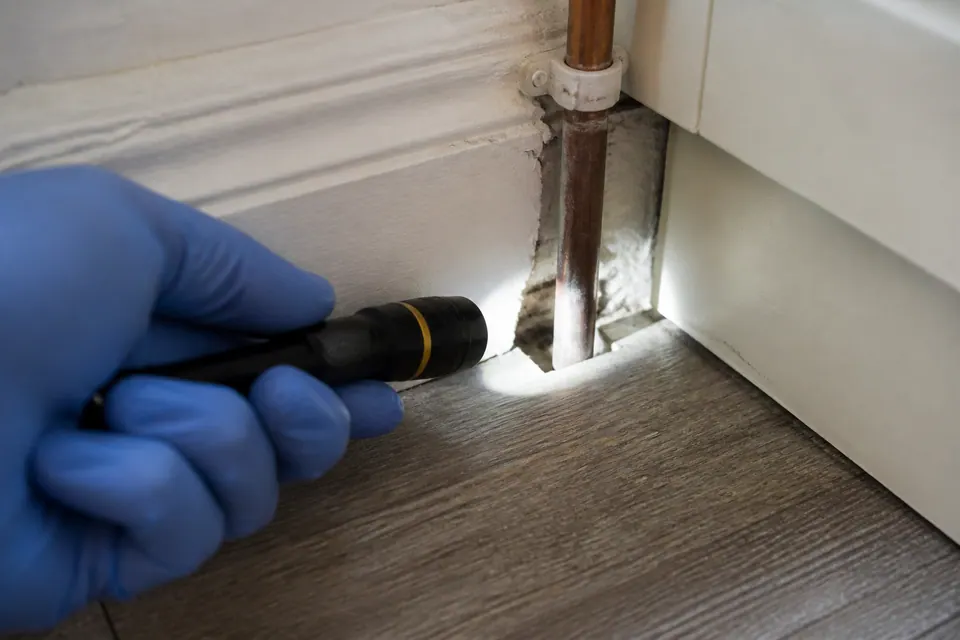

Illustrations are not a Reigate recurrence case or verified outcome.
ADDRESS AND AVAILABILITY
Provide the full postcode and locations of new observations.
Coverage and availability need confirmation for the work now requested.
Open Reigate in Google Maps ↗13 / CLEAR EXPECTATIONS
The earlier label should not replace reassessment.
Property changes should be disclosed accurately.
Instructions should match the programme now agreed.
REIGATE / QUESTIONS
They should describe what they know directly. Attribute earlier information to its source instead of treating it as their own observation.
Give both room references and dates, then explain what the current room is used for. Assessment can consider whether the accounts are related.
Not necessarily. Describe the access change without turning it into a causal conclusion.
Keep them available and ask how the present report should be handled in relation to that programme.
Do not assume identification from the earlier label. Describe the current finding on its own merits.
No. Record the interval honestly, including the limits of how often the area was observed.
Mention the arrival and where it was placed, but do not claim it introduced a pest without evidence.
The current scope needs confirmation; an earlier included area does not automatically extend to a new one.
Label dates and locations clearly so a historic image is not mistaken for current evidence.
Ask what the new evidence supports and whether the next step is review under existing guidance or a separately agreed assessment.
15 / TAKE THE NEXT STEP
Check coverage with the postcode, current evidence and earlier record. Describe intervening changes before further work is agreed.
