
Does an old quotation still cover the new outline?
Ask for the current extent and conditions to be reviewed. A previous area description should not automatically include later changes or different materials.
Forest Hill / PROPERTY CONDITION
Describe how the outline changed without assuming why.
A Forest Hill corner enquiry becomes clearer when the current boundary can be compared with an earlier view. Include both adjoining surfaces, keep the dates and allow for different lighting or camera distance. A changing outline is useful evidence, not proof of one moisture source or identical finishes.
Current extent · earlier view · two surfaces
Forest Hill / THE PROPERTY BRIEF
The current extent matters more than an old estimate.
Send the present view with any reliable earlier image and explain the interval. Show both surfaces forming the corner, noting different finishes or known work between observations. Ask how the current extent affects assessment before relying on an older quotation or assuming the same area is involved.
02 / DIRECT ANSWERS
Ask for the current extent and conditions to be reviewed. A previous area description should not automatically include later changes or different materials.
Do not alter the finish to create a comparison. Keep dated images with a fixed room reference and discuss the existing condition before cosmetic work.
Not by itself. The evidence needs to be considered alongside viewpoint, material and reliable history rather than treated as a complete diagnosis.
The current scope and access may differ. Ask for a proposed duration after the present condition has been reviewed.
Appearance is not a return instruction. Follow the guidance for the agreed treatment method and circumstances.
Explain that difference and retain the original images. Do not rely on darkness alone to describe a larger affected area.
A fixed window feature can help orientation, but any separate window concern should be labelled rather than automatically added to the treatment scope.
No. A visual record informs the enquiry but does not identify or repair the source; further assessment may need its own scope.
Forest Hill / ACCESS & PEOPLE
Explain whether camera distance or lighting differs. A larger-looking crop does not automatically establish growth over a larger area.
Identify furniture or storage moved between images. Newly exposed material should not be described as newly affected without supporting history.
Keep each side of the corner’s finish distinct, including any damage or redecoration. A shared junction does not mean the coatings have the same condition.
Tenants can share dated images and explain uncertainty without recreating an earlier appearance. The enquiry does not require disturbing the finish or deciding responsibility.
Landlords can supply confirmed maintenance or decorating information for the interval. Avoid interpreting the image difference as proof that one earlier task failed.
Homeowners should ask whether the new view changes the proposed scope. An older area estimate should not automatically define work when the visible extent or access is different.
04 / A CONTROLLED APPROACH
Review the present boundary and both materials with the dated history. Identify what has actually changed and what remains uncertain because of viewpoint or access.
Agree preparation for the current layout. Do not assume an earlier clear view means the same access can still be provided.
Carry out suitable work within the confirmed present scope. A changed boundary should not be silently handled as though the old area description remains complete.
Explain the reviewed result and how any later observation should be recorded. Keep residual staining, material damage and source questions separate from a visual comparison alone.
The schematic is not proof that a changing outline has one cause or that every visible difference represents new growth.
Retain the dated view with a fixed room reference.
Use the boundary and materials agreed for the current work.
Record the result without altering the earlier evidence.
These illustrative stages are not customer comparative photographs. A visual change does not by itself certify the moisture condition or a permanent outcome.
05 / QUOTATION, NOT GUESSWORK
Provide the present extent before relying on a previous estimate. Photographs may support a suitable defined area, while recurrence, different materials or uncertain limits can require assessment. The quotation should reflect what is currently visible and accessible, not only an older image.
See the main mould-removal service ↗| Scope | Quotation basis | Difference to clarify |
|---|---|---|
| Suitable area with a clear present boundary | Photographs may support pricing | Identify current dimensions and each finish |
| A returning or apparently extended outline | Assessment may be needed | Allow for viewpoint and access differences in the evidence |
| Damaged material or unresolved extent | Specialist quotation may be required | Keep further investigation or replacement separately agreed |
Confirm the current total and exclusions. An earlier photograph or quotation should not imply that all later changes, additional material or repair work are automatically included.
06 / ROOM-BY-ROOM CONTEXT
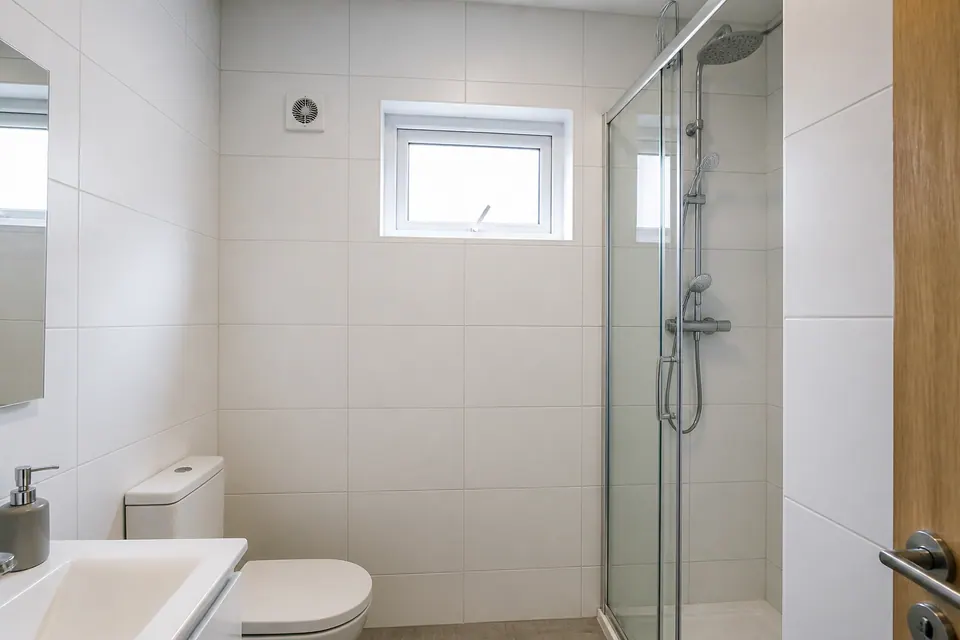
For a bathroom corner, identify the finishes and when the image was taken relative to use. Appearance can differ without establishing a new affected extent.
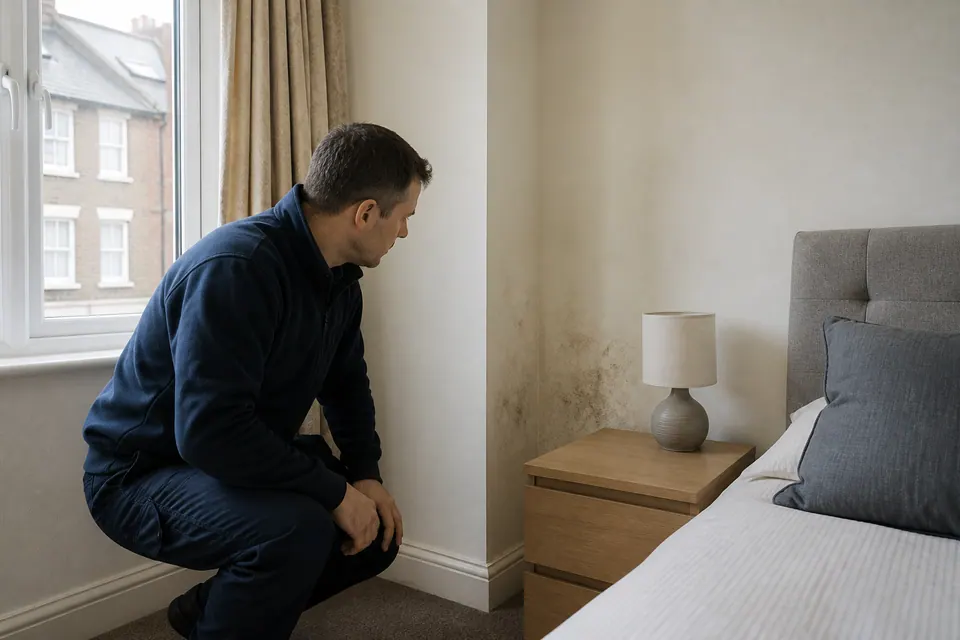
For a bedroom, explain furniture changes between views. A newly visible strip should not automatically be called newly developed growth.
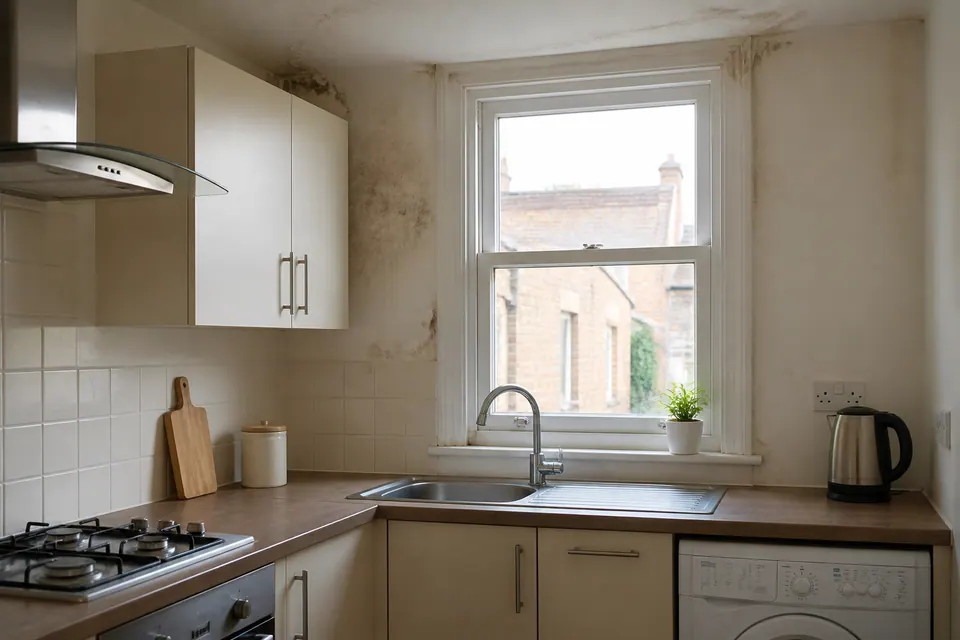
For a kitchen, retain a fixed unit or doorway in the wider image. Keep any plumbing history distinct from the visual comparison.
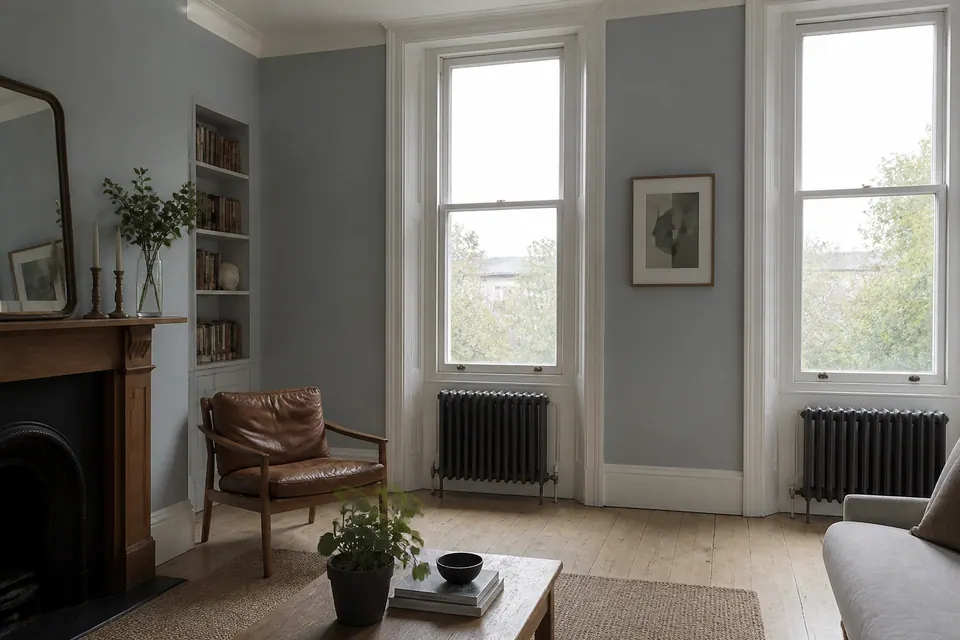
For a living room, show both sides of the corner rather than comparing isolated crops. Material differences can matter even where the outline appears continuous.
If a shared area appears in the evidence, keep its permission and scope separate. A comparison photograph does not establish authority to treat it.
For lower-ground rooms, include reliable water history alongside the outline. The shape of a patch does not identify the source or suitability of the material.
07 / WHEN IT COMES BACK
Describe whether the boundary appears fixed, extended or visible on another finish, allowing for the limits of the photographs. Keep the original images rather than relying only on cropped comparisons.
Continuing moisture can contribute to a returning or changing patch, but the outline alone does not identify the source. Known water events, material condition and the timing of work remain separate parts of the assessment.
Do not wipe or scrape a border to make it easier to measure. Use existing room references and describe uncertainty instead of creating an artificial before-and-after view.
08 / SEPARATE THE QUESTIONS
Treat the comparison as one part of the evidence. A shift in apparent size can prompt useful questions while lighting, framing, material and intervening work still need to be considered.
| Visible issue | Possible contributing factor | What may need checking |
|---|---|---|
| A corner mark extends beside a window | Moisture near the reveal may be relevant | Keep glass observations separate from the wall comparison |
| A bathroom corner appears darker in a later view | Repeated wetness may contribute | Consider timing and lighting before calling it a larger area |
| A boundary changes after recorded work | Past or continuing moisture may matter | Clarify the actual task and current material condition |
| The outline returns on an adjoining finish | An ongoing contributor may remain | Review both surfaces without assuming one diagnosis |
Leak work, ventilation changes, material replacement and further investigation require separate agreement where relevant. A documented outline should not imply those tasks are included in treatment.
Mould describes fungal growth and damp describes excess moisture. The shape of a mark alone does not establish either its source or the condition behind the visible finish.
| Question | Mould | Damp |
|---|---|---|
| The condition described | Growth on an identified surface | Excess moisture affecting material or surroundings |
| Useful evidence | The current outline and material condition | Known water history and observed wetness |
| A possible relationship | Growth can recur where moisture persists | Moisture may contribute without producing a diagnostic outline |
| The next decision | What suitable area belongs in the present work? | Does a source question require further assessment? |
09 / LOCATE THE ISSUE
Choose the setting and show the boundary within its surroundings. A comparison needs enough context to distinguish a real visible change from a different camera view.
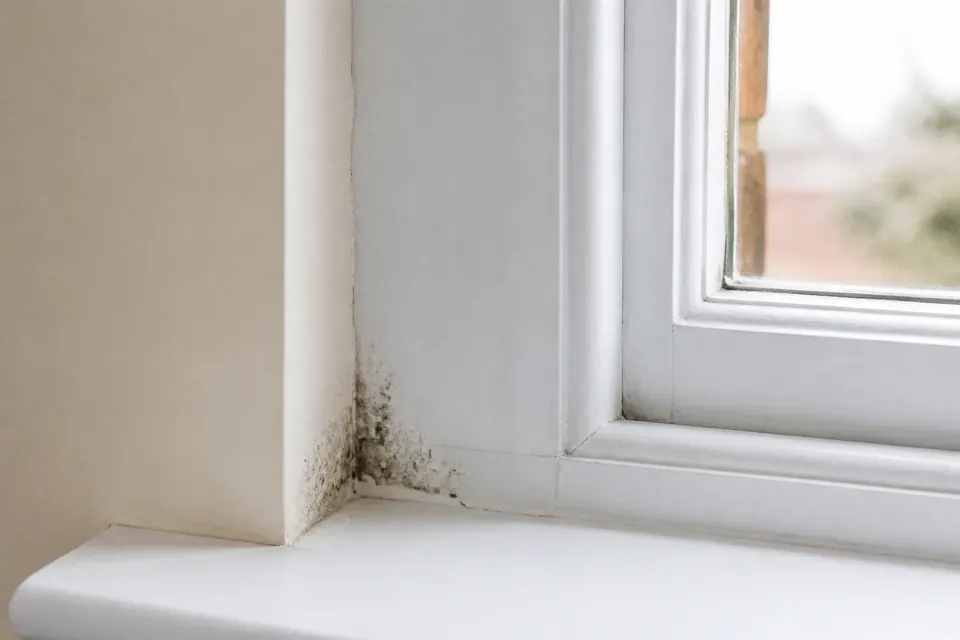
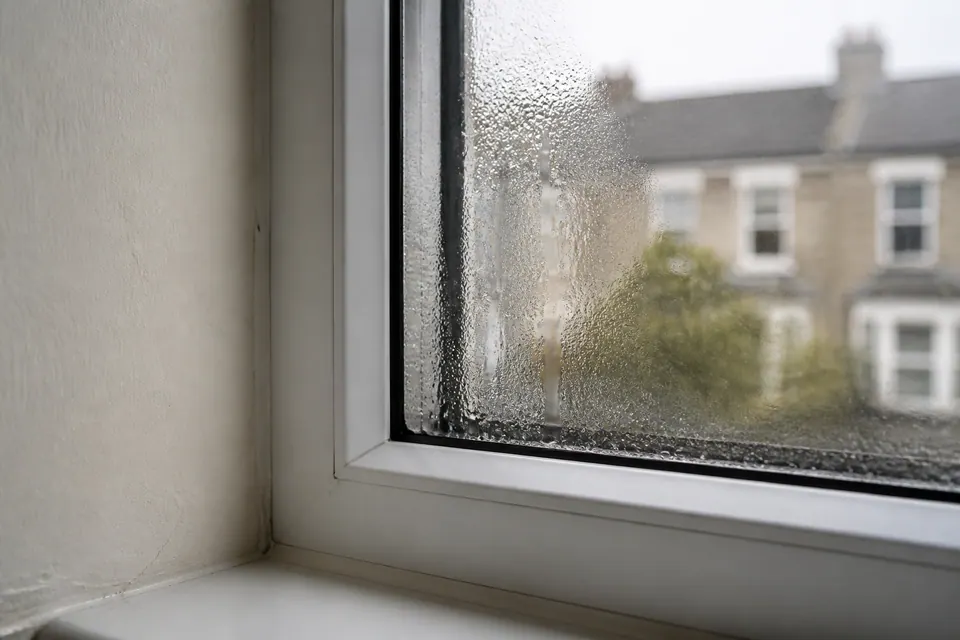
Keep the sill or frame edge in both images where possible. Water observed on the glass is a separate detail and should not automatically explain a change in the wall outline.
Show each side and identify the coating or component involved. A darker image after room use should not alone be described as a larger affected area.
Explain any difference in furniture position between the photographs. A newly visible portion is not necessarily a newly developed condition, and the unseen extent should remain uncertain.
Include a fixed unit or doorway as a reference and keep any confirmed plumbing event separately dated. Do not use proximity to a fitting as proof of the source.
Use a wider view to show where the outline sits on both walls. A tight crop can make a similar boundary appear different because its scale is unclear.
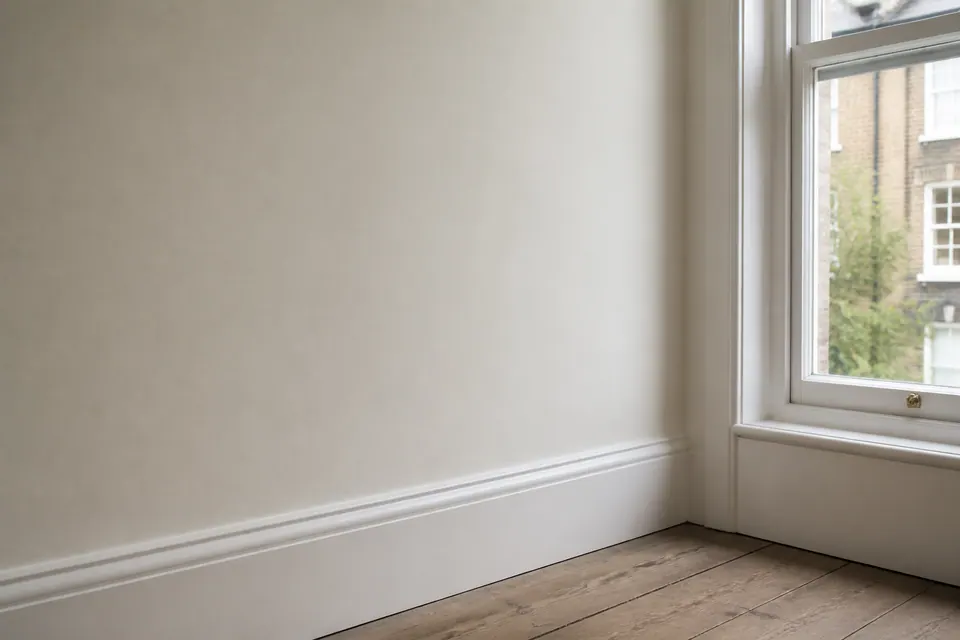
Describe the finishes independently and mention any damage without touching the edge. A change on one material should not be automatically attributed to the adjoining surface.
State what is visible in each view and whether access changed. Do not move affected contents merely to reproduce an old photograph or assume the hidden area follows the same outline.
A comparison can support an assessment without proving a cause. Keep uncertainty about lighting, scale, access and material visible instead of presenting the photographs as a definitive diagnosis.
Forest Hill / PLAN THE APPOINTMENT
Send the postcode, present corner image and any earlier dated view. Explain changes in access or decorating so the proposed visit is based on the current room rather than an outdated arrangement.
Identify the person who can explain the interval and any confirmed work between observations.
View the Forest Hill area map.
Forest Hill / BEFORE BOOKING
Use the photographs to explain the observation without asking them to prove more than they show.
A similar viewpoint and fixed room feature can help comparison where safely available. Explain differences rather than altering the surface or moving affected items to force a match.
Keep it with its date and explain the limitation. Do not treat the apparent scale as a precise measurement of the earlier area.
Do not change the finish simply to create a record. Use photographs and existing features to locate the boundary.
Not automatically. Describe both finishes and their observations separately, leaving the connection for assessment.
Yes, if known. Give its date and actual scope without assuming it explains the later appearance.
State that clearly. A newly exposed portion may change what is visible without establishing when the condition developed.
Appearance alone does not establish the moisture condition or material suitability. Keep the present evidence and any instructions in view.
The proposal should reflect the current assessed scope. Explain the change rather than relying on an outdated estimate.
The dated images, agreed current boundary and relevant instructions, with any unresolved moisture or material question separately recorded.
A PROPERTY-SPECIFIC NEXT STEP
Send the Forest Hill postcode, both corner surfaces and the dated comparison. Ask how the present extent affects the appropriate next step.
The illustrations are not customer comparison records or proof that a particular outline identifies a moisture source.
