
Where does the assessment begin?
It begins with the reported spill, stain or low-flow area and the channel feeding that point. The relevant elevation, roof level and access route can then be considered together.
Rainwater routes · access · clear scope
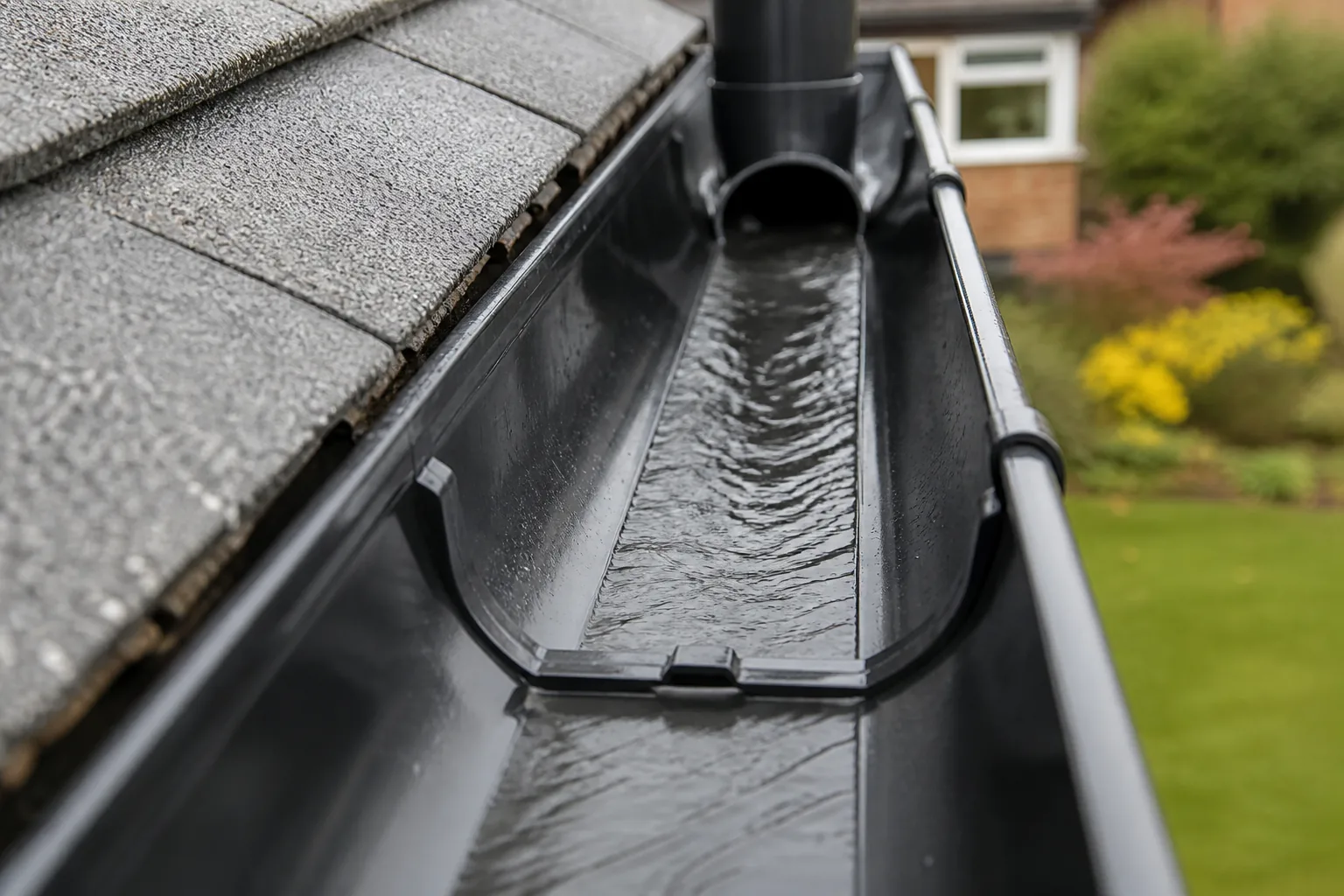
When water escapes from a roof edge, the first useful step is to locate the affected channel rather than assume the entire system is blocked. Gutter cleaning in Barking covers routine debris within accessible agreed runs and reachable outlets where specified. Damage, hidden downpipe restrictions and below-ground drainage are considered separately.
Quick answers
It begins with the reported spill, stain or low-flow area and the channel feeding that point. The relevant elevation, roof level and access route can then be considered together.
A local build-up or outlet issue may be involved, but alignment or damage is also possible. The whole affected run should be considered without assuming every other elevation needs the same work.
No. Marks on walls, fascia or the outside of the gutter can reveal previous water movement, but surface washing is distinct from clearing routine debris inside the agreed channel.
No. Routine cleaning reaches agreed channels and specified reachable outlet openings. A restriction concealed deeper in a downpipe needs separate assessment because its location and suitable treatment are not yet known.
They can change the usable space directly below a gutter or interrupt the route to it. Sharing those details early helps determine which elevations can form part of the agreed scope.
It will not mend a crack, joint, bracket or detached section. Cleaning may expose the condition more clearly, but any physical fault should be addressed through a separate repair assessment.
Local property context
A Barking address may present a simple front roof edge, several connected channels or a rear run affected by an addition below. These are possibilities to verify, not facts to presume from a postcode. The route to the side or garden can be as important as the channel itself, particularly where gates, boundaries, stored items or planted areas reduce working space. Before booking, it helps to identify the point where water appears, the level of that gutter and whether the same symptom occurs across the whole edge or only near one outlet.
The visible symptom guides attention but does not guarantee a cleaning-only answer. Overflow near the middle of a run can follow dense debris, while dripping at a connection may indicate either backed-up water or a failed fitting. Accessible agreed channels can be cleared of leaves, moss, silt and ordinary loose material; reachable outlet openings are addressed only where included. Repairs, deeper downpipe work, underground drainage and any specialist access arrangement require separate consideration, keeping the proposed service accurate for the property.
Access can change around a single building. A clear frontage does not establish that the rear or side is reachable, particularly where an addition, enclosed yard, boundary or fragile surface sits below. Every included run is reviewed individually, and specialist access is considered only as a separate arrangement when required.
| Property situation | Access or gutter consideration |
|---|---|
| Mid-terrace home | Front and rear runs may be separate, while access to the garden side depends on the actual route through or around the property. |
| Corner or end position | An additional side roof edge may exist, subject to the building layout, and needs its own symptom and access review. |
| Home with an enclosed rear area | Limited working space, stored items or delicate surfaces can affect whether the rear channel is within scope. |
| Property divided into flats | Booking authority, access through shared areas and responsibility for the roofline should be clear before work is arranged. |
Common causes
Routine build-up rarely consists of one material. Damp leaves can trap grit, silt and fragments of moss, then collect more debris around corners or outlet openings. Removing that mixture restores available space in the accessible channel, but it does not treat a restriction hidden inside connected pipework.
Wet leaves can settle into layers and slow water moving towards an outlet.
Loose roof moss can collect in the channel and hold other material in place.
Small twigs can bridge narrow points and trap lighter debris behind them.
Loose surface material may wash down from the roof during wet weather.
Older material can become dense and reduce the channel available for runoff.
Fine deposits can gather beneath larger debris and close to an outlet.
Structured service guide
| Area | Included when agreed and accessible | Kept separate |
|---|---|---|
| Gutter channel | Routine leaves, moss, silt and loose fragments | Repairing its fall, joints or supports |
| Outlet mouth | Material at the reachable opening | A restriction inside the lower pipe |
| Adjacent roof surface | No general roof clearance | Roof treatment or removal of fixed material |
| Drain at ground level | No underground drainage work | Diagnosis or clearance below ground |
Structured service guide
| Visible symptom | Possible debris explanation | Possible separate concern |
|---|---|---|
| Overflow at one end | Leaves cover the outlet opening | Restriction continues inside the downpipe |
| Repeated drip at a joint | Backed-up water reaches the connection | Seal or fitting has failed |
| Pool in the channel | Silt occupies a shallow section | Channel alignment creates a low point |
| Gap below the roof edge | Not resolved through clearance | Bracket, fascia or channel position needs assessment |
Structured service guide
| Planning point | What can vary | How it affects the quote |
|---|---|---|
| Channel extent | One short run or several elevations | Changes the amount of agreed clearance |
| Vertical level | Lower addition, main eaves or mixed heights | Changes the access review |
| Surrounding space | Open ground, narrow yard or boundary | Can include or exclude a section |
| Nature of concern | Loose material, damage or concealed flow issue | Directs cleaning or separate assessment |
Structured service guide
| If this applies | Clarify before booking | Likely decision |
|---|---|---|
| The rear is reached through shared space | Is access authorised and available? | Confirm the route or limit work to other runs |
| An addition spans the width below | Can the upper edge be approached safely? | Assess that channel apart from lower sections |
| Only an outlet corner spills | Does the channel hold debris elsewhere? | Target the affected run and keep pipe depth separate |
| A fitting is visibly displaced | Is cleaning suitable before repair? | Keep the fault outside routine clearance |
A clear service sequence
Seasonal context
Rain reveals symptoms, but the material may have accumulated over a longer period. Falling leaves, loose moss and windblown fragments affect each elevation differently depending on its immediate surroundings. A check based on visible condition and past behaviour is more useful than assuming every gutter fills at the same time.
Nearby trees, roof moss, gutter shape and exposure can all affect how quickly material accumulates. A visible symptom is more useful than applying one fixed timetable to every address.
Barking service area
Nearby gutter-cleaning pages
Before booking
Included work is limited to the accessible gutter channels agreed for the address, removing leaves, moss, silt and ordinary loose debris. Reachable outlet openings can be included by agreement. Pipe interiors, repairs, underground drainage and specialist access sit outside that routine scope.
Yes, a single elevation can form the proposed scope if that is where the concern lies and the run is assessed as accessible. The route to the rear, surfaces below, roof level and outlet position still need to be considered before confirmation.
Debris may be reducing capacity there, or water may be backing up from an outlet. A sagging or misaligned section can create a low point as well. Cleaning addresses accumulated material; channel shape or support problems need repair assessment.
When agreed, routine material can be removed from the opening where the channel meets the downpipe. That does not amount to clearing the entire pipe. Continued poor flow after the opening is free suggests the concealed route needs separate consideration.
The person arranging the service should confirm that entry and working access are permitted for the proposed time. Shared areas, locked gates and neighbouring land cannot be presumed available. Any uncertainty may alter which run can be safely included.
The possibility depends on its size, material, projection and the wider approach to the upper gutter. A structure below can prevent ordinary access or require another plan. The run is not included until its access has been assessed and agreed.
Not by itself. Growth shows that organic material and moisture have remained in part of the channel, but it does not locate a pipe restriction. The accessible debris can be cleared, then any continuing flow problem considered separately.
Not automatically. Other runs may be clear, inaccessible or unrelated to the symptom. Their visible condition and service history can inform the decision. A quote can list the affected elevation while offering separate consideration of any additional accessible channels.
Treat it as a possible repair issue and mention it before booking. Debris clearance does not secure a bracket or confirm the fascia behind it is sound. The affected section may need repair assessment before or after any suitable cleaning.
Provide the full address, affected side, roof level, description of the water behaviour and photographs from safe ground positions. Mention additions, locked routes or boundaries below the channel. These details support a clearer access and scope discussion.
Discuss the actual roofline
The quote is shaped by the defined channel runs, their levels, the amount of roof edge involved, outlet attention and the space available below. Photos may clarify these points before a visit. Unknown concealed blockages, damage, drainage below ground and specialist access are excluded unless assessed and agreed as separate work.
