
Can leaves block only part of a gutter?
Yes. Debris can gather at an outlet, behind a connection or in a sheltered corner while the rest appears open. A local spill therefore does not always mean the entire roofline is full.
Rainwater routes · access · clear scope
Leaves, moss and fine sediment can quietly reduce the working space inside a gutter. Our Rickmansworth cleaning scope is built around the individual property: agreed channels must be accessible, and outlets are included only where reachable and confirmed. Repairs, deeper downpipe obstructions, underground drainage and any section requiring specialist access are assessed outside the routine visit.
Quick answers
Yes. Debris can gather at an outlet, behind a connection or in a sheltered corner while the rest appears open. A local spill therefore does not always mean the entire roofline is full.
No. Staining may remain from an earlier overflow or arise from a leaking fitting. Watching the gutter during rain and checking for visible debris provides more useful context before cleaning is agreed.
It can be considered if requested and accessible, but it should be listed separately from the main house. Its height, surrounding space, channel length and debris can differ from the primary roofline.
No. The underground drain is outside routine gutter cleaning. Clearing an agreed reachable outlet does not mean that concealed downpipe sections or below-ground drainage have been opened or tested.
Ground level can change the effective height and practicality of reaching a channel. A roofline that appears modest from one side may present different access conditions at the rear or side.
A crack is a repair concern. Loose debris can still be removed from an accessible agreed section where appropriate, but cleaning cannot seal the damage and should not be described as doing so.
Local property context
Some Rickmansworth properties may sit near mature planting, while others have more open rooflines; either setting can gather material depending on wind, roof shape and maintenance history. Building height is not the whole access picture. Sloping ground, deep borders, additions, separate outbuildings and restricted side routes can influence which channels are reachable. The enquiry should therefore describe the actual layout and the elevations of concern. That detail makes it easier to define a useful job without assuming access from a general property description.
If water cascades over an edge, note whether it happens along the run or directly above an outlet. Leaves and moss may be the cause, but a dipping channel, leaking union or slow downpipe can create similar effects. Cleaning removes ordinary debris from accessible agreed areas. It does not correct the channel's fall, replace a fitting, reach a concealed blockage or resolve a drain below ground. Remaining symptoms are valuable clues that a separate repair or investigation may be needed.
A safe scope starts at ground level with the surroundings. Slopes, walls, planted beds, extensions, neighbouring boundaries and locked routes can all affect reach. Mention detached garages and outbuildings separately; being on the same property does not automatically place their gutters in the agreement.
| Property situation | Access or gutter consideration |
|---|---|
| Homes near established planting | Leaves and seeds may gather unevenly, so inspect outlets and sheltered corners as well as long runs. |
| Split-level properties | Changes in roof and ground height can make access different on each elevation. |
| Homes with outbuildings | Sheds and garages require an express decision on whether their channels are included. |
| Semi-detached or linked homes | Identify boundary sections and any access that depends on a neighbouring area. |
Common causes
Organic material rarely stays dry and loose for long. Rain can compress leaves with moss and fine sediment, particularly near outlet openings. Removing that layer from reachable areas frees the channel, while any resistance lower in the rainwater system remains beyond ordinary gutter cleaning.
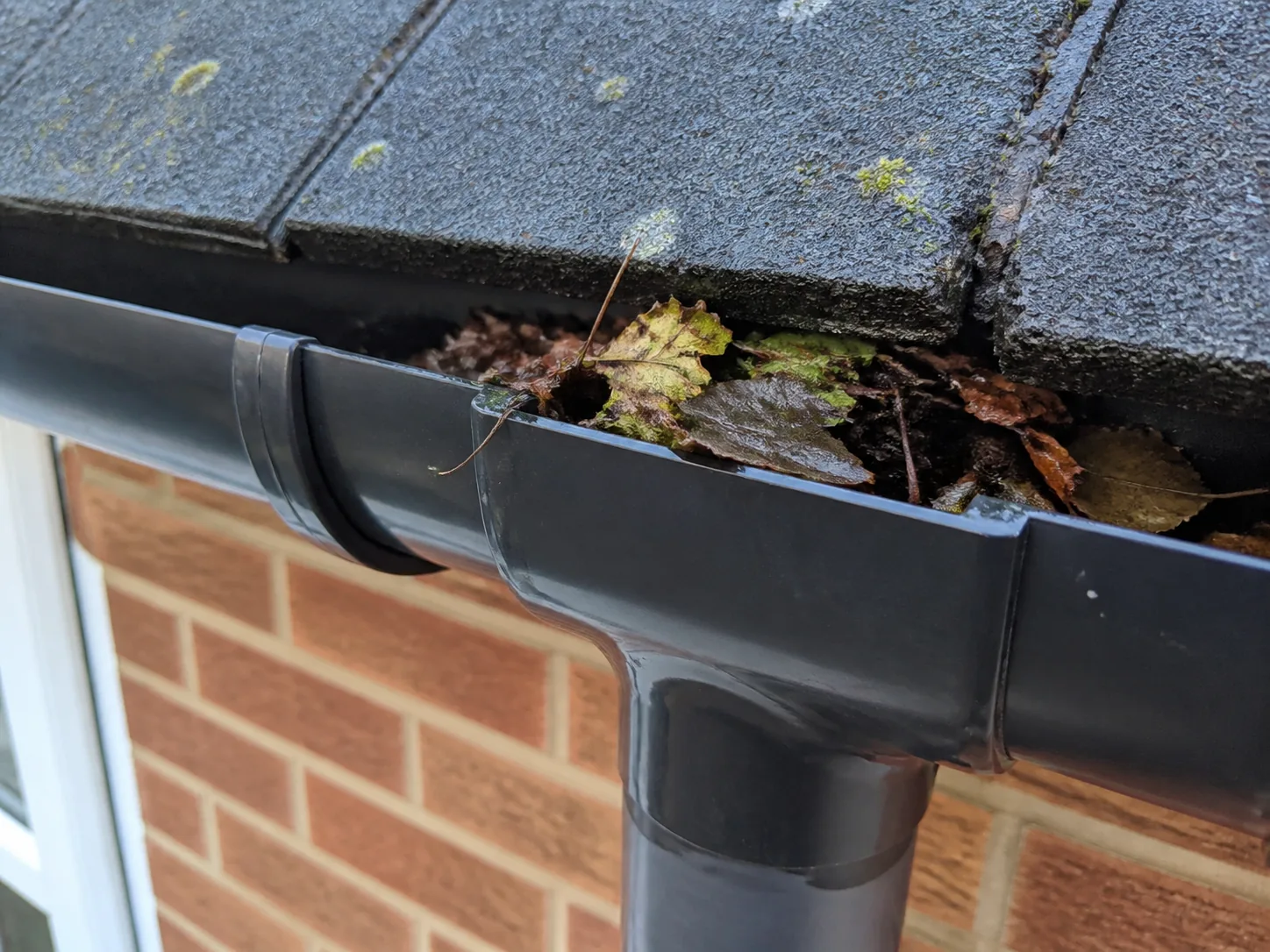
Wet leaves can settle into layers and slow water moving towards an outlet.
Loose roof moss can collect in the channel and hold other material in place.
Small twigs can bridge narrow points and trap lighter debris behind them.
Loose surface material may wash down from the roof during wet weather.
Older material can become dense and reduce the channel available for runoff.
Fine deposits can gather beneath larger debris and close to an outlet.
Structured service guide
| Location in the system | Agreed routine work | Not implied |
|---|---|---|
| Reachable channel | Clear leaves, moss and silt | Repair or replacement |
| Accessible outlet mouth | Remove loose debris when included | Clear the full downpipe |
| Below-ground connection | No routine action | Drain investigation |
Structured service guide
| What you notice | Cleaning is relevant if | Further assessment is relevant if |
|---|---|---|
| Plants in channel | They grow in removable silt | A structural issue also exists |
| Water at a joint | Debris causes backing up | The fitting leaks when the run is clear |
| Slow outlet | Material covers the reachable opening | Resistance lies deeper down |
Structured service guide
| Condition | Why it affects the conversation |
|---|---|
| Sloping garden | Reach may vary across one elevation |
| Several outbuildings | Each requested roofline adds scope |
| Dense build-up | Clearing demand differs from light leaves |
| Restricted boundary | A section may not be routinely accessible |
Structured service guide
| If you observe | Useful response |
|---|---|
| Fresh leaves gathering after autumn weather | Check channels and outlet openings |
| Moss accumulating outside leaf fall | Base timing on condition, not the month |
| Only one sheltered corner filling | Request attention to that precise run |
| Clear channels but continued overflow | Consider a non-cleaning cause |
A clear service sequence
Seasonal context
Leaf fall may create a clear maintenance point where trees are close, but seeds, moss and silt can collect at other stages of the year. Check the channels when conditions allow you to see how they drain. Local weather alone cannot set one schedule for every address.
Nearby trees, roof moss, gutter shape and exposure can all affect how quickly material accumulates. A visible symptom is more useful than applying one fixed timetable to every address.
Rickmansworth service area
Nearby gutter-cleaning pages
Before booking
Routine work removes accessible leaves, moss, silt and similar loose debris from the channels named in the agreement. A reachable outlet can also be included. Solid unusual obstructions, concealed downpipe restrictions and drainage below ground need a separate plan.
Nearby trees may increase falling leaves, seeds or small twigs, but distance alone does not set the interval. Wind direction, roof shape and earlier build-up also matter. Inspect what actually reaches the channel and adjust maintenance to that pattern.
Roof pitch, wind, shelter, nearby planting and outlet position can make material settle unevenly. One clean-looking elevation does not confirm the opposite side is the same. Consider each run on its own condition, especially after periods of leaf fall or strong weather.
A leaking pipe is not simply channel debris. A reachable outlet can be cleared under an agreed clean, but loose connections, splits or deeper restrictions in the downpipe require separate assessment. Describe where the water escapes so the tasks are not confused.
Permission and practical arrangements should be settled before the visit. Access should not be assumed because a gutter faces a neighbouring garden or passage. If the required route is unavailable, the affected channel may need to remain outside the agreed routine scope.
No. Cleaning removes current routine debris from the areas reached, but later material can arrive and non-cleaning faults may affect flow. Channel capacity, severe rainfall, alignment, downpipes and underground drainage can all influence future behaviour independently of the clean.
Yes. Porches, projecting windows, garages and additions may have short channels with their own outlets. Identify these areas during the enquiry if they require attention. Their inclusion should be deliberate, rather than inferred from a request for the main roofline.
Debris may cause water to back up, so clearing can help when that is the source. Water behind the gutter can also result from alignment, roof-edge or component problems. If it continues after cleaning, the building detail needs separate examination.
List every elevation requested and note storeys, gates, narrow passages, rear structures, slopes and planted areas. Explain whether outbuildings are included. Wide photographs taken safely from ground level can help show the relationship between rooflines and obstacles.
Stop treating it as an ordinary leaf-and-silt clean until the material and risk are understood. Construction residue, fixed objects or wildlife concerns may need a different response. The routine scope should be revised rather than stretched to cover an unknown situation.
Discuss the actual roofline
The price discussion is shaped by how much channel is requested, its levels, access conditions and the quantity and type of routine debris. A property with several modest runs may need more consideration than one continuous roofline. Suspected repairs or hidden restrictions should be priced as separate tasks.
