
Residential lockout
The locksmith confirms a reasonable basis for entry, checks the private door and discusses a suitable method. The shared route should already be available.
Building use · entrance identity · authorised host · workable window
Hotels, homes, converted terraces and managed apartments can sit close together or share a building envelope. A Paddington locksmith brief should identify the use behind the door, the authorised host and the route that avoids confusing guest, staff and residential access.
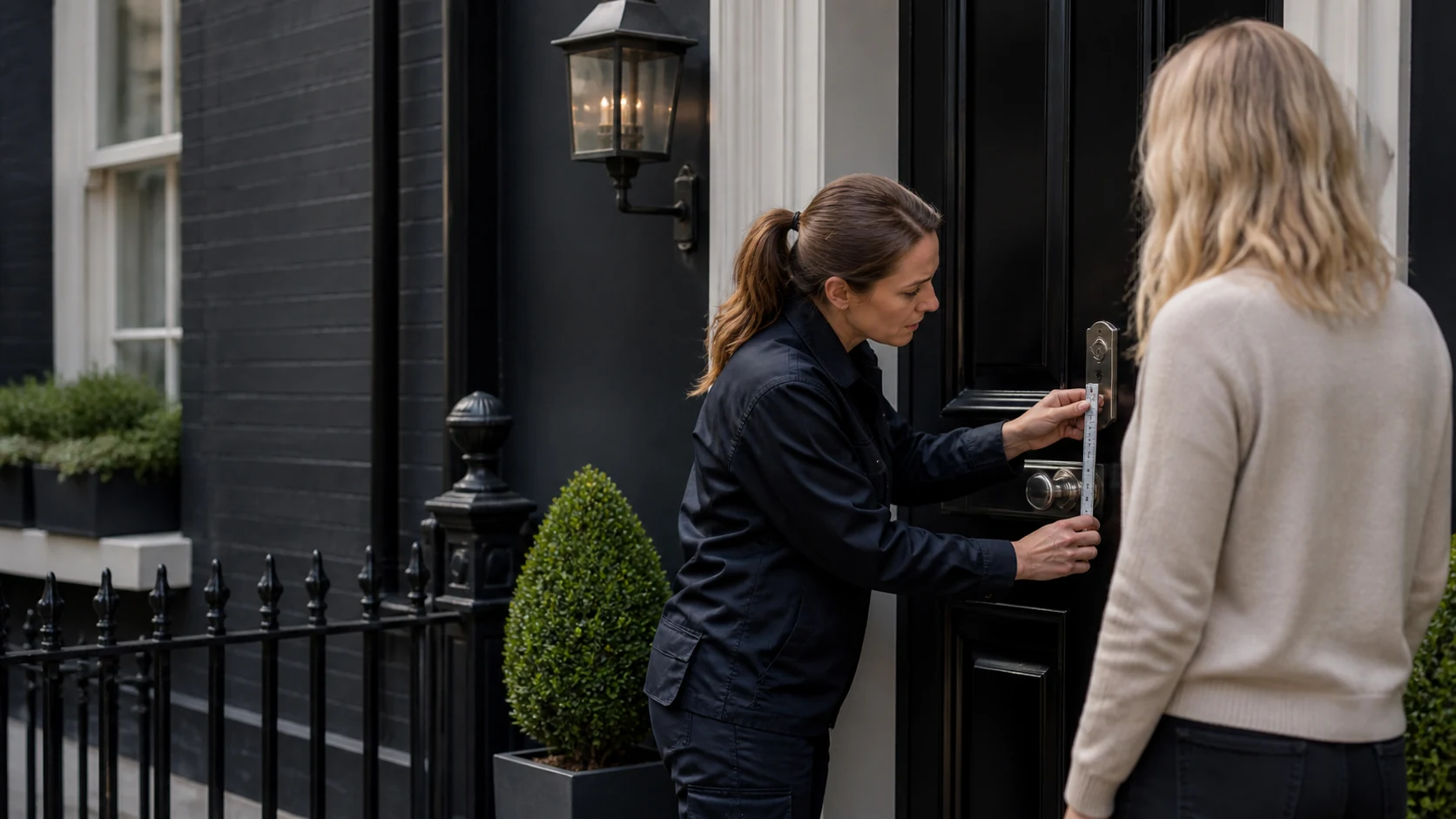
Identify the use behind the door
A guest who cannot enter a room should contact the accommodation provider, which controls that room and its access procedure. A resident locked out of a private flat needs to show a lawful connection to the dwelling. A hotel manager may commission work on staff or premises doors but cannot automatically approve an unrelated residential entrance. Establishing the building use first protects everyone involved.
Give the trading or building name only where it genuinely identifies the entrance, then add the number, bell or reception point. State whether a staffed desk will meet the locksmith or an individual must come downstairs. If the route uses a side or service door, confirm that the engineer is permitted to bring tools through it. Avoid sending active codes in open messages; arrange their secure handover with the responsible host.
| Use behind the door | Appropriate first contact | Locksmith booking boundary |
|---|---|---|
| Private home or flat | Occupier, owner or properly authorised agent | Private lock work after reasonable authority checks |
| Guest accommodation room | Accommodation manager following its access procedure | Property operator commissions work; a guest should not alter the lock independently |
| Hotel staff or service door | Duty manager or facilities contact | Premises hardware and operational window defined by the operator |
| Communal apartment entrance | Freeholder, managing agent or building manager | Shared users and access-control implications considered together |
| Commercial unit within a converted building | Business owner plus building contact where the route is shared | Business lock separated from residential common parts |
Make the door unmistakable
Converted terraces can have a former main doorway serving flats, a basement business entrance and another bell for upper floors. Managed developments may direct contractors through reception. Send a safe image of the entrance and describe the route without publishing access credentials. The locksmith should know whether luggage, deliveries or public circulation will pass the work area.
At the door, report the device in ordinary terms. Does a metal key enter and turn? Does a card reader display a response? Does an intercom release make a sound? Does the mechanical latch retract? These observations help separate a lock enquiry from a hotel card system or powered access fault. Do not remove reader covers, force a latch or borrow another user’s credential for experiments.
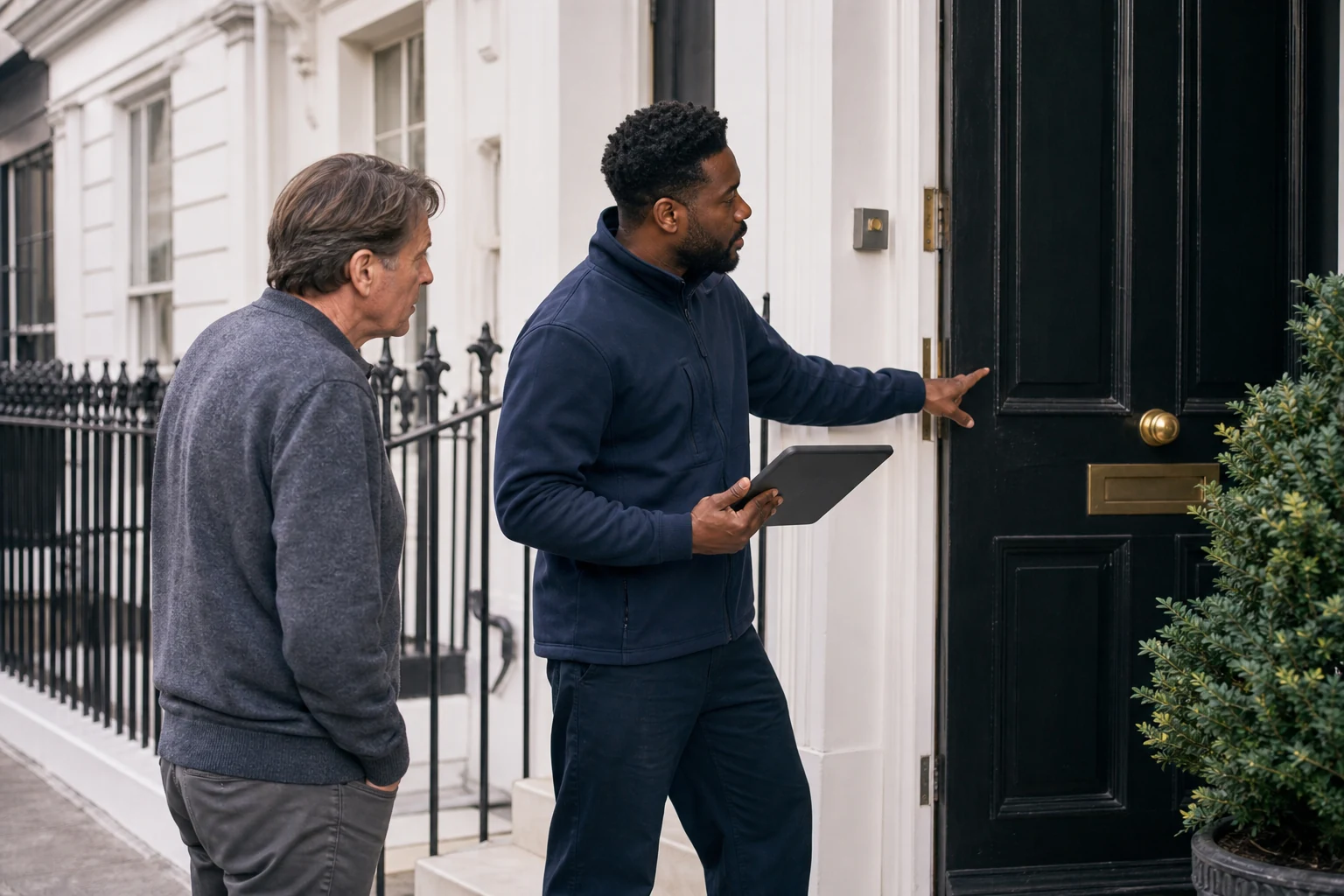
Choose the response by user and system
| Reported event | First organised response | Technical or authority limit |
|---|---|---|
| Resident locked out of an upper-floor flat | Confirm the residential entrance and prepare evidence of occupancy | Private opening does not authorise changes to the building’s street door |
| Guest card no longer opens a room | Use the accommodation provider’s verification and reissue process | Electronic credential management belongs to the operator |
| Staff key snaps in a service door | Keep the pieces, control the entrance and contact the premises manager | Extraction, opening and replacement require operator approval |
| Communal fob works but latch does not move | Notify building management and record reader and latch behaviour | Access-control and mechanical components may need different specialists |
| Private lock is stiff only when the door closes | Stop forcing it and note operation while open if this is safe | Lock condition and door-to-frame contact both require assessment |
| Mixed-use entrance has been damaged | Protect people, preserve required evidence and identify all affected users | Temporary security, door repair and system work may be separate |
Locksmith services within the correct boundary
The locksmith confirms a reasonable basis for entry, checks the private door and discusses a suitable method. The shared route should already be available.
An authorised hotel or business contact can commission work on mechanical locks it controls. The operational window and key recipients need to be clear.
A fragment can sometimes be removed while preserving the lock. The remaining hardware is then tested before repair or replacement is proposed.
Key-control concerns, wear or a planned upgrade may justify a change. Compatible measurements and the required users determine the actual part and key count.
Mechanical observations can be recorded for building management. Powered readers, intercoms and central credentials remain with the relevant access provider.
The immediate scope may be controlled closure. Permanent leaf, frame, glazing, decoration or powered-system reinstatement should be allocated separately.
Quote from the host’s real requirement
There is no reliable Paddington locksmith price based on area name. A quote depends on the actual door, timing, method, labour, parts and authorised access. Hotels and businesses should state when the entrance can be controlled; residents should explain the common route and proof arrangements.
| Scope element | Useful input | What the quote should distinguish |
|---|---|---|
| Private entry attendance | Door state, authority route, lock details and safe meeting point | Attendance, opening and any repair after entry |
| Operational premises work | Duty contact, affected door, quiet window and staff control | Assessment, labour, part and interruption arrangement |
| Mechanical replacement | Measurements, function, finish, key quantities and use level | Specified hardware and compatibility preparation |
| Electronic-system referral | Reader, fob, intercom and latch observations | Mechanical locksmith work versus credential or electrical service |
| Shared-entrance change | Building authority, all user groups and door requirements | Approval, communication and key handover for common access |
| Damage reinstatement | Condition of lock, frame, leaf, glass and nearby systems | Temporary secure state versus full permanent restoration |
If the booking reaches the wrong entrance or the host cannot approve work, the locksmith should not improvise an authority chain. Rebook or obtain the proper contact. If the hardware differs from the description, ask for a revised scope before additional parts or destructive methods are accepted.
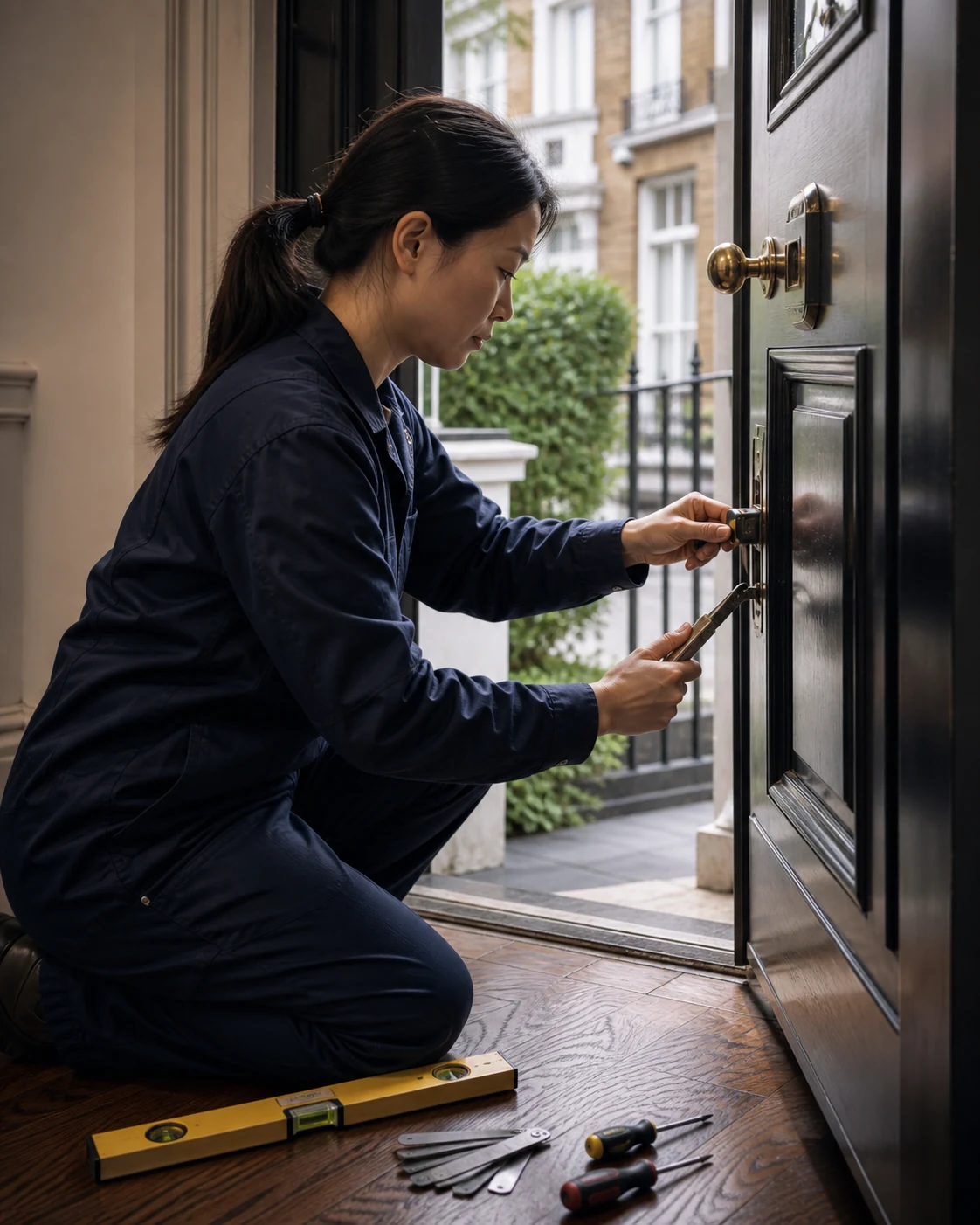
Paddington property context
A hotel reception is an obvious meeting point, but it should not be assumed to manage a neighbouring or upper-floor residence. Likewise, a resident may know the staff entrance but have no right to admit a contractor through it. Use the exact host and door function to establish the route.
Converted terraces can divide original entrances between basement, ground and upper uses. Bell names and floor details are more useful than a generic instruction to meet outside. For managed apartments, obtain contractor registration and the key holder for shared cupboards or doors before attendance.
Transient users make key and credential discipline important. A guest access problem should pass through the operator’s identity checks; a resident’s lockout follows private-property verification. Mechanical keys, cards and fobs should not be treated as interchangeable simply because they open doors in the same building.
Handover to the enduring controller
After mechanical work, test the door with the person responsible for its ongoing operation. A hotel or business manager should receive premises keys through its internal process. Private residential keys go to the resident, owner or authorised agent, not the nearest staffed desk unless that has been formally arranged.
Record any electronic behaviour that remains unresolved, any area not entered and any temporary security measure. The follow-on task should name the responsible provider. A clear handover is especially important where staff shifts or short stays mean the person reporting the fault will not be present later.
Paddington locksmith FAQ
The guest should contact the accommodation operator, which verifies identity and controls the room access system. The property manager decides whether external mechanical work is required.
Only if a formal building arrangement gives it that role. A staffed desk nearby should not be assumed to hold residential authority.
Provide the number, bell name, floor, door description and route from the street. Avoid sending active codes through unsecured channels.
Not always. Report the reader response and mechanical latch separately so the operator can route credential, electrical and lock work correctly.
The hotel or premises manager should name an authorised contact, working window and key recipient. A staff member’s possession of a key may not be enough.
The locksmith needs reasonable evidence of occupancy, ownership or authorised management. Explain if documents are inside so another verification route can be discussed.
The host should clear and control the space before work begins. The locksmith should not be responsible for moving or guarding guests’ or customers’ property.
Give business keys to the authorised premises custodian and residential keys to the named private recipient. Keep the two handovers distinct and count each set.
Nearby coverage
Select the page that matches the actual address and building use.
Identify the use, host and door
Share the Paddington building use, exact route, observed lock behaviour and authorised person who will meet and approve the work.
