
What will routine cleaning remove?
The agreed work removes leaves, loose moss, silt and similar debris from channels that can be accessed. A reachable outlet entrance may be included, but pipe interiors and drains are separate.
Rainwater routes · access · clear scope
Gutters work best when routine material is not occupying the route to the outlet. In Brentwood, the cleaning scope covers accessible channels selected for the visit, removing leaves, moss, silt and similar build-up. Reachable outlet entrances can be included by agreement. Leaking parts, pipe restrictions beyond reach, underground drains and rooflines with separate access needs require another discussion.

Quick answers
The agreed work removes leaves, loose moss, silt and similar debris from channels that can be accessed. A reachable outlet entrance may be included, but pipe interiors and drains are separate.
Yes, if porch, bay, garage or extension runs are named in the request and can be reached. Their small size does not make them automatic parts of the main roof scope.
No. Debris can make water back up and escape, but split sections, failed seals and loose joints also leak. Cleaning only addresses the accessible material, not damaged components.
A slope or raised garden changes the effective height of an elevation and the space around it. Those details may affect whether the visible channel can form part of the agreement.
Loose debris at an accessible outlet mouth can be removed when agreed. This does not amount to testing the full downpipe or confirming that underground drainage is unrestricted.
No. Each side may differ in length, height, access and debris. A useful quotation reflects the selected runs and their actual conditions instead of applying assumptions across the property.
Local property context
A Brentwood property may combine a main roof with lower additions, a porch, bay or garage. It may also have different ground heights around the building. Such features affect what can be considered, but they should never be presumed from the location alone. Start by naming the front, rear or side channels causing concern and any smaller rooflines that also need attention. Explain walls, planted borders, narrow gaps and shared routes. That detail creates a scope based on the actual setting rather than on a broad house type.
Where material gathers is just as important as how much is visible. Loose moss may be spread along a run, whereas wet leaves can form a dense pocket around a bend or outlet. If water escapes through a crack or separated joint, clearing nearby debris will not restore the fitting. Likewise, an open outlet mouth does not establish that the downpipe is clear below it. The routine task removes accessible build-up in agreed areas. Repair, realignment and investigation of hidden routes are separate responses to different problems.
Access depends on the height and setting of each requested run. Rear additions, raised ground, retaining walls, enclosed passages and garden features can make adjacent elevations quite different. State whether an outbuilding or shared area is involved, and arrange required permissions beforehand.
| Property situation | Access or gutter consideration |
|---|---|
| Semi-detached homes | A side route may assist access, while the boundary of adjoining rooflines still needs clarity. |
| Properties with attached garages | Confirm whether the garage channel connects to the house run and whether both are requested. |
| Homes with raised rear gardens | Changing ground can alter the effective height and available space at the back. |
| Converted or shared buildings | Responsibility, permission and the exact communal section should be settled in advance. |
Common causes
Fine grit can settle underneath leaves and moss, making the channel shallower even when the top looks patchy. Damp organic matter may then hold further debris in place. Removing these contents from included accessible runs creates space for water without testing concealed drainage.
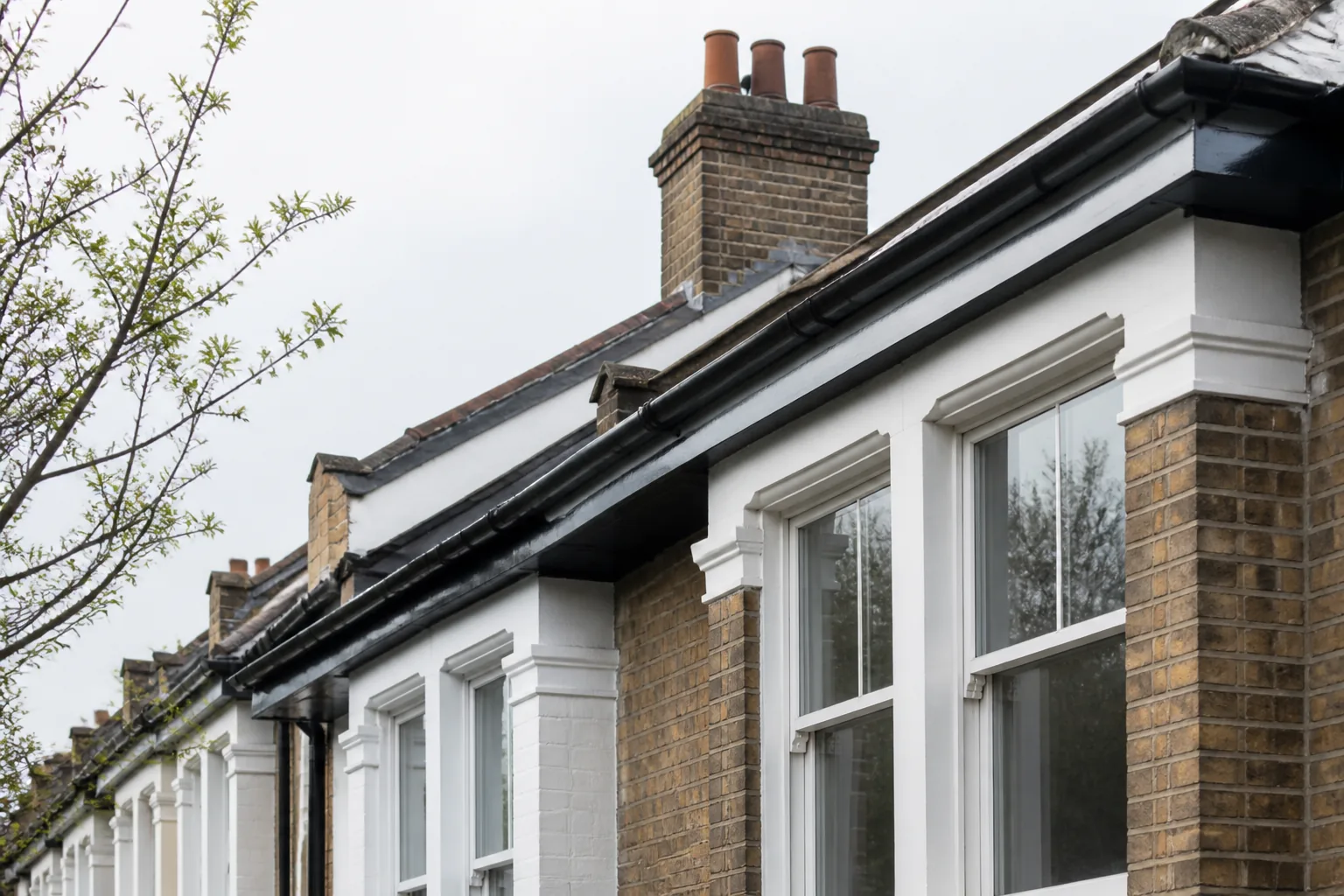
Wet leaves can settle into layers and slow water moving towards an outlet.
Loose roof moss can collect in the channel and hold other material in place.
Small twigs can bridge narrow points and trap lighter debris behind them.
Loose surface material may wash down from the roof during wet weather.
Older material can become dense and reduce the channel available for runoff.
Fine deposits can gather beneath larger debris and close to an outlet.
Structured service guide
| System part | Within an agreed clean | Beyond routine scope |
|---|---|---|
| Accessible selected run | Lift ordinary debris | Alter damaged guttering |
| Reachable outlet entrance | Remove loose obstruction | Open hidden pipe sections |
| Below-ground pipe | Not included | Drainage work |
Structured service guide
| What you notice | Role for cleaning | Separate response |
|---|---|---|
| Leaves packed at a bend | Remove the accumulation | Assess damage if present |
| Water through a split | Clear nearby contents | Repair the section |
| Poor flow below a clear mouth | No channel debris to remove | Investigate the pipe |
Structured service guide
| Detail supplied | Reason it helps |
|---|---|
| Named elevations | Shows the intended extent |
| Number of roof heights | Informs access review |
| Walls, slopes or additions | Highlights restrictions |
| Type and amount of contents | Indicates likely clearing effort |
Structured service guide
| Where applicable | Ask this |
|---|---|
| An attached garage | Does its gutter join the requested run? |
| A raised rear garden | How does the approach differ from the front? |
| A shared building | Who controls access and responsibility? |
| Several lower roofs | Which individual channels need attention? |
A clear service sequence

Seasonal context
Falling leaves are one source of build-up, but wind-blown grit, seeds and pieces of roof moss do not follow one season. Damp sheltered corners may retain them for longer. Review the areas that have shown overflow or visible accumulation rather than relying on a standard month.
Nearby trees, roof moss, gutter shape and exposure can all affect how quickly material accumulates. A visible symptom is more useful than applying one fixed timetable to every address.
Brentwood service area
Nearby gutter-cleaning pages
Before booking
Routine work is limited to agreed accessible channels, plus reachable outlet mouths where specified. It does not cover repairs, realignment, obstructions further down a pipe, underground drainage or rooflines excluded because their access has not been agreed.
It may address current overflow if debris is causing water to escape, but an existing stain does not prove an active blockage. Leaking components, earlier events and other building details can also be relevant. The present cause should be assessed separately.
Wet leaves can settle closely together and trap moss fragments or grit, leaving less open depth for rainwater. They may gather at bends and outlets rather than evenly. Accessible routine accumulations can be removed under the agreed cleaning scope.
Yes. Its gutters have their own height, surroundings and outlet arrangement. A request concerning the house does not include them by default. Name the structure and relevant sides so they can be assessed and, if appropriate, added.
No. The visible entrance may be open while material remains lower inside the pipe or at its underground connection. Routine work can remove reachable debris at the mouth, but the concealed route needs its own assessment if discharge remains poor.
Removing accessible material may reduce the load, but it cannot restore supports or correct the fall. Sagging is a repair concern. Mention it before booking so clearance and any component work are not treated as the same task.
That cannot be assumed. A front may be open while the side is narrow and the rear sits beyond an addition. Describe the approach to each requested gutter. A section should remain excluded if suitable access is not available.
No single interval suits every address. Accumulation depends on planting, shelter, roof condition and earlier clearing patterns. Check visible contents and rainwater behaviour, then arrange attention when the property indicates a need rather than solely because a year has passed.
Cleaning removes loose routine contents from the channel. Repair changes or restores a component, such as sealing a union, replacing a cracked piece or correcting supports. Both may be needed, but one should not be promised as part of the other.
If a gate is locked, a route is obstructed or permission is missing, the affected run may have to remain outside the visit. The completed work should reflect only areas actually reached under the agreement, with the excluded section reconsidered separately.
Discuss the actual roofline
A quotation considers requested channel length, the number of distinct roof levels, access around each side and the amount of debris. Smaller isolated runs still require individual assessment. Component work, hidden blockages and drainage enquiries should not be bundled into ordinary clearance.
