
Is autumn the only useful cleaning time?
No. Leaf fall is one prompt, but moss, seeds and grit can gather at other times. Visible accumulation and rainwater behaviour provide better guidance for an individual property.
Rainwater routes · access · clear scope
The right time to clean depends on what each roofline collects and how water behaves. Gutter cleaning in Camberley removes leaves, loose moss, silt and routine debris from agreed accessible channels. Reachable outlet mouths may be included by agreement. Component repairs, obstructions concealed in downpipes, underground drainage and sections needing another access solution stay outside routine work.

Visible clues
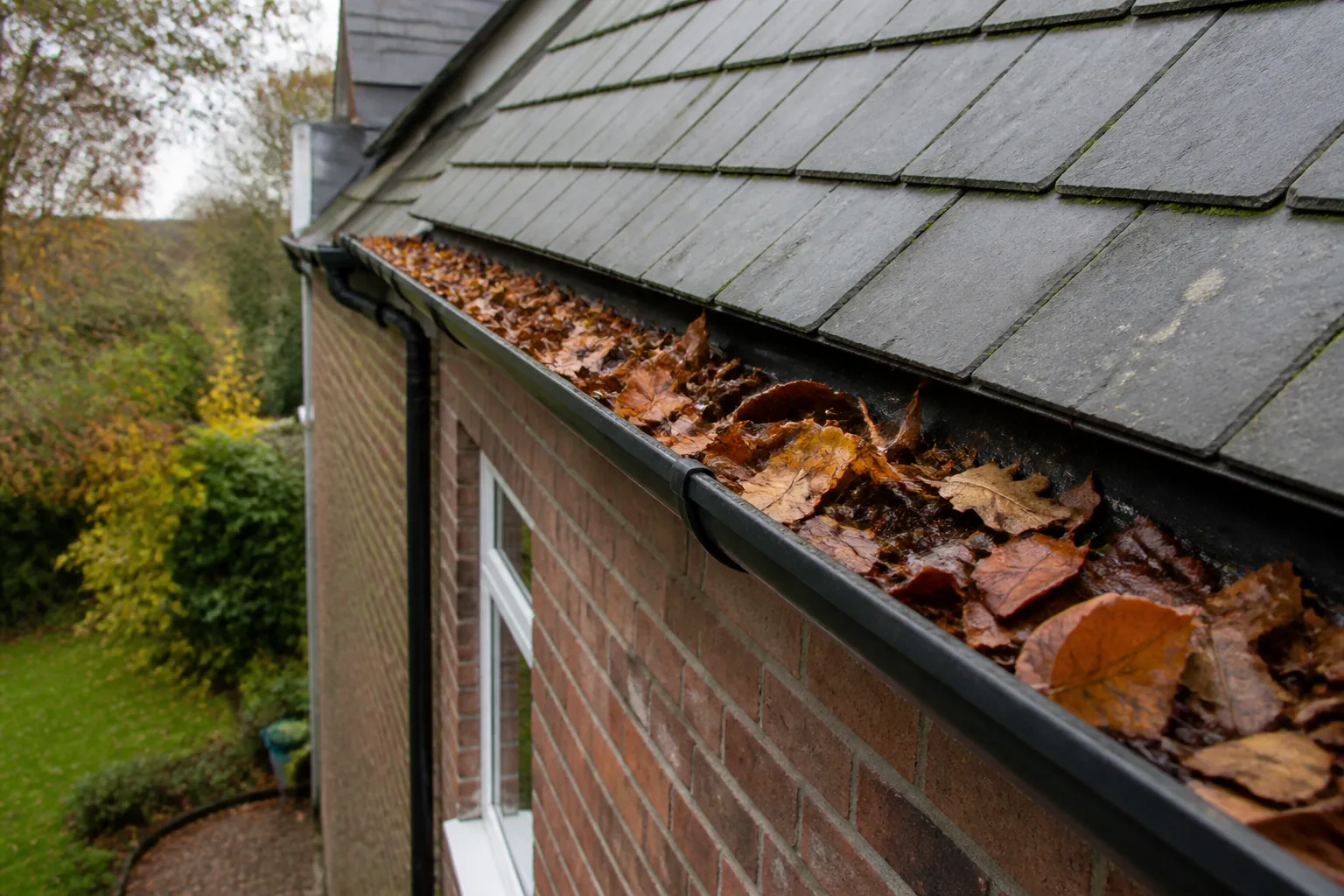
Visible shoots, a dark strip of retained silt, overflow or one persistently damp section can prompt a closer check. A drip at a seam, bowed channel or slow pipe after the outlet mouth is open may indicate a separate fault.

Local property context
A Camberley property may have one corner that fills quickly while another elevation remains open. Shelter, wind direction, roof condition and nearby planting can influence this, but nothing should be assumed without seeing the actual address. Note where leaves or sediment are visible and where overflow has occurred. Identify whether the affected channel belongs to the main roof, a bay, porch, addition or garage. These observations support a focused request and avoid applying the same cleaning timetable or scope to every run.
Seasonal build-up is only part of the picture. A sudden fall of leaves can cover an outlet entrance, whereas moss fragments and grit may gather slowly into a shallow bed. Both can be cleared from accessible agreed channels. Water that continues to pool in an empty run, drip through a joint or move slowly below an open outlet could have another cause. Cleaning does not correct channel fall, renew damaged fittings or investigate the concealed pipe and underground drainage, so those symptoms need separate consideration.
Access can change between seasons as well as elevations when planting or ground conditions alter. Tell us about extensions, conservatories, walls, narrow paths, gates and separate buildings. Permission for any shared approach should be settled before the affected run is agreed.
| Property situation | Access or gutter consideration |
|---|---|
| Homes near planting where present | Observe which elevations receive material rather than assuming every nearby tree affects every run. |
| Properties with corner valleys | Adjacent channels may receive different deposits and should be identified individually. |
| Houses with rear extensions | Lower and upper rooflines may collect differently and require separate access decisions. |
| Homes with garden garages | Garage gutters need their own condition check and explicit place in the request. |
Structured service guide
| Observation | Possible response | Limit |
|---|---|---|
| Fresh leaves covering a corner | Consider accessible clearance | Cause may extend beyond that corner |
| Gradual silt line | Remove when it reduces open space | Source is not diagnosed |
| Clean channel still overflowing | Seek another assessment | Repeated cleaning may not help |
Structured service guide
| Finding | Channel cleaning | Different concern |
|---|---|---|
| Loose moss and grit | Remove agreed accessible material | None if flow is satisfactory |
| Dripping damaged joint | Clear any surrounding debris | Fitting repair |
| Standing water without contents | No further deposit to remove | Fall or support correction |
Structured service guide
| System part | Routine action | Excluded action |
|---|---|---|
| Selected accessible gutter | Clear leaves, moss and silt | Replace components |
| Reachable outlet mouth | Uncover when included | Clear concealed pipe length |
| Underground connection | No channel-cleaning action | Investigate drainage |
Structured service guide
| Where applicable | What to observe |
|---|---|
| Sheltered rear corner | Whether damp debris persists |
| Roofline near planting | Which run actually receives material |
| Extension and upper gutter | Different accumulation and access |
| Separate garage | Its own condition and requested sides |
Seasonal context
Rather than choosing a universal month, watch known catch points after leaf fall, windy periods and sustained rain. Seeds and loose moss may accumulate outside autumn, while sheltered deposits can remain damp. The condition of each run is the best prompt for review.
Nearby trees, roof moss, gutter shape and exposure can all affect how quickly material accumulates. A visible symptom is more useful than applying one fixed timetable to every address.
A clear service sequence
Quick answers
No. Leaf fall is one prompt, but moss, seeds and grit can gather at other times. Visible accumulation and rainwater behaviour provide better guidance for an individual property.
Look for material above the rim, sediment along the bottom, overflowing edges, plant growth or delayed drainage. Drips at fittings and pooling without debris may point towards different work.
It removes accessible leaves, loose moss, silt and comparable everyday deposits from the agreed runs. A reachable outlet mouth is included only when specifically part of the arrangement.
Yes, when its location, extent and access are described clearly. Nearby channels or outbuildings do not become included automatically, and the symptom may still involve a separate fault.
No. Loose matter can be lifted from an agreed reachable outlet entrance, but pipe interiors, bends and below-ground connections are concealed areas requiring a different investigation.
Name the relevant elevations and smaller roofs, describe visible contents, and mention levels, obstacles, gates or shared routes. Include known leaks or damage as separate concerns.
Camberley service area
Nearby gutter-cleaning pages
Before booking
Repairs, alignment work, unnamed or inaccessible channels, deeper downpipe clearance and underground drainage are excluded. Routine cleaning concerns everyday debris in agreed accessible runs, with loose material at a reachable outlet mouth included only where specified.
No. Where trees are present, species, distance, wind and shelter affect where material lands, while roof moss and grit may be equally relevant. Observe actual accumulation in each channel instead of setting a timetable from planting alone.
Yes. Small moss fragments can catch grit, while fine sediment settles as water slows. Together they may form a damp shallow layer that reduces working depth. Accessible loose deposits can be removed during an agreed clean.
Roof shape, wind exposure, shelter and the route towards outlets can influence where material gathers. The pattern is property-specific. Identifying the repeat catch point helps focus checks without assuming the rest of the system behaves identically.
It may help if debris has raised the water level, but poor alignment, roof-edge details or damage can also be responsible. Continued tracking behind an open channel requires separate assessment of the fitting and surrounding construction.
Yes. Material may remain farther down a pipe, around a concealed bend or at the underground connection. Routine channel cleaning does not establish the state of those areas, so continued slow flow needs another scope.
Yes. Their size, shelter and outlet may give them a different accumulation pattern from the main roof. If wanted, name the porch sides explicitly so condition and access can be properly considered within the agreement.
The usable approach at the time of the visit determines whether the run is accessible. Describe dense planting or other changing conditions beforehand. A section may need to be excluded if the agreed route is no longer available.
Possibly. If ordinary debris has been removed, recurring overflow may relate to fall, capacity, a fitting or a concealed obstruction. Further cleaning should not be assumed to solve it without carefully considering those other causes.
Note when material becomes visible and which rainfall reveals a problem. Compare individual runs after windy or wet periods, especially known catch points. This address-specific history is more useful than applying one interval to every roofline.
Discuss the actual roofline
The expected charge follows the requested extent, separate heights, usable approach and the amount of dry or compacted material. A targeted clean can differ from several disconnected rooflines. Repair requirements and investigation of concealed water routes need independent scopes.
