
Lock repair
A serviceable component can be repaired after condition is confirmed.
Dated symptom · stable route · alignment check · fault boundary
A door that changes gradually needs a timeline, while a sloping approach needs a safe arrival plan. A Muswell Hill enquiry should keep those two records separate and avoid treating local terrain as a diagnosis.
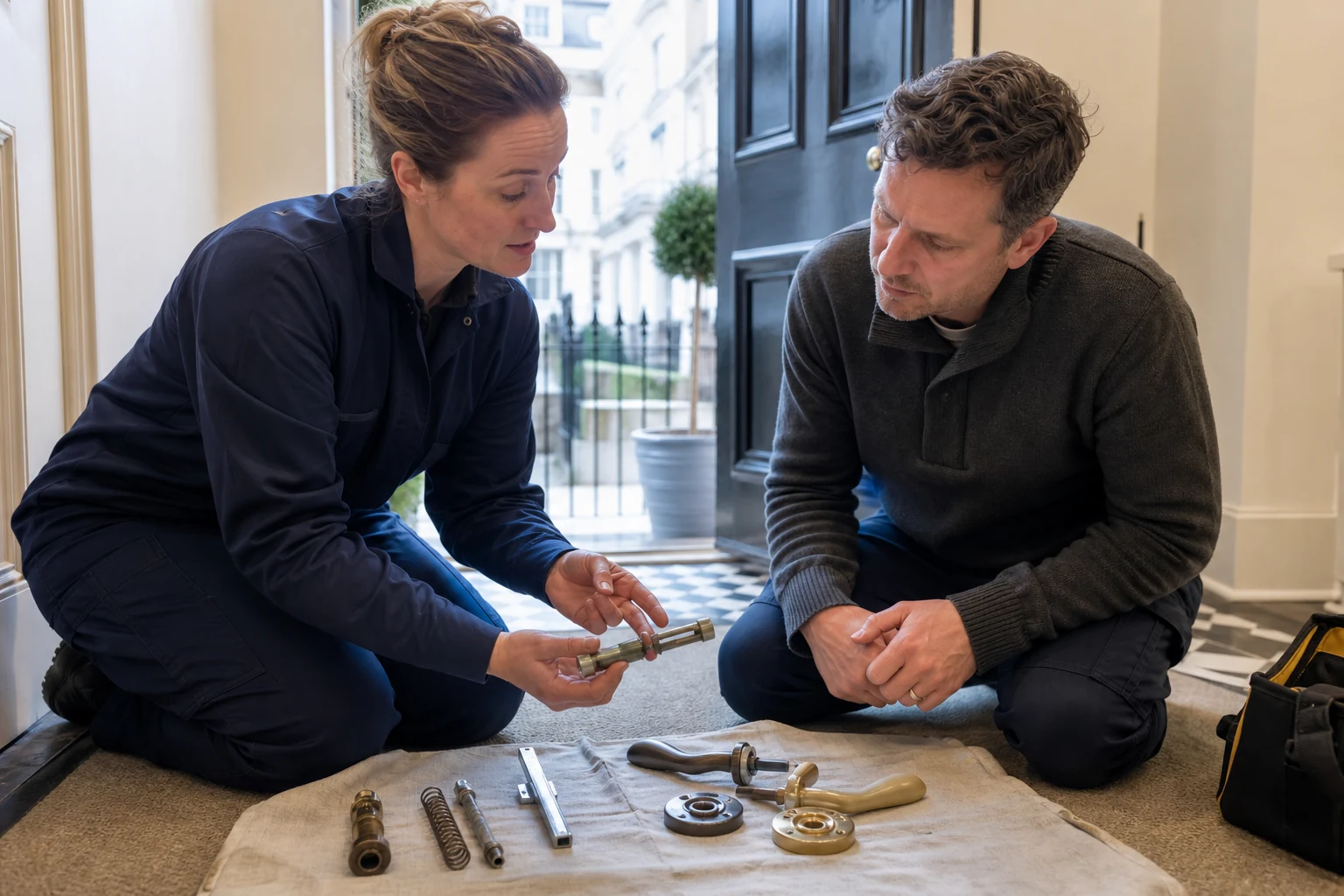
Dated fault timeline
Record when a key first became stiff, when the latch began missing or when the handle stopped returning. Add later entries only from ordinary use. Do not repeatedly cycle the door, move a keep or force a key for a more complete diary.
Include door position and direct contact. “Needed a pull while closed” is useful; “the hill moved the frame” is unsupported. The locksmith can assess mechanical components and alignment, while wider property movement belongs with the appropriate professional.
| Timeline field | Factual entry | Use in assessment |
|---|---|---|
| First change | Date or period and ordinary action involved | Establishes sequence without cause |
| Door position | Open, meeting frame, closed or locked | Separates free lock movement from engagement pressure |
| Resistance point | Key, handle, latch, top, side or threshold | Directs the first inspection |
| Later change | Only observed increase, decrease or new symptom | Shows progression without staged testing |
| Safety state | Secure, insecure, jammed or restricted access | Sets attendance priority and preparation |
Arrival record
Give the authorised entrance, number of access stages, outdoor steps and safe place for tools. Clear loose items and provide lighting. Do not ask the locksmith to carry equipment across a neighbour’s path or unstable ground.
At the door, preserve its current position. Photograph the full leaf, lock faces, edge and frame. Keep keys and fragments. If the door is communal, arrange management authority and every controlled key before attendance.
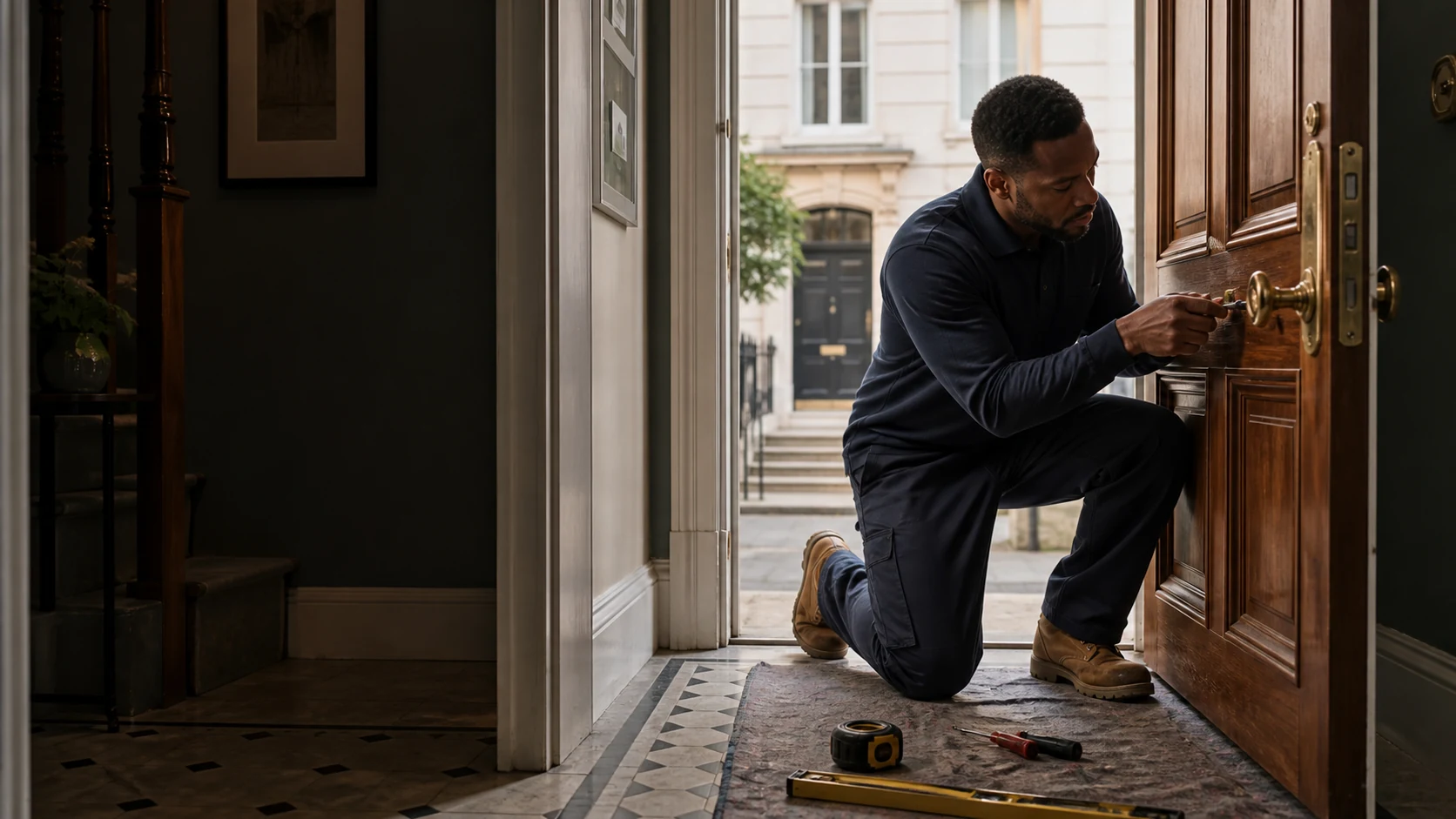
Timeline to first check
| Timeline pattern | Safe observation | Inspection boundary |
|---|---|---|
| Key gradually stiffens in all positions | Compare sound keys without force | Keyway and lock condition |
| Key stiff only after closure | Record door pressure and contact | Lock versus alignment |
| Latch increasingly misses keep | Photograph contact unchanged | Leaf, hinges, frame and latch |
| Handle return becomes slow | Limit use and note resting position | Furniture, spindle and case |
| Door intermittently jams | Record genuine dates and position | Changing contact and component wear |
| Visible frame change accompanies fault | Preserve photographs and seek advice | Locksmith evidence versus wider building review |
Fault-led services
A serviceable component can be repaired after condition is confirmed.
Open and closed operation is compared before adjustment.
Dimensions and function guide hardware when repair is unsuitable.
Fragments are preserved and removed before further decisions.
Authority and door state guide the opening method.
Structural questions remain with the relevant building professional.
Quote against the timeline
Muswell Hill does not determine a standard price. Access, assessment, labour and parts shape the quote. The proposal should state what the locksmith can conclude and what remains outside that discipline.
| Line | Evidence | Boundary |
|---|---|---|
| Access | Steps, slope and controlled route | Safe areas available |
| Diagnosis | Timeline and direct tests | Mechanical finding and limits |
| Adjustment | Measured contact | Specific hinge or keep change |
| Repair | Identified component | Part, labour and final test |
| Replacement | Dimensions and compatibility | Hardware, keys and preparation |
| Wider concern | Frame or building observations | Referral to appropriate provider |
When hidden damage appears, pause for revised approval. A dated symptom record does not authorise undefined work.
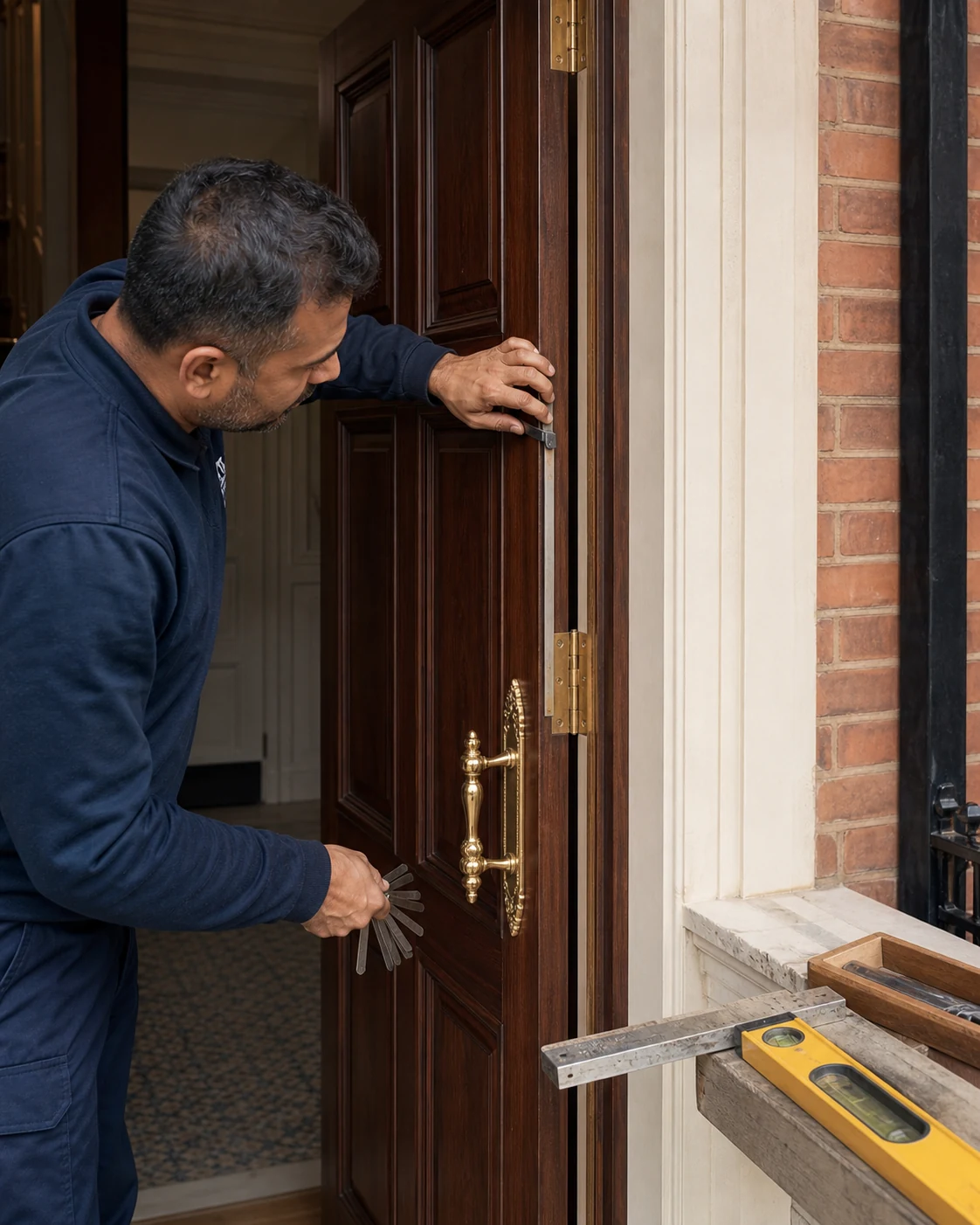
Muswell Hill property context
A stepped period entrance may require a street-level meeting contact and clear landing. The age and slope do not diagnose the door.
A converted house can separate communal and private authority. Record each symptom at its own door and involve management where needed.
Split levels can make it harder for the decision-maker to observe the entrance. Arrange someone who knows the timeline and can approve work.
Close the timeline
Test closing, latching, locking, unlocking and release. Note the repaired stage and whether any contact remains. Count keys.
Record referred door or building concerns and preserve the before-and-after observations for the property file.
Muswell Hill fault-timeline FAQ
Record genuine changes from ordinary use. Do not continue unsafe operation to create more data.
No. It is access context, not a mechanical or structural diagnosis.
Only when directly observed alongside the event, without claiming causation.
No. Old marks do not prove the correct current alignment.
Use an appropriately qualified property professional; the locksmith reports door-and-lock evidence.
Yes when assessment identifies the fault. The diary supports inspection but does not need to delay safe work.
Arrange freeholder or managing-agent authority before alteration.
Keep the finding, work, normal-operation test, keys and remaining limitations.
Date the change, not the assumed cause
Send the Muswell Hill address, steps, direct fault chronology and authorised contact.
Reading the timeline on site
Begin by confirming that the recorded events concern the same entrance. In a converted house, a street door and flat door may both have been described as “front”. Give each a separate label, owner and chronology. A mismatch at this stage can send an otherwise accurate account towards the wrong mechanism.
Read the entries in order but do not assume that the earliest observation identifies the cause. A stiff key, changing latch contact and slow handle return may be related or may be separate. The on-site assessment compares the key, furniture, lock case, door edge, hinges and frame while preserving the distinction between direct evidence and inference.
Access notes are reviewed in parallel. Steps, a slope, a narrow landing or split levels determine how the locksmith and tools reach the entrance safely. They do not demonstrate why the leaf meets the frame differently. Keep route photographs separate from close images of the lock so the property record does not accidentally present access context as technical proof.
Where safe, the mechanism can be observed with the door open and then at natural closure. No one should lift or pull the leaf to obtain a better result. If normal pressure changes operation, record the direction and stage. If a key flexes, hardware loosens or the door cannot secure or release, stop further household testing.
After inspection, mark each timeline entry as explained, still unconfirmed or outside the locksmith’s boundary. A mechanical finding can support lock repair or measured replacement. Visible cracks, distorted frames or suspected building movement should be recorded without diagnosis and passed to an appropriately qualified property professional.
The approved scope should then refer back to the evidence it addresses. An adjustment can identify the measured contact; a repair can name the component; a replacement can state dimensions, operation and key quantity. General consent to “sort the door” is too broad when finish, joinery or structural questions may remain.
At completion, perform one ordinary test from both sides where authorised. Check closing, latching, locking, unlocking and release. Add the result to the chronology with keys supplied and limitations. The final entry closes the visit, while any referred concern remains visibly open rather than disappearing beneath a successful lock test.
If access to the door itself is difficult, describe a stable working position before attendance. A steep approach, external steps or restricted landing may affect equipment handling and the order of inspection. Clear loose objects and provide light, but do not undertake unsafe building changes simply to prepare for a locksmith.
Keep copies of the chronology with the person responsible for future maintenance. A new resident or managing agent can then see what was observed, what was ruled out, what was repaired and which question was referred. This continuity is more useful than a collection of undated photographs.
