
Existing-lock assessment
Operation, wear, key behaviour, case condition and door engagement are recorded before deciding what is reusable.
Retain · repair · adapt · replace · record the finish
Plan the acceptable change before selecting hardware. On a period entrance or finish-sensitive apartment door, the best mechanical option must also respect retained features, visible evidence and building authority.
The acceptable-change envelope
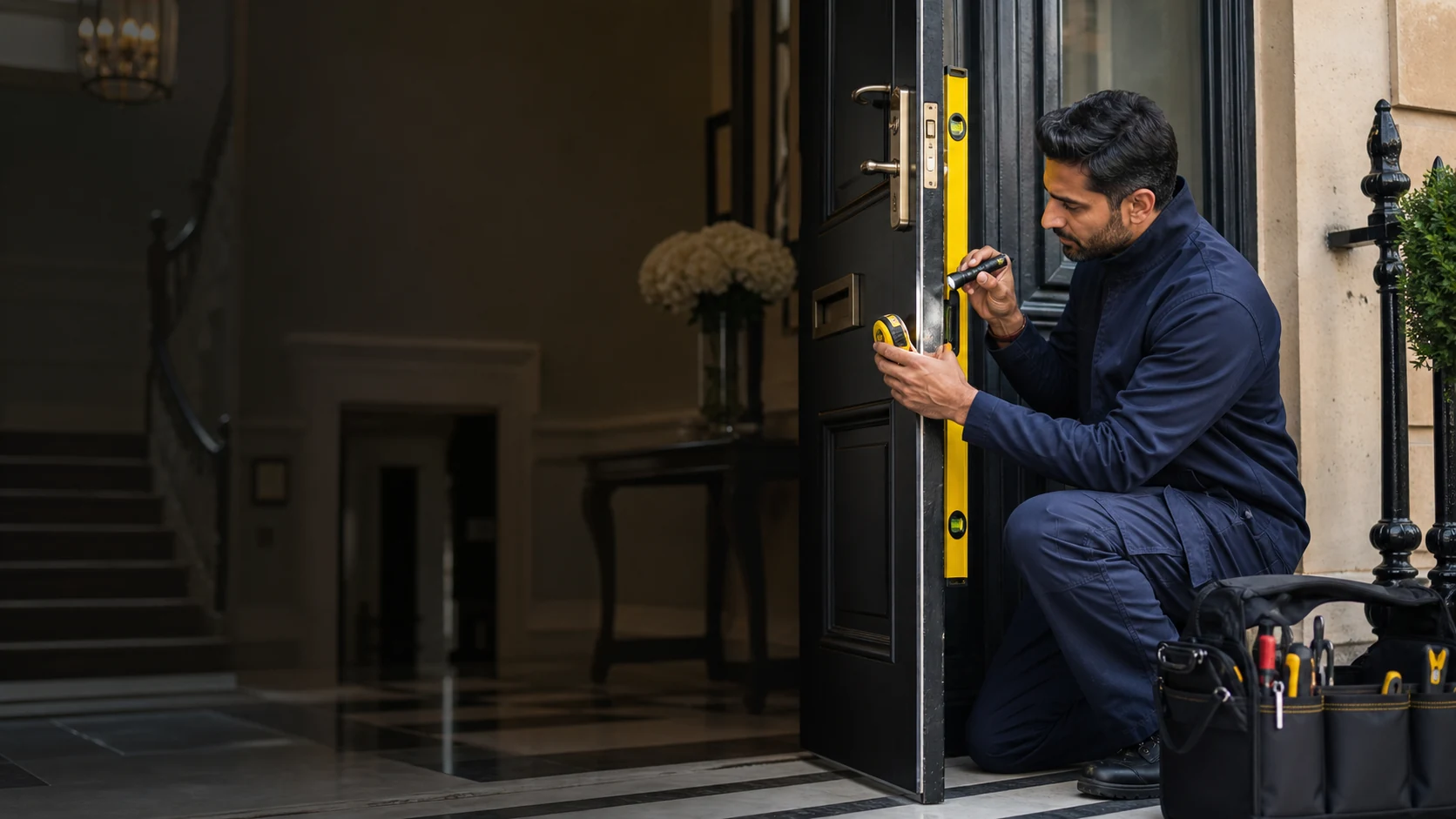
Richmond’s period terraces, riverside apartments and family homes call for different decisions. A painted timber entrance may have established furniture and old fixing holes; a managed apartment may need an approved appearance and protected door construction; a modern family entrance may place everyday operation first. “Match the lock” does not say which of those matters most.
Create an acceptable-change envelope. List what must stay, what can be altered with approval and what outcome is required. The locksmith can then distinguish a repair that retains most visible material, an adaptation using sound existing openings and a replacement that changes the outline. This avoids discovering the client’s finish requirement after a mechanically suitable part has been fitted.
| Feature | Question before work | Evidence to keep |
|---|---|---|
| Door leaf and frame | Are repairs, fresh cut-outs or new fixings permitted? | Wide photographs of both faces and the edge |
| Escutcheon or backplate | Must the existing outline remain covered or visible? | Dimensions, fixing centres and paint shadow |
| Knob, lever or pull | Is it functional, decorative or part of the lock operation? | Both faces, spindle and movement |
| Existing lock case | Can it be serviced, adapted or removed? | Case markings and mortice dimensions where safely accessible |
| Keying arrangement | Which authorised users and doors must remain coordinated? | Key count and access schedule, without publishing key codes |
| Managed-door features | Does the freeholder control appearance, closer or fire performance? | Written building rule or approval route |
| Finish and ageing | Is exact match, compatible tone or deliberate contrast acceptable? | Daylight photographs and a stated priority order |
Evidence without damage
Take straight-on and angled photographs in natural light where possible. Include the whole door, the relationship between separate furniture items, the edge, frame keeps and any old repair. A close photograph records texture; a wider view records proportion. Neither alone is enough for a finish-led decision.
Do not polish, paint over, prise off or dismantle hardware merely to reveal a mark. Record visible information and let the assessment decide what can be safely removed. If a component has heritage or personal value, label that explicitly and agree who retains it after work.

Option appraisal
| Option | Potential advantage | Evidence and limitation to confirm |
|---|---|---|
| Service and adjust | May retain existing case and furniture | Condition, available adjustment and reliable final operation |
| Replace cylinder only | Can change key access with limited visible impact | Correct type, cam, dimensions and sound remaining mechanism |
| Replace compatible handles | Addresses worn movement or finish objective | Centres, spindle, projection, springing and old outline |
| Adapt within existing mortice | May reduce new disturbance to timber | Case size, backset, security objective and approved packing or finishing |
| Install a different case | May meet an operational need when old item is unsuitable | New cut-out, fixing positions, furniture relationship and finish repair |
| Replace multipoint component | Restores a failed part within a modern system | Exact dimensions, strip layout, alignment and door condition |
| Refer door-set work | Protects controlled or materially damaged doors from unsuitable alteration | Joinery, fire-door or building-management responsibility |
Planned locksmith services
Operation, wear, key behaviour, case condition and door engagement are recorded before deciding what is reusable.
Dimensions, cam, projections and authorised key holders are matched to the access objective.
Fixing centres, backplates, spindles, escutcheons and old outlines are mapped before a visible change.
Mortice dimensions or multipoint markings guide compatible repair and replacement options.
Hinges, keeps, latch and bolt alignment are considered so new hardware is not used to mask door movement.
Freeholder, fire-door and appearance controls are established before any private instruction proceeds.

Riverside and period-building practicalities
Report external exposure and any change in operation after wet or warm conditions, but do not diagnose from the riverside setting. Timber movement, hinge wear, frame engagement and internal lock condition require direct comparison. A finish that weathers naturally may be acceptable to one owner and not another, so write the maintenance expectation into the decision.
In an apartment, establish reception access, working hours and the rule for entrance hardware. A building preference for a particular visual form still requires door-level measurement. In a terrace, protect floors and nearby decoration and identify any alarm contact, letterplate or furniture close to the proposed work.
Where finish is important, agree whether a catalogue reference or physical sample is being approved and under what light it was viewed. Existing aged metal, fresh replacement metal and digital photographs can look different. The quotation should promise the named finish supplied, not an unverifiable perfect visual match.
Decision-ready quotation
Richmond does not create a standard price. Access, assessment, component availability, authorised alterations and finishing responsibility shape the quotation. Compare options on the same written outcome.
| Field | Scope to state | Acceptance evidence |
|---|---|---|
| Retained items | Door, frame, case, furniture and items returned to client | Before photographs and inventory |
| Permitted alteration | Drilling, morticing, fixing positions and old-outline treatment | Written acceptable-change envelope |
| Mechanical part | Type, dimensions, compatibility and included keys | Normal operating and security test |
| Visible finish | Named product finish and matching hierarchy | Approved reference, with ageing limitation |
| Door-position work | Hinges, keeps and structural exclusions | Closed-door test without abnormal force |
| Managed requirement | Freeholder approval, controlled features and nominated specialists | Authority confirmed before alteration |
| Making good | Holes, paint, timber repair and responsibility for decoration | Included work and exclusions listed |
| Handover | Keys, old components, care note and remaining observations | Signed count and completion record |
If removal reveals hidden damage or an incompatible case, pause for a revised option. The client should see how function, new work and finish treatment change before approving more.
Richmond locksmith FAQ
No. Condition, available components, reliability and the required security outcome must be assessed before promising retention.
An exact visual match is difficult to guarantee. Approve a named finish and state whether tone, shape or retained material has priority.
It may. Measure backplates and escutcheons and agree how uncovered paint or timber will be handled before work.
Yes when the existing system is sound and the correctly measured cylinder meets the access objective.
The owner or authorised occupier may also need freeholder or managing-agent consent, especially for controlled door sets.
No. Photograph visible details and allow the locksmith to plan safe inspection without unnecessary disturbance.
Sometimes, but case dimensions, backset, bolt positions, furniture and security function must be compared directly.
Agree this in advance. Items can be returned, retained temporarily or disposed of according to the written handover.
Test operation, inspect agreed visible areas, count keys, reconcile retained items and record any making-good work outstanding.
Map and nearby live pages
Choose the page matching the property and access conditions. These nearby area pages are already live or included in the final set.
Agree the acceptable change
Send photographs, retained features, permitted alterations, operating problem, finish priorities and the authorised decision-maker.
Care after installation
Ask for care guidance that matches the supplied material and keep abrasive products away unless the manufacturer permits them. Report new stiffness rather than masking it with an unsuitable spray or extra force. Periodic observation of fixings, handle return and frame engagement helps separate ordinary finish ageing from a mechanical change that needs assessment.
