
Authorised opening
Door state, evidence of authority and actual hardware guide an explained method and security plan.
Handle · cylinder · mechanism · alignment
A multipoint entrance is a sequence, not a single lock. Describe what the key, handle, hooks or bolts and door position do at each stage so the faulty function can be assessed before parts are chosen.
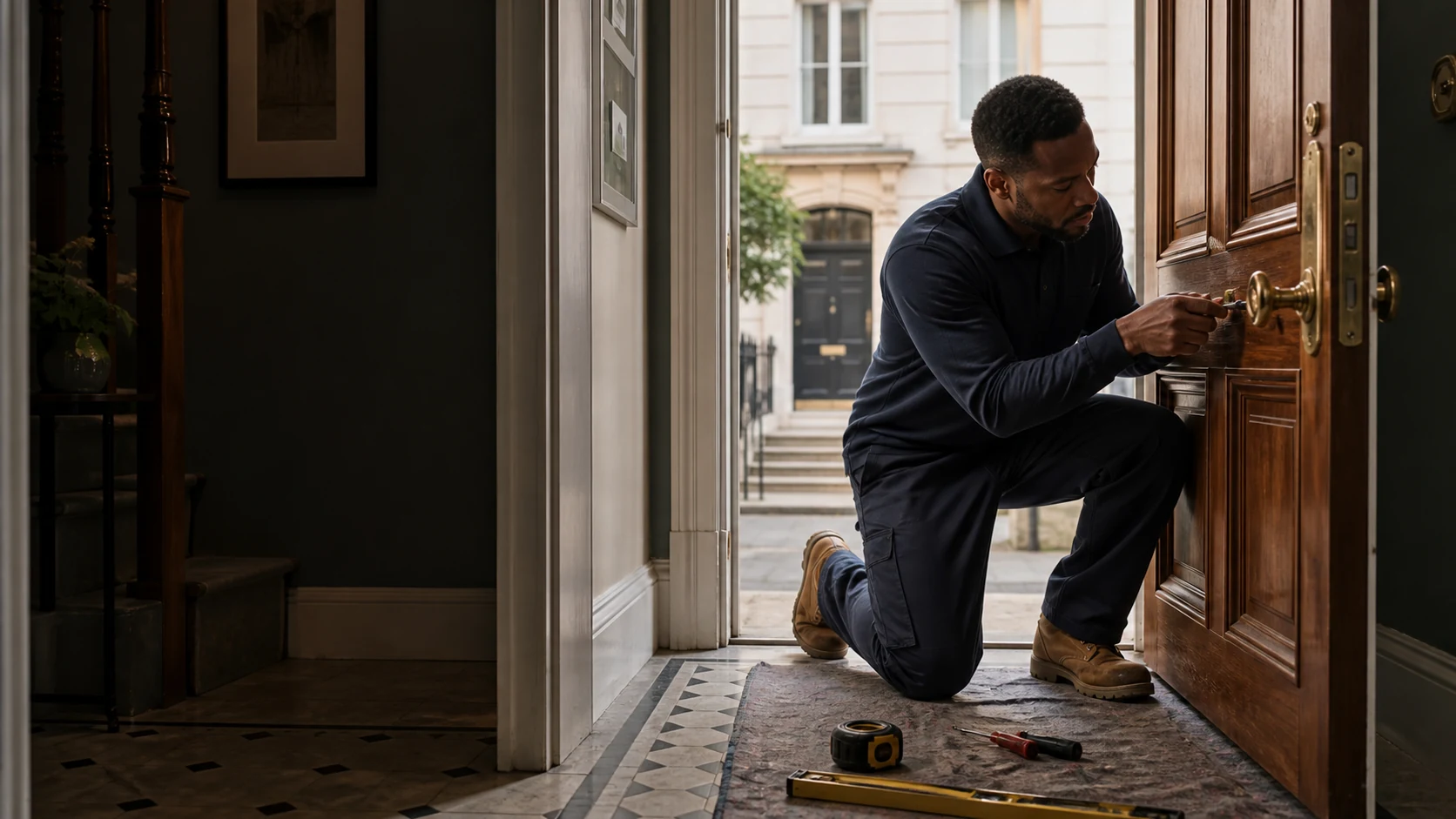
Operating-sequence record
Begin with the door open or closed. If it is open and can safely remain open, do not close it simply to repeat a fault. Note the handle position before touching the key, whether the handle lifts fully, how the key turns, and whether it can be removed. Avoid repeated force when the resistance has changed.
A useful record says “the handle lifts when the door is open but stops halfway when the door meets the frame”. That observation is more useful than naming a gearbox from a photograph. It shows that alignment or contact may need to be assessed alongside the internal mechanism. The eventual finding may involve one part, several interactions or ordinary door maintenance outside a locksmith-only scope.
| Stage | Safe observation | What remains unconfirmed |
|---|---|---|
| Approach | Door open or closed, access available, visible damage or obstruction | Internal condition and suitability of any opening method |
| Handle movement | Lift, downward movement, return and looseness without extra force | Handle set, spindle and mechanism relationship |
| Key movement | Entry, rotation, resistance point and withdrawal | Key wear, cylinder condition and transmitted movement |
| Locking points | Visible hooks, bolts or rollers moving only when safely observable | Hidden strip and gearbox condition |
| Frame meeting | Where the leaf first contacts seals, keeps, sill or frame | Adjustment, hinge condition and preparation needed |
| Final closure | Whether the door closes, latches, locks and reopens normally | Reliability until a complete inspection and test |
Cylinder or mechanism?
A cylinder accepts the key and transfers rotation. The multipoint mechanism moves locking elements along the door edge. Handles and a spindle can operate the latch or lift sequence. These parts have to match one another and the door preparation. A stiff key does not prove the cylinder alone is responsible.
If the door is open, note whether the key behaves differently away from the frame. Stop if the mechanism cannot be operated gently or if the door could become insecure. Do not remove the cylinder, loosen handle screws or spray an unknown product into the lock. An incomplete dismantling can lose the useful relationship between the symptom and assembled system.
Send a whole-door photograph, both handle faces, the door edge and the frame keeps. Measurements and part identification are confirmed from the actual installation, not promised from colour or a close-up of the keyway.
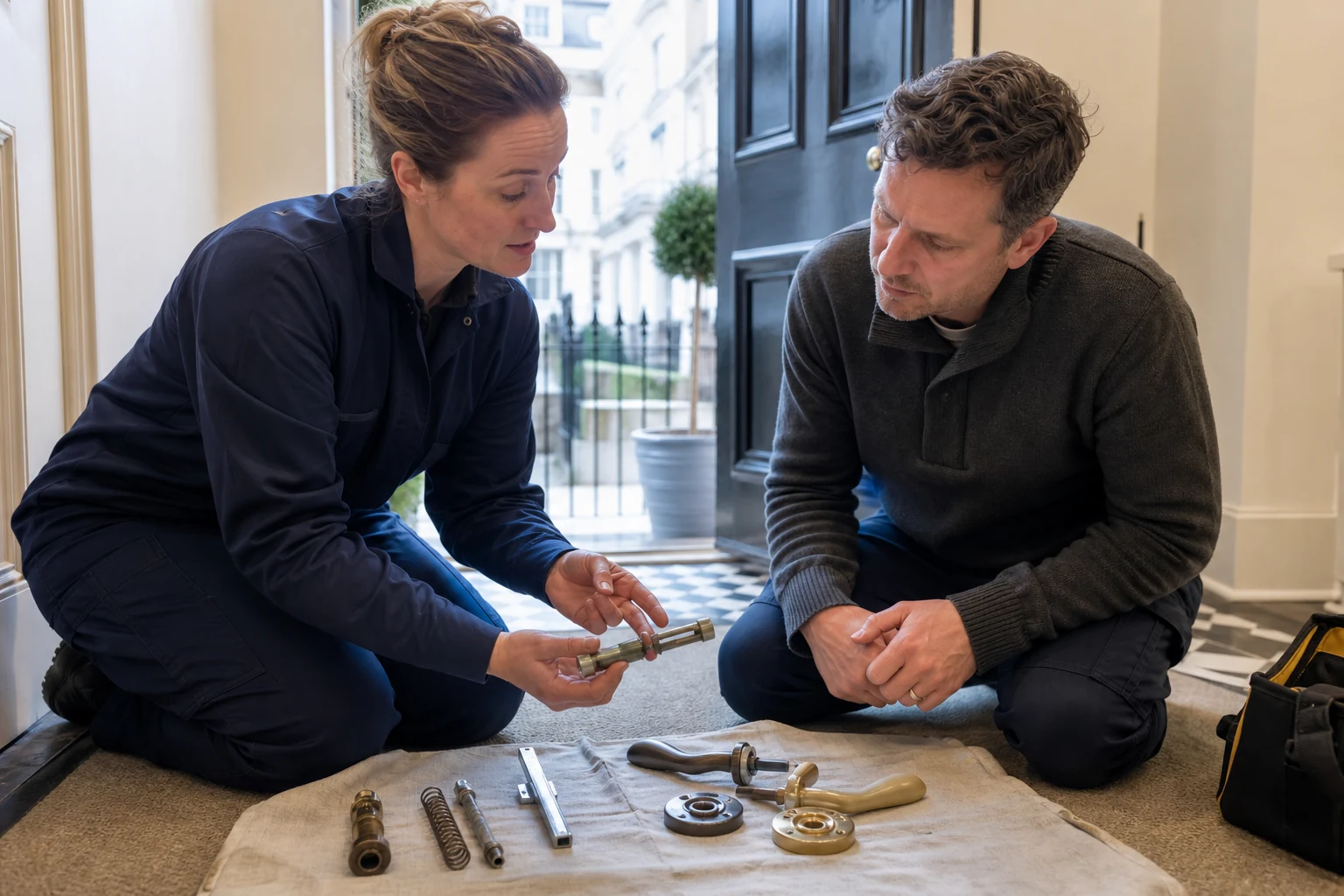
Problem-to-next-step guide
The safest next step depends on door state and the point where operation changes. The table below is a booking guide, not a remote diagnosis. It helps keep possible lock work, door adjustment and access needs in view.
| Reported behaviour | Useful comparison | Assessment question |
|---|---|---|
| Handle lifts open but not closed | Observe frame contact without forcing the handle | Do leaf position, keeps or seals prevent full travel? |
| Handle will not lift in either position | Leave assembled and note the first resistance point | Are handle, spindle or internal mechanism restricting movement? |
| Key turns but door remains locked | State handle position and whether rotation feels connected | Is movement reaching the gearbox and locking strip? |
| Key only turns when pressure is applied | Describe direction and degree of gentle pressure | Is door loading affecting latch, bolts or cylinder transfer? |
| Door locks but key will not withdraw | Stop repeated cycles and preserve the current state | Are cylinder position and mechanism travel completing correctly? |
| One locking point appears out of line | Photograph edge and matching keep without adjustment | Does the door need alignment, keep work or mechanism assessment? |
| Closed rear door cannot be opened | Confirm authorised alternative access to the property | What opening route and post-entry repair are proportionate? |
A system-based scope
Door state, evidence of authority and actual hardware guide an explained method and security plan.
Leaf position, hinges, seals, sill and keeps are reviewed alongside locking travel.
Handle set, fixings, spindle and return are considered without assuming the gearbox has failed.
Key operation, dimensions, compatibility and desired key outcome support retention or replacement.
Identification and condition determine whether adjustment, serviceable repair or replacement is proposed.
Distortion, damaged preparation, hinges or structural frame work can require a door specialist.
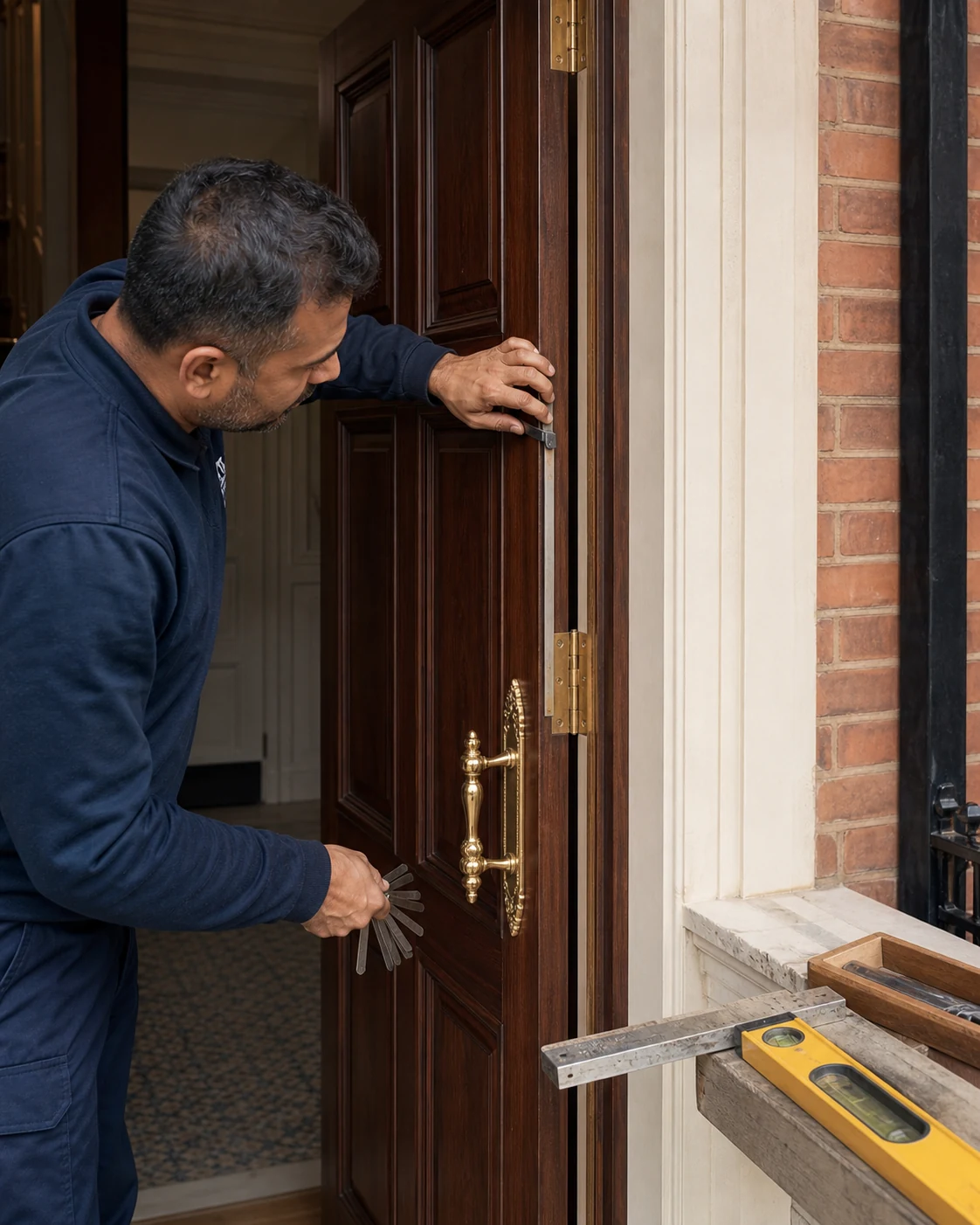
Putney property context
Putney enquiries can involve riverside flats, terraces, managed developments and rear multipoint doors. Those contexts help organise the visit; they do not establish the material, hardware, weather exposure or fault at a particular address.
For a terrace, say whether the affected door is at the street, rear garden or side passage. If a rear door is closed, explain whether lawful entry through the front leaves safe internal access to it. Do not climb a fence, cross a neighbour’s property or use a balcony as an improvised route.
For a managed flat, distinguish the common entrance from the private door. Reception or management may control contractor access and building credentials, while the resident or owner handles private mechanical work under the applicable agreement. Actual restrictions should be supplied from current building documents.
Where an entrance faces an exposed position, describe observed moisture, swelling or seasonal change rather than attributing it to proximity to the river. Inspection should determine whether seals, door movement, keeps or lock components contribute.
| Property arrangement | Prepare before attendance | Boundary to keep visible |
|---|---|---|
| Terrace with rear multipoint door | Front access, rear-door state, keys and full edge photographs | Lock system versus door alignment and garden access |
| Riverside flat | Actual entrance exposure, floor route and private authority | Observed condition versus assumption from setting |
| Managed development | Registration, management contact and exact private entrance | Common access versus resident lock work |
| Converted house | Common front door, freeholder contact and private flat details | Shared and private key plans |
| Ground-floor patio entrance | Safe internal approach, external obstruction and door state | Locksmith access versus glazing or door repair |
Quote by function
Price depends on access, whether the door is open or closed, investigation, labour, compatible parts and any adjustment or making good. Putney alone cannot establish those inputs. Ask for a scope that names the functions to be assessed and the approval point if findings change the plan.
The route, door state and customer authority are recorded.
Handle, key, mechanism and frame contact are assessed safely.
Adjustment, repair, replacement and door work remain distinct.
Parts, labour, destructive steps and exclusions receive consent.
Closing, locking, unlocking and reopening complete the handover.
If the mechanism cannot be identified until controlled removal, the quote should say so. An unexplained generic part should not replace measurement and compatibility checks.
Putney locksmith FAQ
Frame contact or alignment may be involved, although the complete mechanism still needs inspection. Stop forcing it and describe the difference between positions.
No. Key wear, cylinder condition, mechanism load and door pressure can produce related symptoms. Assessment should keep them separate.
Repeated force can worsen the condition or leave the door closed. Record the current behaviour and avoid unnecessary cycles.
Do not add an unidentified product. The material, mechanism and maintenance requirement should be confirmed before treatment.
Send the complete door, handles, keyway, full door edge and matching frame keeps, plus any visible contact point.
Sometimes that may meet the finding and desired key outcome, but dimensions, compatibility and mechanism operation must be verified first.
The resident, owner, landlord or manager should follow the actual lease or tenancy boundary. Management controls common entrances.
Explain the internal and external routes when booking. Do not cross neighbouring property or attempt an unsafe access method.
Check handle travel, key operation, all accessible locking points, closing, locking, unlocking and reopening with the customer.
Nearby coverage
Use the task links for the relevant service and current nearby pages for other property guidance.
Describe the whole operating sequence
Send the door state, handle and key behaviour, frame comparison, access route and authority for a finding-led scope.
