
Leaves
Wet leaves can settle into layers and slow water moving towards an outlet.
Rainwater routes · access · clear scope
Overflowing rainwater can point to leaves, moss or silt restricting a channel, but the cause is not always visible from below. Our Ilford gutter-cleaning service begins with the actual roofline and access needs, then sets out which gutter runs and reachable outlets can be cleared and which concerns need separate assessment.

Seasonal context
Build-up does not follow a universal calendar. A channel near overhanging growth may collect material at a different rate from a more open elevation, and loose moss can arrive after wet or windy weather. Visible symptoms and the condition of the actual roofline are better guides than an automatic interval.
Nearby trees, roof moss, gutter shape and exposure can all affect how quickly material accumulates. A visible symptom is more useful than applying one fixed timetable to every address.
Common causes
Leaves can form a wet layer across the channel, while moss and fine silt occupy the smaller route towards an outlet. Twigs or loose roof material may hold that build-up in place. Where water still struggles after accessible debris is cleared, a deeper restriction or defect may need separate investigation.
Wet leaves can settle into layers and slow water moving towards an outlet.
Loose roof moss can collect in the channel and hold other material in place.
Small twigs can bridge narrow points and trap lighter debris behind them.
Loose surface material may wash down from the roof during wet weather.
Older material can become dense and reduce the channel available for runoff.
Fine deposits can gather beneath larger debris and close to an outlet.
Local property context
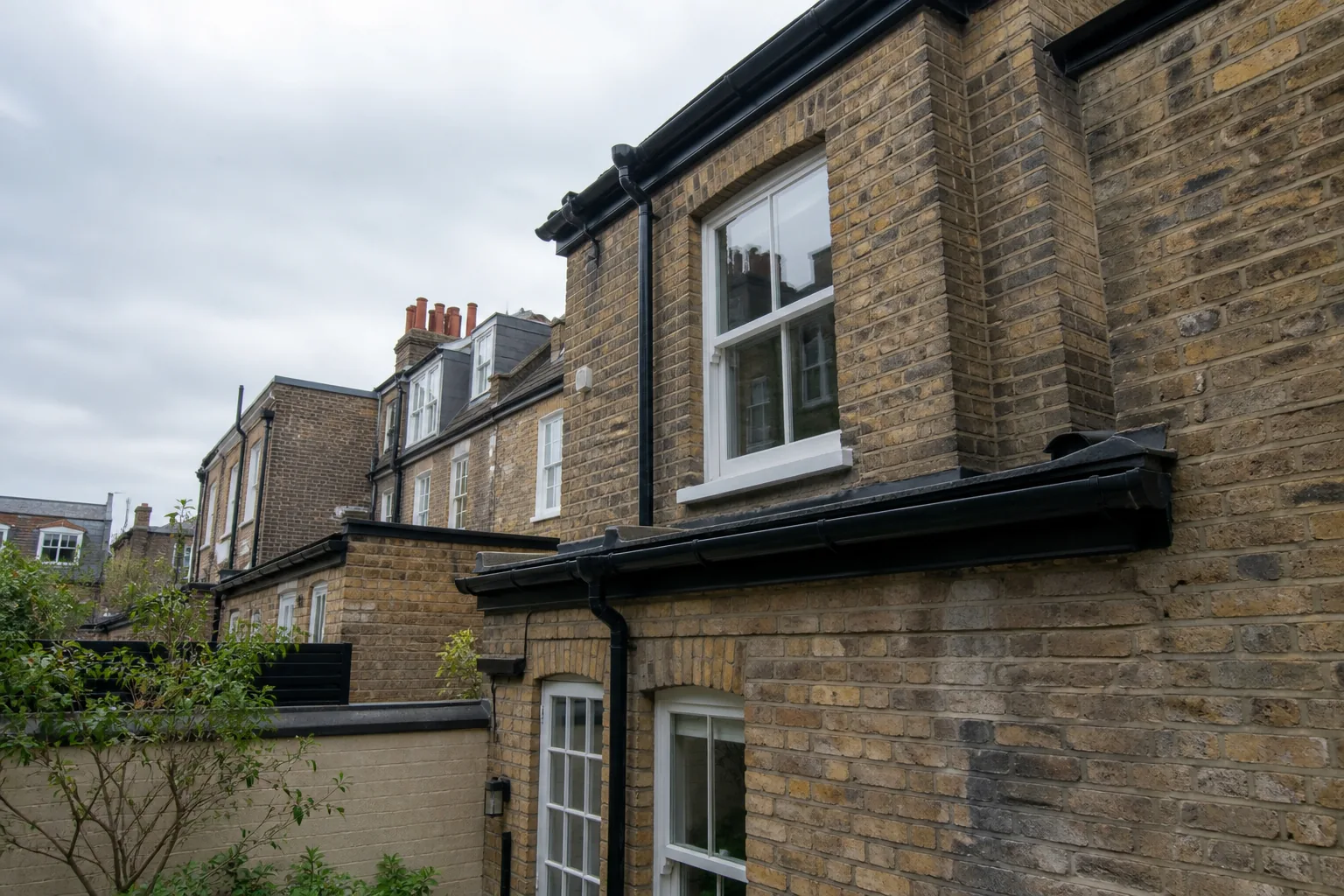
Homes in Ilford cannot be treated as one standard access job. Some streets may include closely spaced terraces, while other addresses may have side passages, extensions or converted roof areas that change how a gutter can be approached. Even neighbouring properties can present different working space and channel layouts. A useful enquiry therefore identifies the elevations causing concern, any shared boundaries and anything beneath the gutter line. The actual address determines what can be included safely, rather than a general description of the area.
A stain on an outside wall, dripping at a joint or water passing over the front edge can help locate the concern, although none proves that routine debris is the only cause. The channel may be restricted, an outlet may need attention, or a fitting could be damaged. Cleaning covers accessible agreed gutter channels, leaves, moss, silt and other routine debris, with reachable outlets included where agreed. Cracks, loose sections, concealed downpipe restrictions and underground drainage remain separate matters requiring their own assessment.
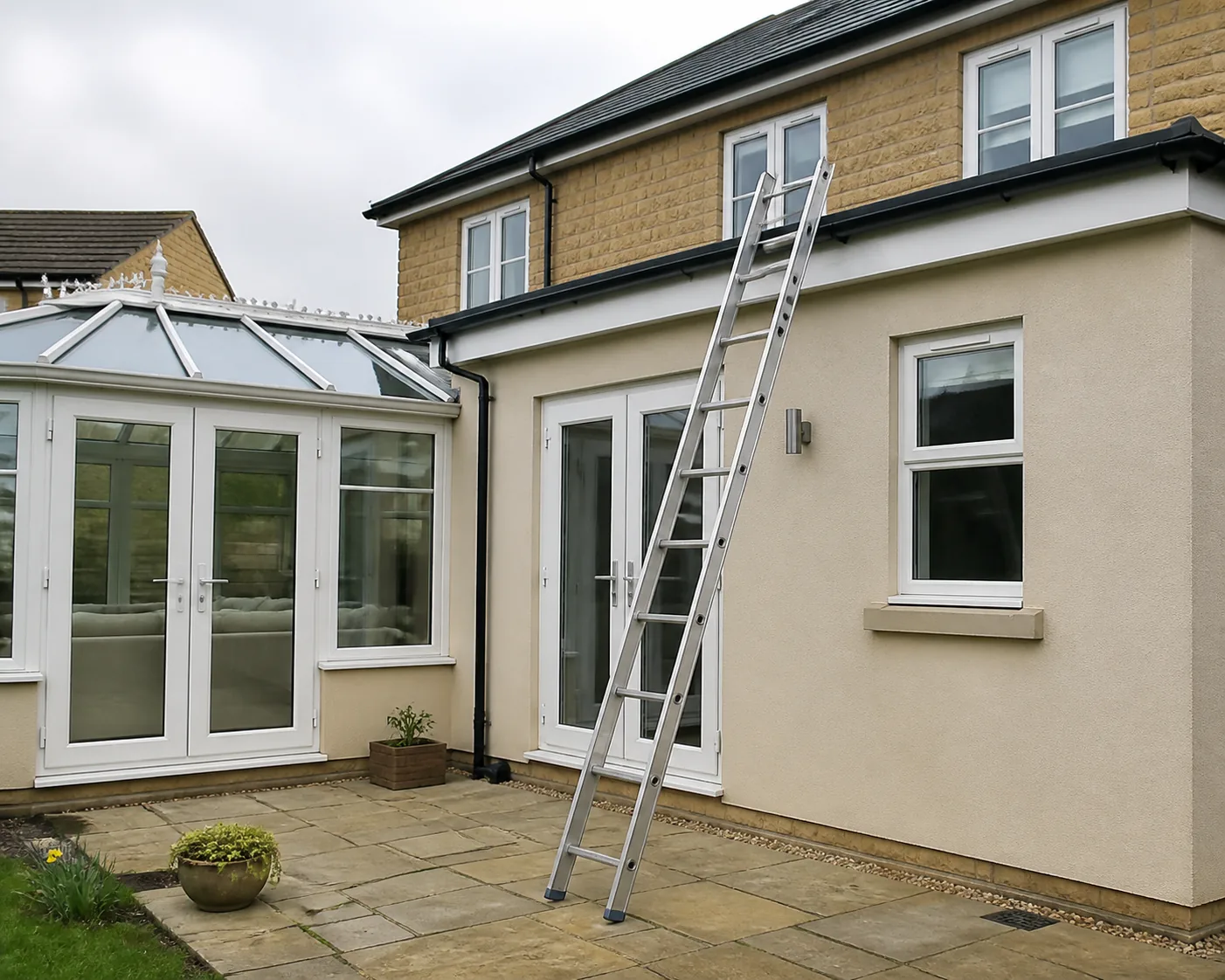
Access is considered for each elevation, not just for the building as a whole. Rear additions, narrow routes, neighbouring land, delicate surfaces below or changes in roof height may affect what is reachable. If an agreed section needs specialist access, that requirement is assessed separately before work is confirmed.
| Property situation | Access or gutter consideration |
|---|---|
| Closely spaced terrace | A narrow side route or a boundary below the gutter may limit approach options; each elevation needs its own access review. |
| Home with a rear addition | The addition may sit below an upper run or create a separate lower channel, so heights and surfaces beneath both need consideration. |
| Semi-detached property | Front, side and rear runs may have different working space, and only the accessible agreed sections are included. |
| Converted roof area | Changed roof shapes can introduce shorter channels or concealed transitions that require an address-specific scope. |
A clear service sequence
Structured service guide
| Part of the rainwater route | Cleaning position | When another assessment is needed |
|---|---|---|
| Accessible agreed channels | Leaves, moss, silt and routine debris can be cleared | When the section cannot be reached within the agreed access plan |
| Reachable outlet opening | Can be attended to when included in scope | When the restriction continues deeper into the pipe |
| Gutter fitting or joint | Loose debris around it can be removed | When it is cracked, open, displaced or leaking after clearance |
| Underground drainage | Not part of gutter-channel cleaning | Requires a separate drainage assessment |
Structured service guide
| Observed clue | Cleaning may help when | Repair may be relevant when |
|---|---|---|
| Water over the outer edge | Debris is reducing the usable channel | The channel is sagging or does not direct water correctly |
| Drip near a connection | Material is forcing water around the connection | A seal, joint or fitting has failed |
| Staining below a run | Past spillover followed accumulated debris | A crack or persistent leak remains after cleaning |
| Little flow at the pipe | The reachable opening is covered | A deeper or damaged pipe is restricting the route |
Structured service guide
| Factor | Why it matters | Useful information to provide |
|---|---|---|
| Number of elevations | Each run may need separate access and clearing | Identify front, rear and side concerns |
| Height and roofline changes | Different levels can change the workable scope | Share full-height exterior photos where possible |
| Space beneath the gutter | Extensions, boundaries or delicate surfaces may affect access | Mention known restrictions around the building |
| Outlet and downpipe symptoms | A reachable opening differs from a concealed blockage | Describe where water gathers or flow appears reduced |
Structured service guide
| If the address has | Question to resolve | Possible scope effect |
|---|---|---|
| A narrow side passage | Is there usable space below the side run? | The side elevation may need separate access consideration |
| A rear addition | Which upper and lower channels sit above it? | Runs can be assessed independently rather than grouped together |
| Adjoining rainwater goods | Where does the agreed responsibility end? | Only a clearly defined portion may be included |
| Several roof levels | Which level shows the symptom? | Height and access can differ for each affected channel |
Quick answers
The agreed, accessible gutter channels are cleared of leaves, moss, silt and routine loose debris. Reachable outlet openings are included where agreed, while deeper downpipes and underground drainage need separate assessment.
No. Debris is one possible cause, but a poorly aligned channel, damaged joint, restricted downpipe or unusually heavy rainfall may look similar. Cleaning and repair decisions should remain separate.
That depends on height, working space, boundaries and what lies below each run. The scope lists accessible elevations rather than assuming the whole building can be treated in the same way.
No. Cleaning removes routine debris from agreed accessible channels. Cracks, failed joints, detached sections, poor falls and other faults require a separate repair assessment and are not presented as cleaning.
The address, clear photos, the affected elevations, approximate building height and any access limits are useful. They help define questions, although the property review still controls the final scope.
Not necessarily. Nearby growth, loose roof moss, exposure and channel shape can change how quickly debris returns. Visible build-up or spillover is more informative than one interval applied to every home.
Ilford service area
Nearby gutter-cleaning pages
Before booking
It covers the gutter runs agreed as accessible, removing leaves, moss, silt and comparable routine debris. Reachable outlet openings can be attended to where included. It does not automatically cover concealed downpipes, repairs, underground drainage or any section requiring separately arranged specialist access.
Say whether the concern is at the front, rear or side, and note whether water spills from an edge, joint or outlet area. Ground-level photos taken during dry weather or rainfall can help distinguish the location, without requiring anyone to approach the roofline.
That can indicate a restriction farther into the downpipe, a drainage issue below ground, or a fault in the rainwater goods. Those possibilities sit outside routine channel cleaning and need an appropriate separate assessment before further work is proposed.
A shared or adjoining arrangement needs its limits understood before work is agreed. Access, ownership boundaries and the route of the channel can affect the practical scope. Only the clearly agreed, accessible portion should be included, with neighbouring areas left outside unless properly arranged.
Removing a build-up may stop water from reaching and spilling over a joint, but it will not mend a failed seal or cracked fitting. If leaking continues once the channel can carry water, the joint should be considered as a separate repair concern.
Possibly, but the extension changes the surface and working space beneath the upper run. Its roof material, projection, height and surrounding access all need consideration. The section is included only when it is assessed as accessible within the agreed service scope.
It may be, especially when water is visibly collecting near its outlet, but sound alone is not conclusive. Rainfall intensity, the roof area feeding it and flow elsewhere all matter. A concealed restriction is assessed separately from the reachable opening.
No general guarantee can be made. Fine silt, moss and small fragments may still gather around or beneath a guard, and the guard itself can affect access to the channel. Its condition and removal needs should be discussed before the scope is fixed.
It may be relevant when height, setbacks, restricted ground space or surfaces below prevent ordinary safe access to an agreed run. No particular access arrangement should be promised in advance; the requirement and any resulting change to scope are assessed separately.
The damaged area is kept distinct from the cleaning task. A loose bracket, crack, open joint or sagging section may need repair, and cleaning alone should not be described as resolving it. The suitable next assessment can then be discussed.
Discuss the actual roofline
A quote should reflect the number of agreed runs, their height and length, outlet needs, working space and any access complication. Photos and a clear address can help with the first review, but the final scope depends on the property. Repairs, deeper downpipes, underground drainage and specialist access are not folded into routine cleaning.
