
How is this priced?
Price the handle, supporting-material repair and decorative finish as distinct outcomes.
BLACKHEATH · HARDWARE AND FINISH
Replace a fitting without losing the surrounding finish.
A new handle can leave the outline of its predecessor on painted woodwork. For a Blackheath repair, show what needs to work better and what appearance should remain.
QUICK ANSWERS
Price the handle, supporting-material repair and decorative finish as distinct outcomes.
Suitable hardware replacement is different from reconstructing damaged joinery.
Several replacements can be reviewed if each has its own specification.
Agree purchase only after plate dimensions and mechanism compatibility are checked.
Damaged backing and requested making good influence the work needed.
A supplied cabinet can be assembled after product review; keep that request separate from restoring existing woodwork.
Do not rely on decorative moulding as an approved mounting surface.
The owner should approve visible finish changes before an alternative is fitted.
START WITH THE TASK
Assemble a cabinet without obscuring existing trim.
02 ↗Discuss shelving around decorative projections.
03 ↗Compare replacement plates with original hardware.
04 ↗Keep the screen footprint clear of wall detail.
05 ↗Choose a mirror position before marking paintwork.
06 ↗Assess the material beneath a loose fitting.
QUICK JOB FINDER
Assemble a cabinet without obscuring existing trim.
Explore this service ↗BLACKHEATH IN PRACTICE

Replace a fitting without losing the surrounding finish.
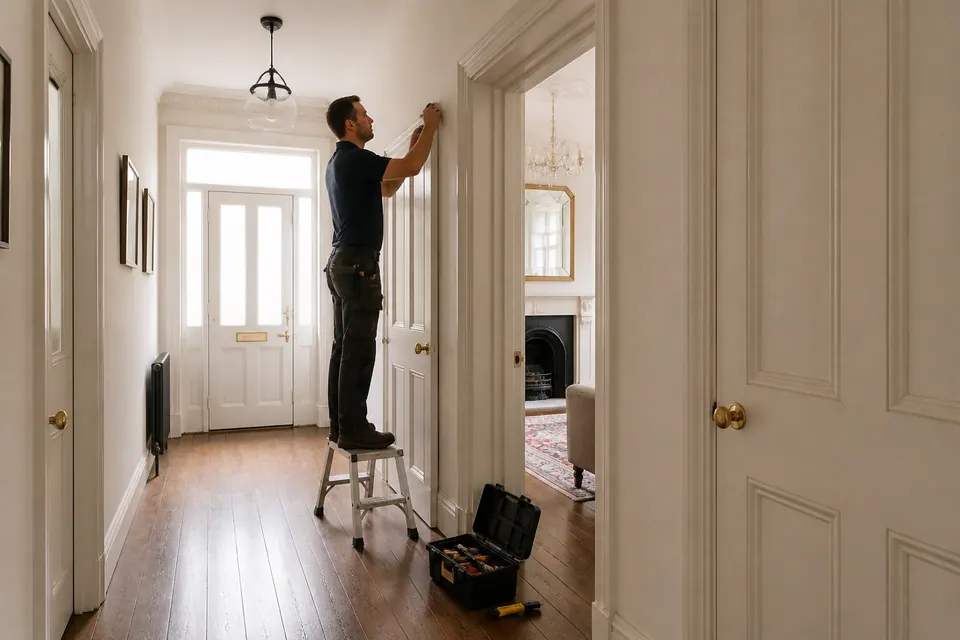
Compare the old backplate with the proposed replacement before ordering. Screw spacing is only one detail: the replacement may uncover paint edges or require another footprint.
Decorative trim near a mirror or shelf can constrain the fixing location. A wider photograph should show that trim as well as the apparently clear wall area.
Where timber has split around a fixing, changing the visible hardware may not resolve the fault. Ask whether the supporting material needs carpentry assessment first.
Assemble a cabinet without obscuring existing trim; Keep the screen footprint clear of wall detail; Assess the material beneath a loose fitting.
A JOB, MADE VISIBLE
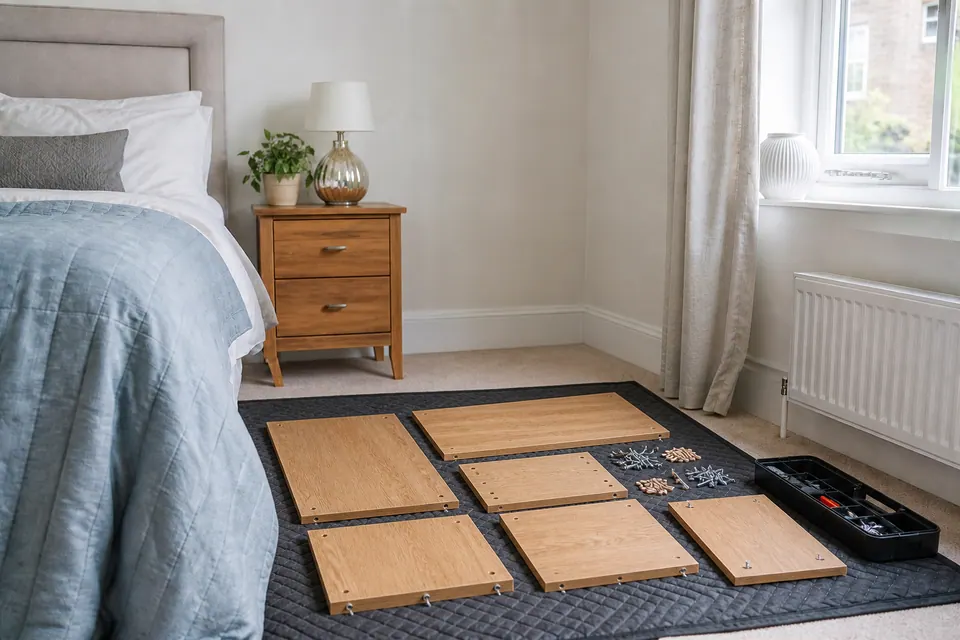
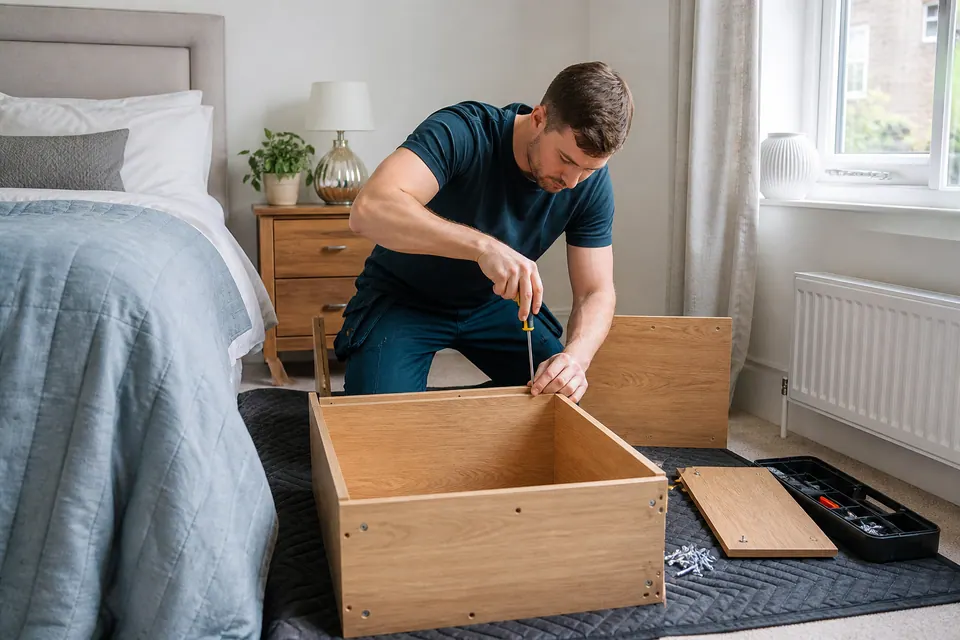
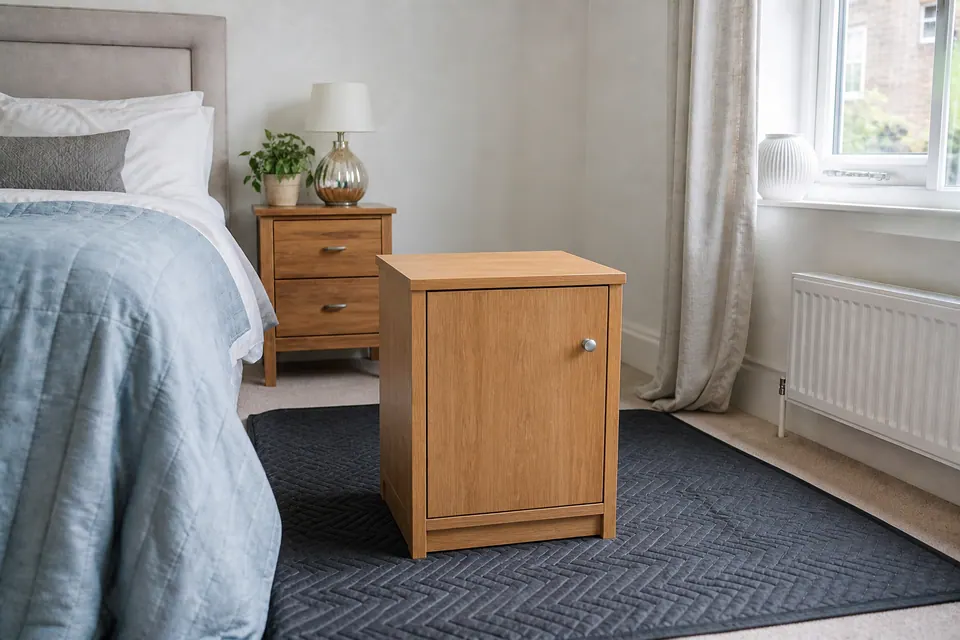
Illustrations explain assembly stages; they do not document a customer project.
CLEAR BEFORE YOU BOOK
Price the handle, supporting-material repair and decorative finish as distinct outcomes.
A supplied cabinet can be assembled after product review; keep that request separate from restoring existing woodwork.
Do not rely on decorative moulding as an approved mounting surface.
| Task | Pricing basis | Guide |
|---|---|---|
| Repair or fitting | Assess the material beneath a loose fitting | Reviewed quote |
| Small furniture assembly | Assemble a cabinet without obscuring existing trim | From £30 |
| Several small jobs | Several replacements can be reviewed if each has its own specification. | Agreed combined work |
| Complex mounting | Keep the screen footprint clear of wall detail | Mounting assessment |
For the published small-item guide, see Alesta’s furniture assembly page . Other fitting and repair requests are quoted individually.
Ask whether the estimate includes the visible fitting alone or also its damaged backing and exposed outline. Matching a finish and replacing hardware are different requirements.
WALK THROUGH THE PROPERTY
ROOM NOTES
Keep the screen footprint clear of wall detail. Include the trim behind the proposed accessory.
View the relevant service ↗| Job type | Example | Property area | Service |
|---|---|---|---|
| Assembly | Assemble a cabinet without obscuring existing trim | Furniture position | Furniture assembly |
| Mounting | Choose a mirror position before marking paintwork | Fitting wall | Fittings |
| Adjustment | Compare replacement plates with original hardware | Opening clearance | Door repair |
| Timber work | Discuss shelving around decorative projections | Storage space | Carpentry |
DIFFERENT ROOMS, DIFFERENT BRIEFS
show access to the finish-sensitive fitting.
identify original details to retain.
approve alternatives to the existing hardware.
label similar handles by their room.
protect equipment near the repair position.
confirm any alteration permissions.
Homeowner? Compare the old backplate with the proposed replacement before ordering. Screw spacing is only one detail: the replacement may uncover paint edges or require another footprint.
Landlord or manager? The owner should approve visible finish changes before an alternative is fitted.
Tenant? Ask the owner to approve alternatives to the existing hardware.
BUILD A REALISTIC LIST
Set the acceptable finished appearance before choosing between a direct hardware exchange and a repair to its supporting timber.
| Situation | A practical next step |
|---|---|
| Simple familiar task | Keep the original fitting in place for initial identification. |
| Several jobs or awkward fitting | Use a reviewed repair brief where timber beneath the plate is damaged. |
| Uncertain wall, load or fixing | An unfamiliar wall finish warrants assessment before accessory installation. |
| Gas, structure or fixed electrics | Refer specialist mechanisms or structural damage beyond decorative hardware work. |
FROM SMALL FIX TO FINISHED JOB
Photograph the original plate before selecting a replacement.
Compare compatible hardware and the visible footprint it will leave.
Agree access to the timber and which adjacent finishes must remain intact.
The reviewed scope should distinguish hardware work from repairs beneath it.
Inspect operation and the agreed appearance, recording anything awaiting wider finishing.
PLAN THE ARRIVAL
Send the Blackheath address details and explain access to the finish-sensitive fitting. Check availability and any entry restrictions before preparing the timber or removing original hardware.
Area orientation
THE DETAILS OF YOUR VISIT
Usually it covers less surface, so existing outlines may remain visible. Show both sizes and agree any cosmetic work separately.
An in-place view is useful first. Do not dismantle an unstable fitting merely for the enquiry; accessible dimensions can be supplied initially.
No. Spindle arrangement, screw centres and plate dimensions also matter. The old item and replacement specification need comparison before fitting.
Explain the proposed position and show the projection. The mounting arrangement must be suitable; decorative detail is not automatically a fixing surface.
Do not assume so. A split can compromise the fixing, and further force may worsen it. Report the condition for assessment.
Only if that finish has been agreed. Local touch-up, broader decoration and the hardware work should be described as distinct requirements.
Identify which features matter most and approve any alternative before purchase. A change in footprint may also change the finishing scope.
List the product alongside the finish-sensitive repair. Combining work depends on preparation, components and available time, not simply proximity between items.
Supply the existing fitting, proposed replacement and desired visible result. This separates a straightforward exchange from timber repair or decorative making good.
TURN THE LIST INTO A PLAN
Show the existing component, its surrounding material and the appearance you want preserved. Those details help distinguish a straightforward exchange from a broader timber repair.
Task images are illustrative.
