
Lockout entry
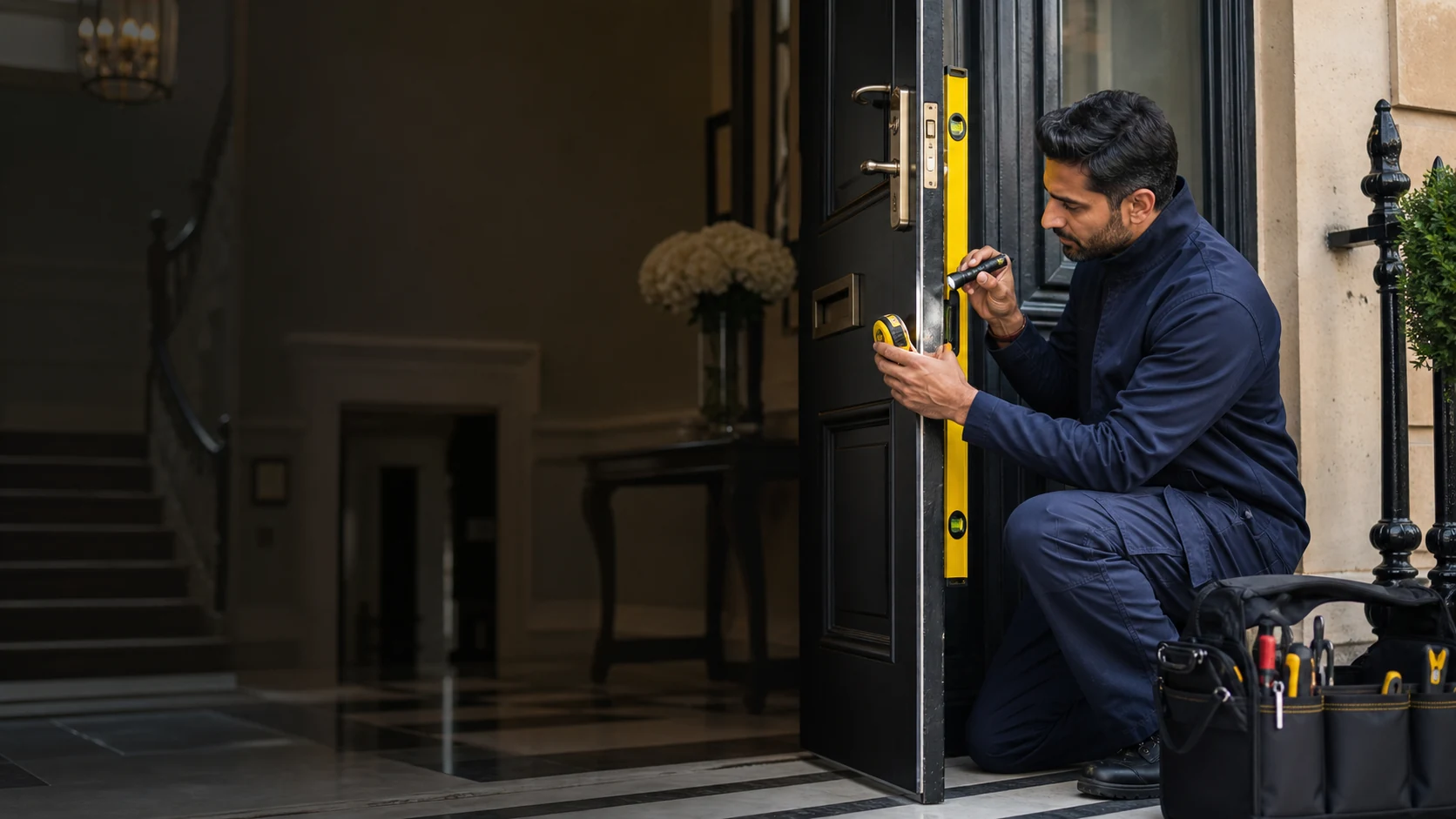
The locksmith verifies authority and examines the door before proposing an opening method. Entry and later hardware work remain separable decisions.
One reporter · one approver · several authorised users · ranked decisions
A busy shared home can produce several accounts of the same door and several requests for what should happen next. A useful Tooting enquiry appoints one reporter, one authorised approver and a complete list of people who must still enter after the work.

Decision roles
One occupant may have seen the key jam, another may know that the door binds in rain, and a third may hold the landlord’s contact. Those accounts are useful when combined, but the locksmith should not receive competing instructions during the work. Nominate a reporter to gather facts and an approver with the authority to accept the agreed scope.
The authorised user list serves another purpose: it identifies everyone who still needs access if keys or hardware change. These people do not all need to negotiate the repair. In a shop-above flat, the commercial occupier, building manager and residents may control different doors. Put each person against their own boundary rather than creating one building-wide decision group.
| Role | Contribution | Limit |
|---|---|---|
| Household reporter | Collects times, key behaviour, handle movement and affected users | Does not diagnose the fault or approve work without authority |
| Authorised approver | Accepts opening method, repair, parts and revised scope | Controls only the doors within their ownership or management authority |
| Current authorised users | Confirm access needs and receive agreed keys | Individual preferences do not replace the accepted brief |
| Landlord or agent | Clarifies tenancy, owner copies and permitted alterations | Must respect private and communal boundaries |
| Building or commercial contact | Controls shared entrance, shop route or powered access system | Does not authorise an unrelated private room or flat door |
Rank the outcomes
Begin with the immediate state. Is anyone unable to enter or leave through an authorised route? Is the door standing unsecured? Is there damage that puts people at risk? Once the present security problem is defined, place repairs and optional improvements on separate lines. This stops a request for an extra key or different handle finish from obscuring a door that cannot latch.
Record only safe observations. Do not repeatedly test a failing lock, dismantle a faceplate or ask each occupant to recreate the problem. If there is immediate danger, fire or a life-threatening emergency, use the appropriate emergency service. A locksmith attendance does not replace urgent public-safety help.
Present state to service branch
| Present state | First service branch | Decision after evidence |
|---|---|---|
| Authorised occupant cannot enter | Lockout assessment with identity and door-state checks | Opening method, then any repair required after access |
| Door closes but lock is unreliable | Fault-led repair assessment | Adjustment, component repair or measured replacement |
| Keys cannot be accounted for | Key-control review by affected door and user group | Redistribution or authorised lock change |
| Key has snapped in the lock | Broken-key extraction enquiry | Test retained lock, then consider repair or access change |
| Door and frame are visibly damaged | Security assessment and safe temporary outcome | Lock work plus allocated joinery, glazing or decoration |
| Existing door works but users want an improvement | Planned hardware review | Compatible option based on goal, door and authority |
| Fob or intercom response has changed | Building access-system triage | Mechanical locksmith, access-control or electrical route |
A service menu for the agreed decision
The locksmith verifies authority and examines the door before proposing an opening method. Entry and later hardware work remain separable decisions.
Stiff keys, unreliable latches and loose handles are considered with the complete door. Alignment and connected components matter alongside the visible lock.
Lost, stolen or unreturned keys are mapped to their doors and users. A private response should not silently alter a communal system.
Keep the fragment and avoid glue or improvised tools. Extraction can be followed by a check of the keyway, door and reason for resistance.
A defined temporary closure can address the immediate state. Permanent frame, leaf, glass or decorative work may need another provider.
When the door already works, identify the desired access or security outcome and confirm compatibility before buying hardware.
Compare the same decision
No Tooting postcode produces a valid standard locksmith price. Method, labour, hardware, timing and actual access determine the proposal. In a shared home, compare quotes against the same door, user list and authority.
| Comparison line | Question for both proposals | Evidence at handover |
|---|---|---|
| Attendance and assessment | Which door, timing and investigation are included? | Reported issue and inspected boundary recorded |
| Opening | Is the price attendance only, attempted method or agreed successful scope? | Method used and any sacrificed component explained |
| Repair | Which fault or adjustment is included? | Normal operation tested after the repair |
| Replacement | What hardware, dimensions, function and keys are supplied? | Installed item and copies counted |
| Associated damage | Are door, frame, glazing and making good included or excluded? | Temporary and permanent responsibilities named |
| Shared access | Who approves the communal or mixed-use entrance? | Building recipient and unaffected users documented |
If one proposal assumes replacement and another allows investigation, they are not directly comparable. Ask each to state the first decision point and how additional findings are approved. The household spokesperson can gather answers, while the authorised person accepts the final scope.

Tooting property context
A shared terraced home may have many legitimate key users but only one owner or manager approving permanent work. Appointing a spokesperson keeps observations coherent without reducing anyone’s access rights. The supplied key count should cover the accepted user list.
In a flat above a shop, the commercial route and residential entrance can sit close together. Identify which contact controls each door. Shop staff may help describe the street entrance but should not be assumed to approve a private flat or shared residential change.
Converted properties can add a communal door before the household threshold. Report both if both have symptoms, but retain separate authority and quote lines. One appointment can consider several issues without pretending that they share a cause.
One completion statement
After work, the spokesperson and approver should see the relevant operation tested. Count keys to the named recipients and communicate any changed technique only if it is part of the normal hardware design. Do not leave the household dependent on an undocumented pull, lift or workaround.
Record excluded shared doors, referred access-system issues and permanent repairs still outstanding. The same completion note can be shared with authorised occupants so multiple informal versions do not replace the facts.
Tooting decision FAQ
Choose one reporter who can combine observations and one person with authority to approve work. All users should still be represented in the access list.
Not necessarily. Agree a decision-maker before attendance so the locksmith receives one valid instruction if the scope changes.
Start with immediate danger or inability to secure, then unreliable operation, key control and finally optional improvements. Keep each door on its own line.
Record who observed what and when without voting on a diagnosis. The locksmith can test the actual door and explain the finding.
Yes, provided every door, fault, authority, method and key quantity is itemised. A single total should not hide different outcomes.
The owner or authorised manager should provide a recipient list. Count copies to named users rather than leaving an unallocated bundle.
Refer it to the person controlling that entrance. Residential authority does not automatically cross into commercial or communal hardware.
Keep one note of the door, completed function, keys issued, exclusions and follow-on tasks, then share it only with the authorised people.
Nearby south-west coverage
Use the page matching the property and decision context.
Bring one agreed decision brief
Send the Tooting address, exact doors, combined observations, user list, ranked outcomes and named approver.
