
A long-occupied home
Use the dates and images you have rather than relying on a reconstructed seasonal pattern. Memory can be described as approximate.
Kew / WHEN THE MARK CHANGED
A few reliable dates are more useful than an assumed pattern.
If spotting returns around a window, note when it was first noticed, what happened between appearances and what is visible now. Record condensation only when it was actually observed. A simple chronology can help the enquiry without turning a seasonal guess into a diagnosis.
Discovery · intervention · current view
Kew / ACCESS & PEOPLE
Use the dates and images you have rather than relying on a reconstructed seasonal pattern. Memory can be described as approximate.
Separate your own observations from information supplied by somebody else. The earliest image you received may not be the earliest occurrence.
Identify what was actually changed and which component it concerned. Decoration elsewhere should not become part of this patch’s treatment history.
A clear current report is useful even without old photographs. Describe what you saw rather than assigning an unsupported cause.
Pass on the reliable chronology with the current images, not just a conclusion that the problem always happens.
Keep repair, decoration and treatment details separately named so a later enquiry can distinguish their scopes.
02 / LOCATE THE ISSUE
A chronology is useful only if it refers to the same position. Label the component and room so an old photograph of one patch is not used to explain another.
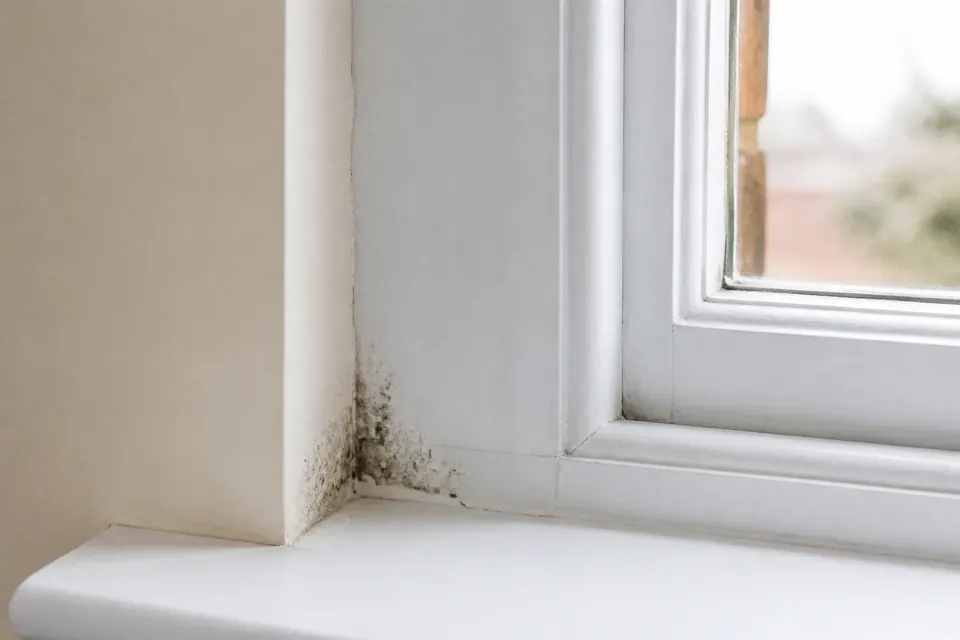
Identify the reveal, frame or sill in each image. Two marks near the same opening may sit on different materials and have different histories.
Keep observations of the window-side face separate from a ceiling patch or fitting. Similar dates do not prove one common cause.
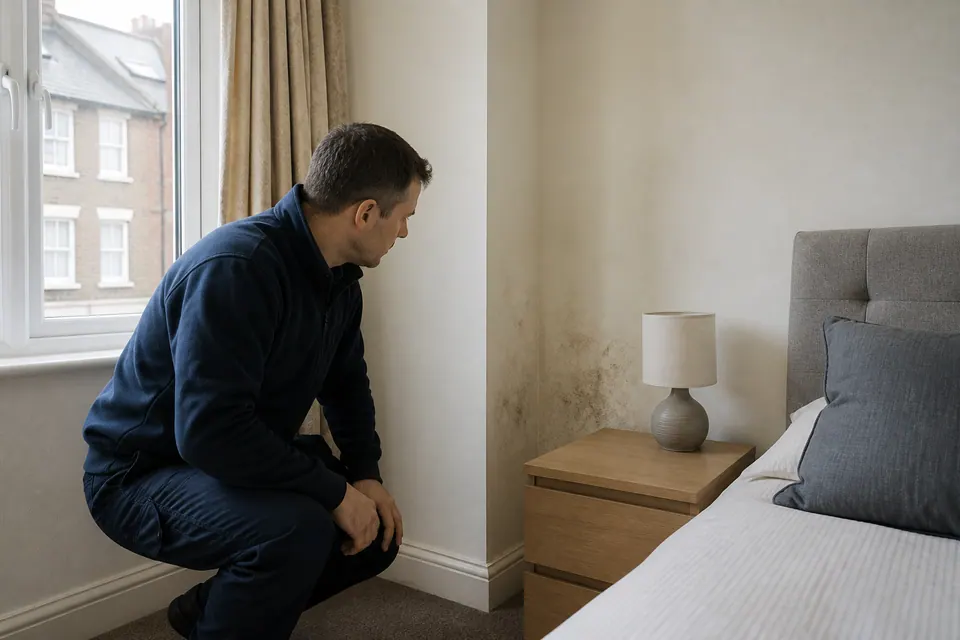
Use a fixed feature to identify the position, especially if curtains or furniture have changed since the older image.
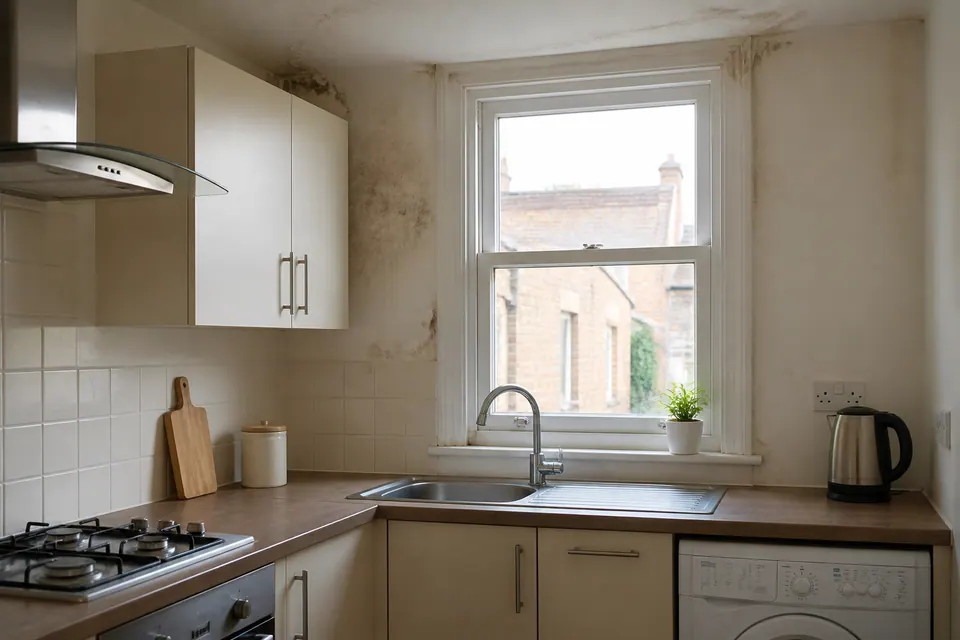
State the specific exposed face and any known water event. Do not transfer the history of a nearby fitting to the wall without evidence.
Label each side of the bay. A returning mark on one face should not become a general claim that all faces were previously affected.
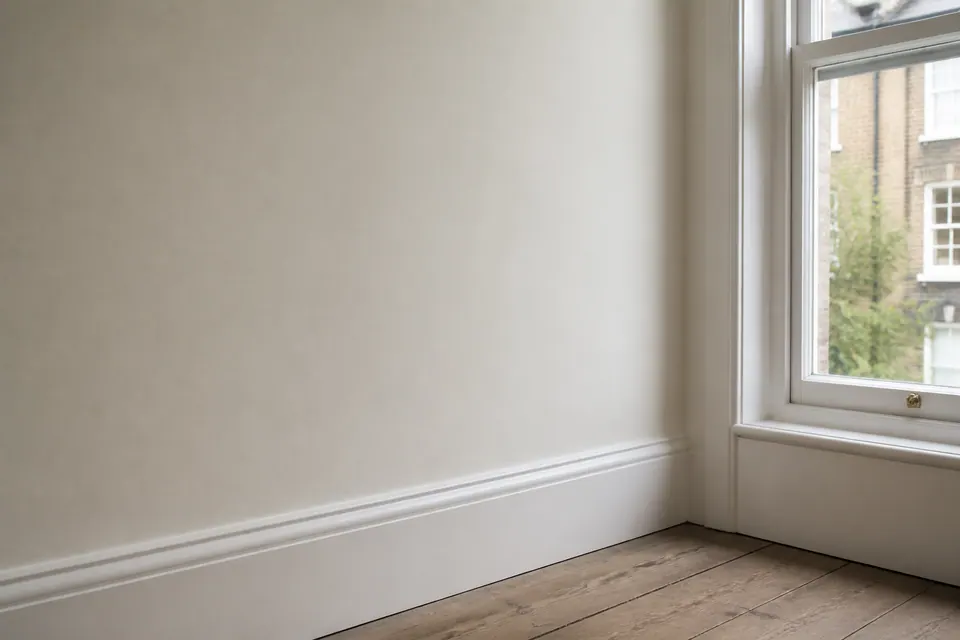
Take the current view from floor level and compare only what can actually be seen. Do not climb to reproduce an old camera angle.
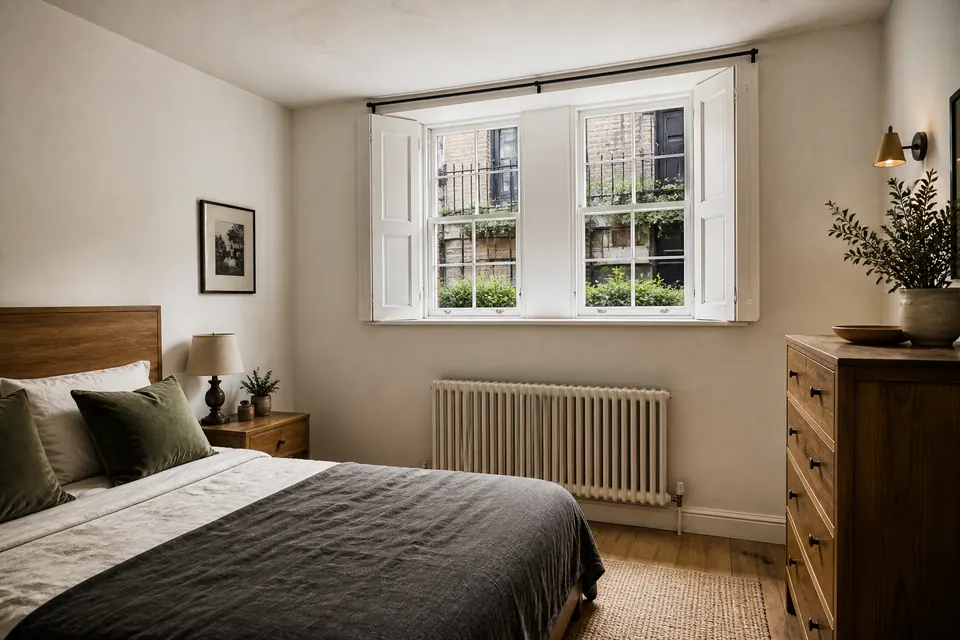
Explain whether the corner was previously visible or was only recently uncovered. Discovery after moving storage does not establish the onset date.
You do not need to reconstruct an exact daily history. A small number of reliable observations can be more useful than a detailed account based on assumptions.
03 / SEPARATE THE QUESTIONS
A mark noticed during colder weather does not establish one cause by itself. Observed condensation, changes to the finish and confirmed repairs should be recorded as different facts.
| Event recorded | What it can describe | What it cannot prove alone |
|---|---|---|
| A dated photograph of spots | The visible condition on that date | When growth first began |
| Moisture noticed on glazing | An observation at that time | The explanation for every nearby mark |
| A newly painted reveal | A change to the decorative layer | That moisture was resolved |
| A patch seen again later | The current visible recurrence | Why the condition returned |
A period without an observed mark does not establish a permanent result or identify the reason for a later change. Ask about the current condition and any assessment needed.
One concerns the marked surface; the other concerns conditions that may need their own investigation.
| Question | Mould | Damp |
|---|---|---|
| Concern | Possible fungal growth on the component | Excess moisture in the material or setting |
| Record available | Photographs of spotting at known dates | Actual wetness observations or confirmed incidents |
| Uncertainty | Unobserved periods and hidden extent | Source, duration and contributing factors |
| Next step | Assess the present suitable treatment | Clarify any further moisture enquiry |
Kew / THE PROPERTY BRIEF
Three useful points can be enough to start.
Explain the earliest observation you can support, any confirmed action since then and the present condition. If the mark seemed to disappear for a period, say whether that is documented or simply not something you noticed. The enquiry should describe your room rather than assume a pattern from the time of year.
05 / QUOTATION, NOT GUESSWORK
An old quotation or photograph may not represent the present extent. Send the current condition and the reliable chronology, then ask which assessment or treatment route is appropriate rather than assuming the previous scope still applies.
Review the main service’s quotation approach ↗| Current concern | Possible next step | History to keep clear |
|---|---|---|
| Small suitable reachable area | Photographic quotation may be considered | The current view, not only the old one |
| Repeated or several positions | Assessment to define the concern | What changed and when |
| Damaged material or complex moisture | Specialist quotation required | Confirmed repairs and remaining questions |
Confirm the included work and exclusions from the current evidence. A previous visit date does not set a new price or guarantee the same treatment is appropriate.
06 / DIRECT ANSWERS
A current wider view and useful dated details can establish the position. A long sequence of near-identical images is not required to begin the enquiry.
Use the first date you actually noticed it and say that earlier timing is unknown. Do not invent an onset date.
No. The timing is context, not a complete diagnosis. Include condensation only where it was actually observed.
Keep the action accurate. Wiping, an assessed treatment and painting are different events and should not be used interchangeably.
Repeated concerns may need assessment. Small suitable accessible areas can sometimes be considered from images, while complex or damaged conditions require a specialist quotation.
Painting over growth is not a substitute for appropriate treatment and consideration of continuing moisture.
Not by itself. The current material and condition still need consideration rather than an automatic conclusion from the calendar.
Follow the instructions for the actual method and work. A recurrence history does not establish a universal return time.
07 / A CONTROLLED APPROACH
Compare useful dated evidence while keeping uncertain periods and different components separate.
Agree access and preparation for the present condition, not simply what was arranged on an earlier occasion.
The assessed current scope defines the work. A familiar location does not make every earlier assumption valid.
Keep relevant moisture considerations and any separate repair needs understandable without promising a permanent result.
Earlier events provide context but do not replace the assessment of what is visible now.
Locate the marked component.
Follow the agreed suitable scope.
Record relevant changes clearly.
Illustrations explain a possible service sequence; they do not document a customer’s recurrence history or guarantee a future interval.
08 / ROOM-BY-ROOM CONTEXT
Do not combine window observations with a separate ceiling patch.
Use a fixed feature when furnishings have changed since an older image.
Record a confirmed water event without assuming it explains every mark.
Label different bay faces rather than one general window history.
Distinguish your observations from reports about other parts of the building.
Supply actual dates and conditions without deriving a cause from its level.
09 / WHEN IT COMES BACK
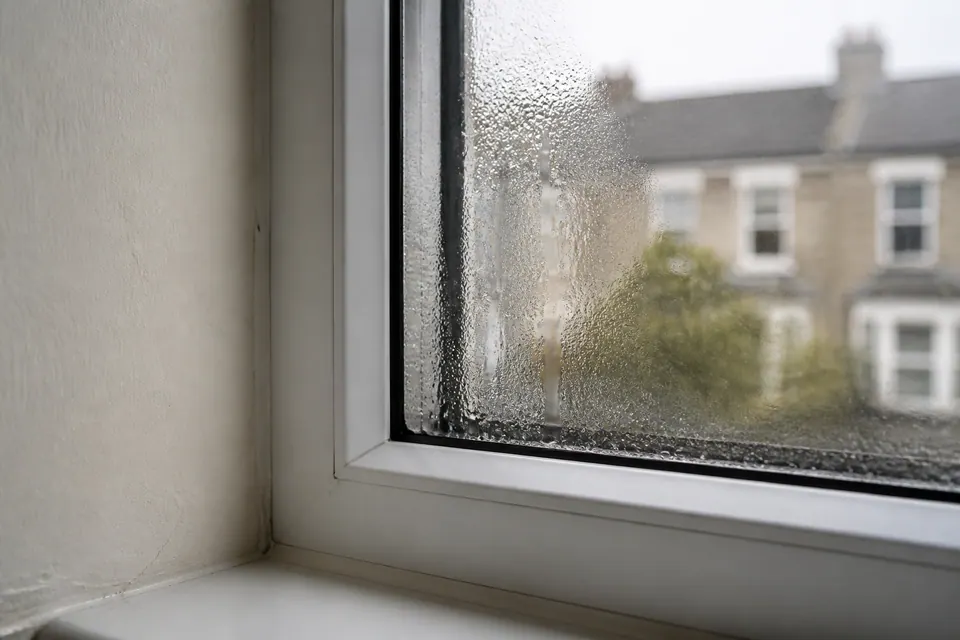
If another mark appears, identify whether it is on the same component. A frame-edge patch and a nearby ceiling stain should not share one history merely because they are close. Include a current view before describing the entire window area as a repeat of the earlier concern.
Continuing moisture can allow growth to recur. A date alone does not establish the source, and another wipe or paint layer may leave that question unresolved.
Keep the earlier and current room labels together, with any confirmed treatment, repair or decorating event between them. Uncertain details can remain explicitly unknown.
Kew / PLAN THE APPOINTMENT
Send the postcode, a current view and the short chronology you can support. Confirm the proposed next step before relying on an earlier appointment arrangement.
Include the present access details if the room or furnishings have changed since any previous work.
Load the area map.
Kew / BEFORE BOOKING
Use the information you have without manufacturing a complete history.
Not necessarily. Describe it as your first observation unless the earlier condition is actually known.
Explain that the timing is uncertain. It may still show a position, but should not establish a precise interval.
Yes, where known, but identify it as decoration rather than assuming it was mould treatment or a moisture repair.
Record that observation as such. Do not turn it into a claim about every morning or the whole season.
No permanent conclusion should be drawn from the interval alone. The current condition still needs consideration.
Confirm the current extent and suitability first. An earlier scope may not describe today’s material or access.
Keep the components and work distinct so one repair is not assumed to cover the entire opening.
No. Start with a current description and the reliable events you know; do not delay solely to create a detailed record.
Identify its exact position and current appearance separately. Proximity does not make it the same patch or establish a shared cause.
Kew / RELIABLE DATES, CURRENT EVIDENCE
Send the postcode and current photographs, then add the dates and earlier actions you can confirm. Ask which next step suits the present condition.
The pictured interiors illustrate the topic; they are not a customer’s dated treatment record or evidence of a guaranteed lasting outcome.
