
Authorised opening
Entry work begins with authority and door condition. The locksmith discusses a suitable method and should explain before any approach would damage or sacrifice a component.
Brief · approve · escort · verify
A Mayfair locksmith appointment may pass through reception, a service entrance and several levels of authority before the relevant door is reached. Prepare the visit as a controlled handover: identify the exact asset, the person approving work and the person who will receive the keys.

A controlled appointment
The person reporting a fault may be a resident, housekeeper, facilities contact or letting representative. The concierge may admit the locksmith but have no authority to approve replacement. A property manager may approve costs without being present, while a separate person receives keys at the end. Treating these roles as interchangeable creates delay and weakens key control.
For Mayfair work, put the chain in writing before attendance. Give the building and door reference, not simply the postcode. State who can verify lawful access, who can make a decision if the diagnosis changes, and who signs for new keys. If the entrance forms part of a communal system or a controlled suite, the freeholder or managing agent may need to confirm what hardware and key arrangements are permitted. A locksmith should not infer permission from an open service door or a verbal message passed through reception.
| Role | Information to record | Decision that role can support |
|---|---|---|
| Person reporting the issue | Direct observation, door state, time noticed and current security concern | Explains the symptom but may not approve alterations |
| Building reception or concierge | Visitor booking, service entrance, lift route and site contact | Facilitates approved access within building procedure |
| Owner, agent or authorised manager | Scope authority, spending decision and hardware restrictions | Approves the agreed repair or replacement |
| Resident or key custodian | Required users, key quantities and handover arrangement | Receives and accounts for completed access |
| Other specialist | Door, frame, safe, alarm or powered-access responsibility | Handles work outside the mechanical locksmith boundary |
Identify before ordering
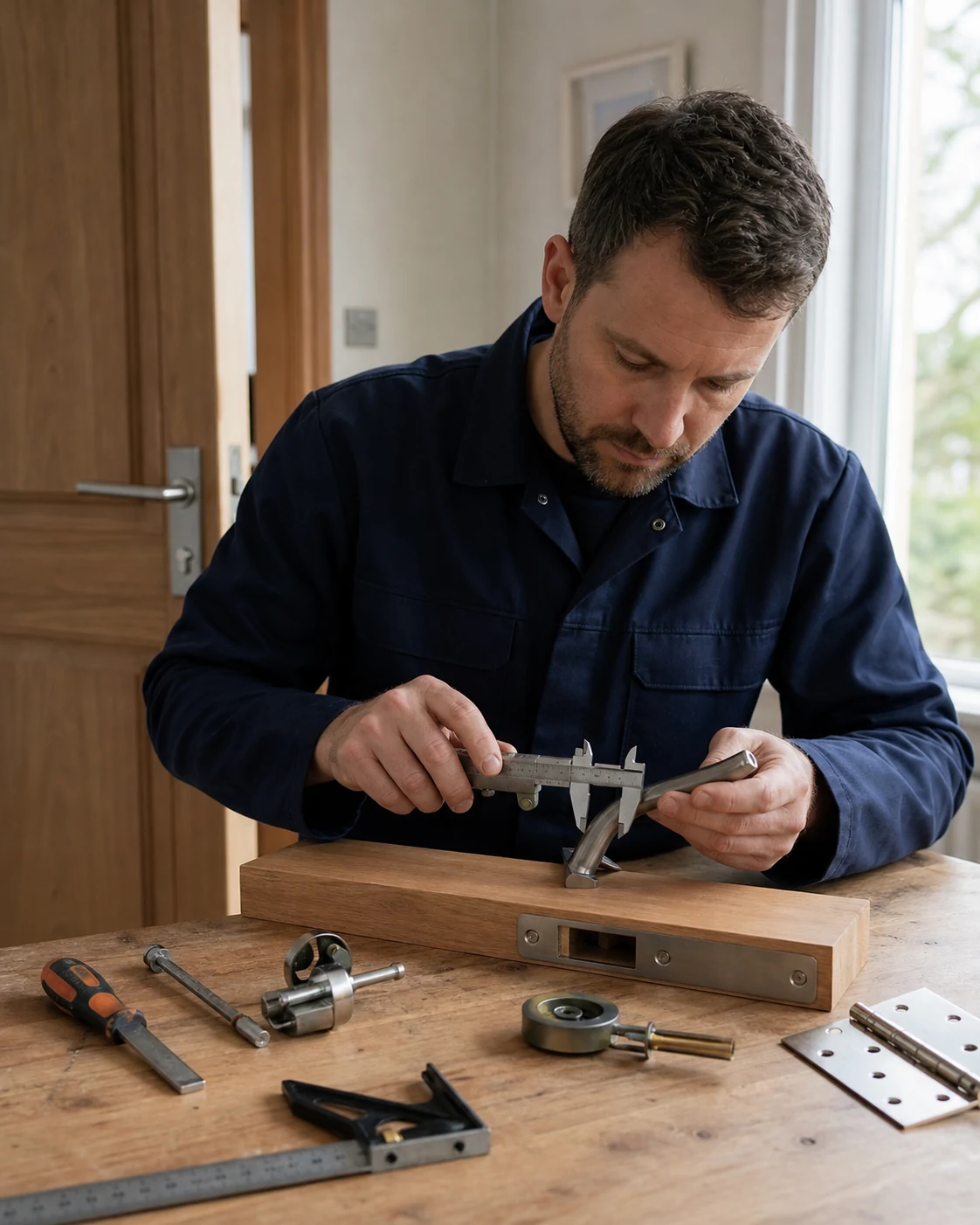
Polished, plated or concealed hardware may be part of a carefully coordinated interior, but appearance does not reveal dimensions, internal mechanism or suitability. Send photographs of the full door, both faces of the lock furniture, the edge hardware and the frame. Retain any labels, key references or property hardware schedule already held. Do not remove a cover or lock case to improve the photograph.
Explain the required outcome. A faulty lock may need repair; a missing-key concern is about key control; a planned aesthetic change may involve compatible furniture rather than the lock itself. Where doors have specialist construction or are identified as fire doors, the building’s responsible person should provide relevant requirements. The locksmith assesses the mechanical work within that information rather than inventing a specification.
From report to route
| Situation reported | Information needed now | Possible boundary to resolve |
|---|---|---|
| Key turns but door remains locked | Door position, handle movement, other working keys and any sounds | Lock mechanism, connected furniture or door pressure |
| Resident cannot pass the main entrance | Whether mechanical key, fob, intercom or powered release has failed | Communal locksmith work versus access-control support |
| Internal door hardware is loose | Which component moves and whether the door can be left safely unused | Local repair, replacement furniture or door preparation |
| Keys have been lost during a tenancy | Which keys, whether they identify the address and who must retain entry | Private cylinder change, controlled key system and landlord authority |
| Lock or frame damaged after an incident | Photographs, police or insurer instructions and immediate securing need | Mechanical lock work, temporary boarding, joinery and decoration |
| Planned hardware change | Door schedule, required finish, performance goal and building approval | Compatible product, sample approval and responsibility for making good |
Relevant locksmith work
Entry work begins with authority and door condition. The locksmith discusses a suitable method and should explain before any approach would damage or sacrifice a component.
A reliable repair depends on isolating the issue: lock case, cylinder, handle, keep, alignment or another connected item. Surface appearance is not enough.
A replacement should identify dimensions, function, compatible door preparation, finish and supplied keys. An undefined “equivalent” may not protect the intended appearance or operation.
Lost keys, staff changes and a new tenancy can change who should enter. Map affected doors and authorised users before changing a cylinder or controlled suite.
Urgent closure may be a temporary outcome. Door-leaf, frame, glass and finish reinstatement can sit with other trades and should be allocated explicitly.
For managed property, a concise record of symptoms, inspected components, limitations and recommendation helps the remote approver make the next decision.
Scope before price
There is no defensible Mayfair surcharge or fixed local figure that can be invented from the address. The cost follows the real attendance conditions, method, labour, parts and approval chain. Ask for enough detail to compare like with like.
| Stage | What the proposal should state | What the client should verify |
|---|---|---|
| Attendance | Agreed time, entrance, contact and assessment boundary | Reception has the booking and the correct door is available |
| Method | Opening, repair or replacement approach and when approval may change | The authorised person can be reached before destructive work |
| Hardware | Identified product, function, finish, keys and compatibility | The specification matches building rules and the required outcome |
| Associated work | Adjustment, drilling, protection, disposal and making-good exclusions | Door repair or decoration has a named owner where needed |
| Testing | Functions to be checked after completion | Door closes, latches, locks and unlocks under normal use |
| Key handover | Quantity, recipient and any old-key or code treatment | Every supplied key is counted and custody is recorded |
If the existing lock reveals concealed damage or a different case from the one expected, pause. The finding, options and revised cost should reach the approver before the work changes. A service entrance and an open diary do not authorise an unlimited scope.
Mayfair building context
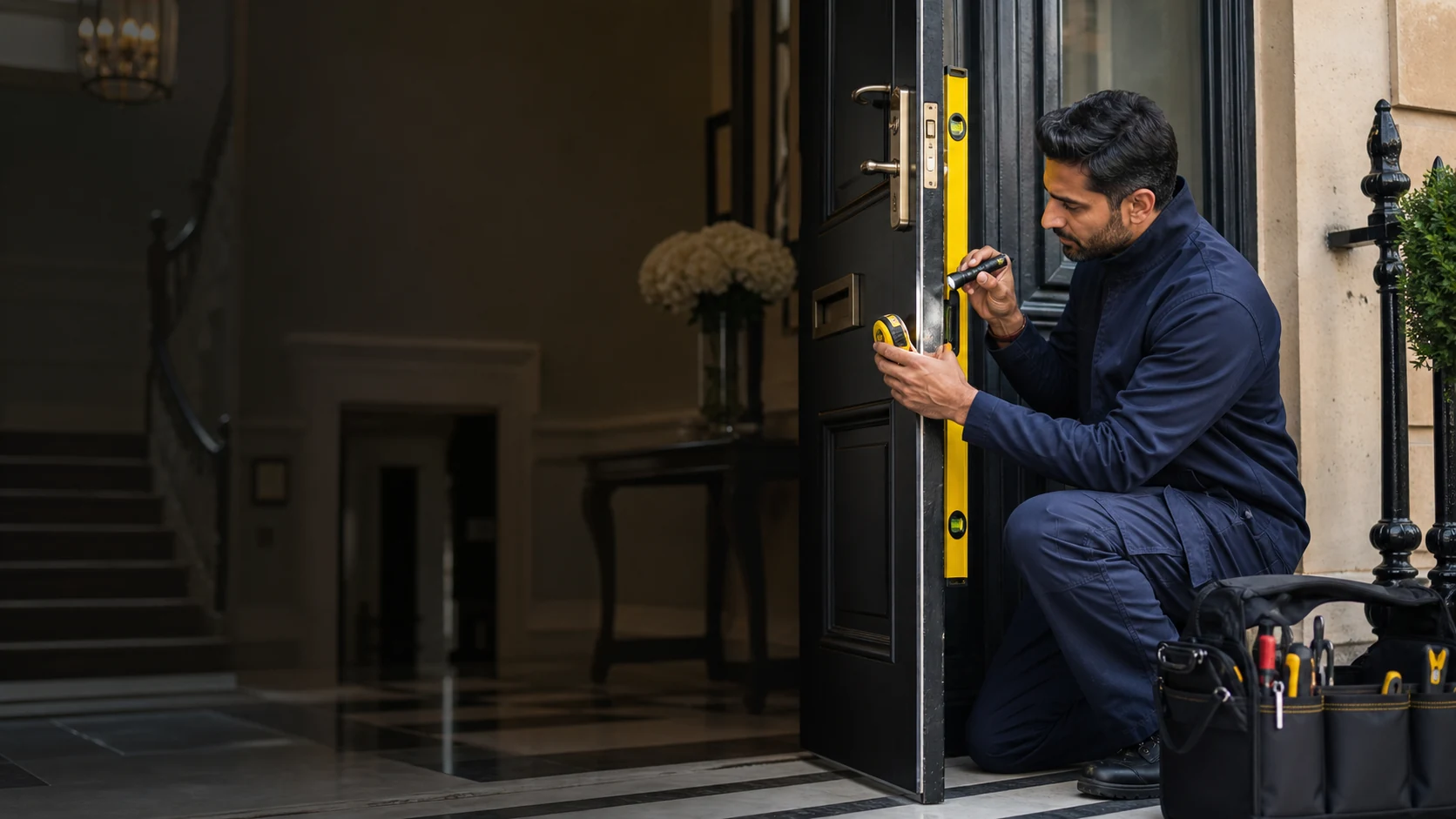
Porter-controlled buildings often have clear visitor procedures, but the engineer still needs the flat number, resident contact and precise door. State whether a service lift must be used, whether tools need protective covering and when the building permits non-urgent contractor movement. If the approving owner or agent is remote, agree how photographs and findings can be shared without exposing keys, codes or unnecessary personal information.
Some properties use several entry layers: street door, staffed lobby, lift control and private entrance. Record which layer has failed. A working fob does not prove a mechanical lock is sound, and a stiff door does not prove the powered system is at fault. Keeping the report component-based makes referral easier.
Carefully finished interiors make reinstatement important. A new plate may not cover old fixing holes; removing furniture can reveal unfaded finish or damaged timber. Ask what the locksmith will protect and what must be handled by a joiner or decorator. This is not an argument against replacement. It is a reason to approve it with open eyes.
Completion record
The person receiving the work should see the door close and lock normally, test the authorised keys and understand any limitation. For a remote client, the building representative can confirm practical operation while the written record identifies installed hardware and outstanding items. Do not send photographs of unprotected key codes or access credentials.
If temporary securing was the agreed outcome, label it clearly and name the person arranging permanent reinstatement. If a powered access issue remains, state what mechanical functions were checked and which specialist has been recommended. A precise handover is part of secure work, not administrative decoration.
Mayfair locksmith FAQ
Reception can often arrange visitor access, but the resident, owner or authorised manager should confirm the door, requested work and approval route.
Provide full-door, edge and hardware photographs, the desired outcome, known key requirements, finish preference and any building specification already available.
Only within an agreed substitution rule. Function, dimensions, visible finish, security requirement and door preparation should remain consistent with the approved scope.
Name the recipient before work begins. Count keys at handover and agree how old keys, spare copies or controlled records should be treated.
Describe the fob, intercom, release and mechanical door behaviour separately. Electrical or electronic faults may require the building’s access-control specialist.
Not unless stated. Making the entrance secure can be followed by separate lock, door, frame, glazing or decorative work.
Only with appropriate building authority and the required system information. One occupier’s request should not compromise access for other authorised users.
Agree a named decision-maker and contact method. The locksmith should share the finding, proposed change and revised amount before continuing beyond the accepted work.
Central London coverage
Choose a nearby page for the actual property location and its entrance context.
Put the approval chain in the brief
Send the Mayfair building details, exact entrance, observed fault, hardware photographs and named person authorised to approve the work.
