
Alignment review
The locksmith compares open and closed operation, locking-point positions and frame keeps. Adjustment is not promised until door and hardware condition are understood.
Balcony-side door · safe position · apartment route · management boundary
A balcony-side or terrace door adds a safety question to a multipoint-lock fault: where can the locksmith stand and how can both faces be reached? For a Battersea apartment or terrace, settle that access before identifying parts.
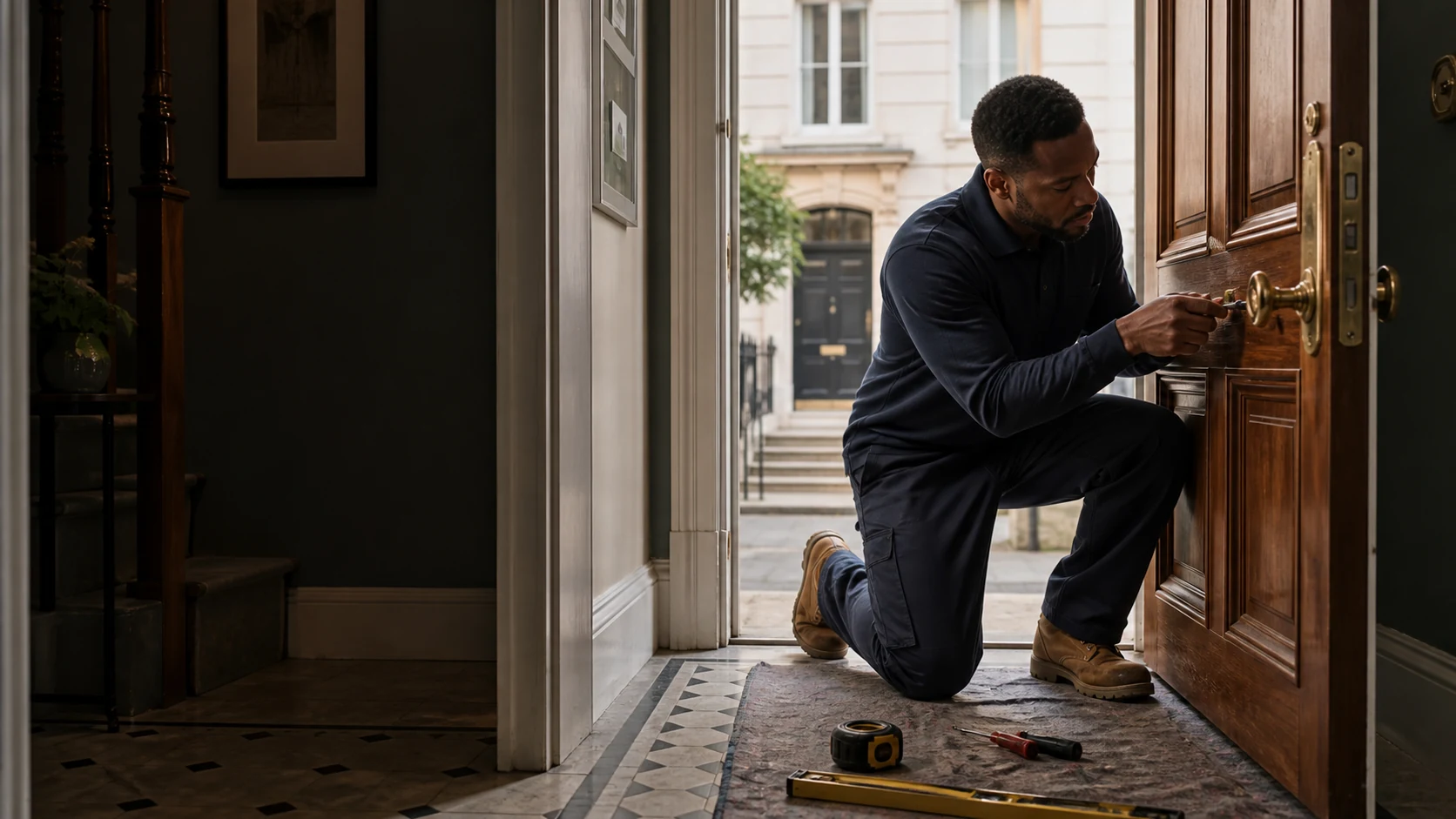
Safe-position plan
If a door opens onto a balcony or terrace, tell the locksmith whether the outside area is safely accessible from the dwelling and whether the door is currently open, shut or partly secured. Do not climb from another balcony, lean through a window or cross a neighbour’s space to reach the external handle. If only one face can be reached, say so at booking.
In a concierge building, provide the apartment, meeting person, contractor procedure and route for tools. Management may also control access to common terraces or external areas. A resident’s permission for the flat does not release a shared façade, balcony structure or neighbouring space. The mechanical lock assessment should begin only when the approved working positions are clear.
| Access question | Detail to confirm | Why it matters |
|---|---|---|
| Where is the door now? | Fully open, normally closed, jammed, or closed without reliable locking | Changes the safe preparation and possible examination route |
| Can both faces be reached? | Authorised internal and external floor-level access | Some identification and testing may require both sides |
| Who controls the outside area? | Resident, building manager or another authorised party | Flat access does not automatically include shared terraces |
| Is the working surface safe? | Clear floor, no unstable furniture and no need to lean or climb | The attendance should not rely on hazardous positioning |
| What belongs to the building? | Frame, glazing, façade seal, powered contact or balcony structure | Non-lock components may require management and another specialist |
Record the door state
A multipoint door can feel different when open, touching the frame or fully closed. Note when the handle becomes resistant, whether the key enters and whether the door can be released again. Stop before force bends a key or damages the gearbox. Do not move frame keeps or adjust hinges to create a temporary result.
Safe photographs may include the whole internal face, handle, cylinder and visible edge strip. Photograph the outside only from a proper standing area that you are authorised to use. A distant image of a balcony door cannot identify a gearbox, and a cylinder measurement should not be guessed from the portion visible inside.
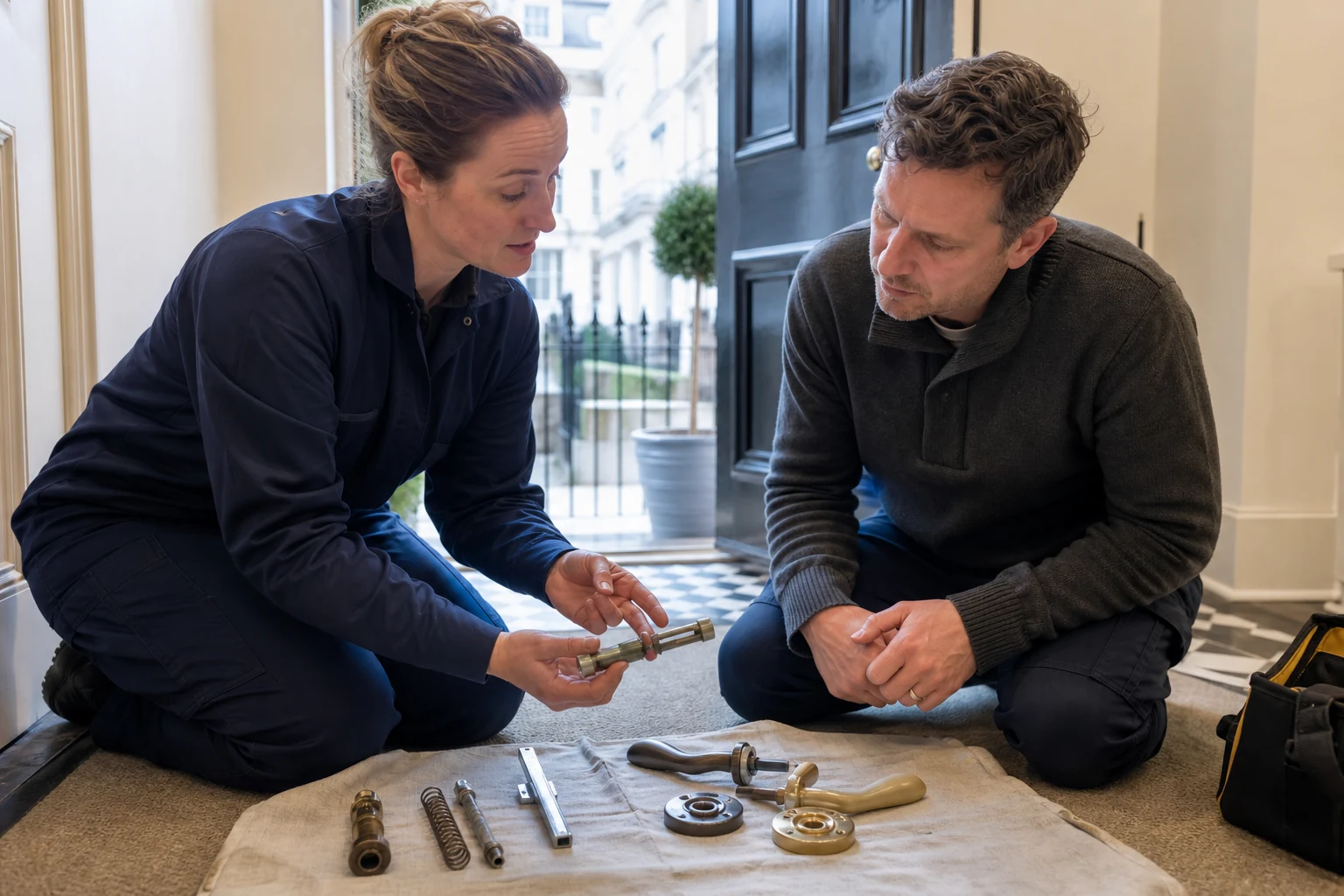
Door-state matrix
| Direct observation | Safe next step | Assessment boundary |
|---|---|---|
| Handle lifts when open but stops at the frame | Leave keeps and hinges untouched and record the contact area | Alignment, locking points and frame condition need comparison |
| Key turns but the handle stays rigid | Stop operating it and place the door in its safest available state | Cylinder movement does not confirm gearbox or strip operation |
| Door closes but cannot be secured | Arrange supervision and tell building management where relevant | Temporary security and permanent mechanism work may differ |
| External handle is loose | Do not reach over a barrier or remove the internal plate | Handles, spindle, fixings and connected gearbox require inspection |
| Water is visible near the threshold | Keep clear, report the observation and seek building advice | Moisture, drainage, seals and structure are not diagnosed from a lock symptom |
| Glass, panel or frame is damaged | Protect the area and follow manager or insurer instructions | Locksmith, glazing and door-envelope scopes must be allocated |
System-based service options
The locksmith compares open and closed operation, locking-point positions and frame keeps. Adjustment is not promised until door and hardware condition are understood.
Fixings, spindle, handle movement and gearbox interaction are checked. New furniture must match the existing centres and door arrangement.
A cylinder issue or key-control concern can be addressed with measured hardware. It should not be used to mask a failed multipoint mechanism.
Case dimensions and edge-strip details guide a compatible part. The apartment development or door colour does not identify the mechanism.
The full strip and locking points may require inspection. Compatibility, part condition and frame engagement determine a sensible scope.
Glazing, panels, structural frames, powered contacts and balcony elements can need management’s nominated trade. The locksmith records the mechanical limit.
Quote access and system separately
No Battersea postcode creates a reliable locksmith figure. The quote follows the actual access, assessment, labour and parts. A balcony-side door may also need a defined limitation if the external face cannot be reached safely.
| Quotation element | Information supplied | Written confirmation |
|---|---|---|
| Apartment attendance | Concierge procedure, floor, resident contact and tool route | Any effect of unavailable building access |
| Safe door access | Current position and authorised standing area on each side | What can and cannot be assessed from the available positions |
| Mechanical diagnosis | Handle, key, door and locking-point behaviour | Whether identification precedes a final parts price |
| Component work | Measurements, condition and compatible part details | Exact cylinder, handle, gearbox or strip included |
| Building-related damage | Frame, glass, panel, seal or powered-system observations | Excluded trades and manager follow-up |
| Operational handover | Safe test positions, key recipients and normal user sequence | Functions tested and limitations retained |
If a mechanism cannot be identified without removal, agree the initial diagnostic scope. Once exposed, the locksmith should show the relevant finding and offer a revised repair choice. Do not treat access to a high-level outside face as an unstated part of the price.
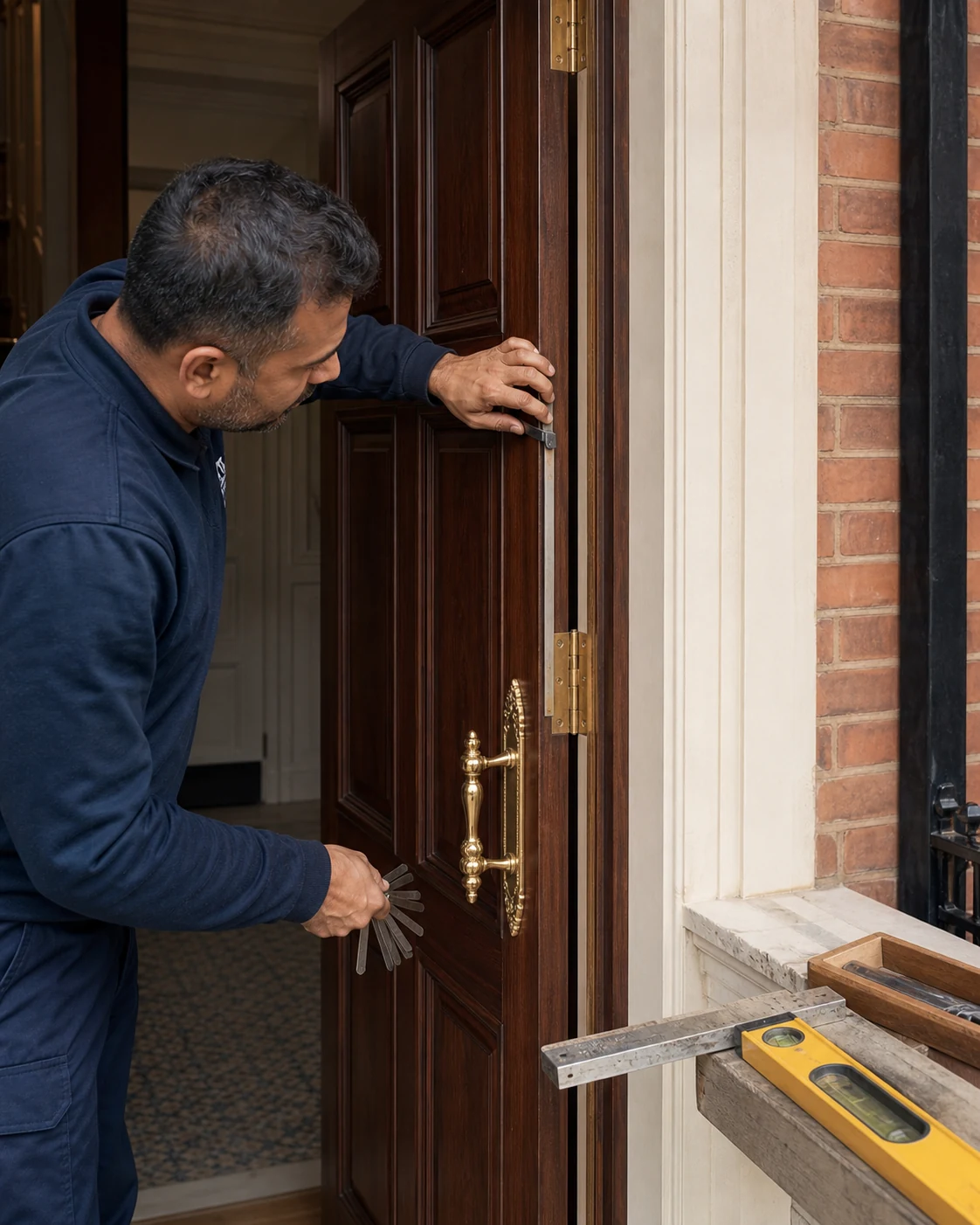
Battersea property context
Newer apartment developments may have concierge booking, lift protection and rules for contractor movement. Provide the appointment details early, but do not ask reception to diagnose or approve a private lock on the resident’s behalf. The resident or owner remains the decision-maker for the dwelling unless another authority is documented.
A balcony-side door may be treated by the building as part of the external envelope even though its lock is used privately. Ask management what information it holds about responsibility before significant alteration. This does not establish the repair; it tells the locksmith where private permission may end.
Victorian terraces can also have rear UPVC additions, but the safe-access question is different. The external face may be reached from a garden rather than a balcony. Describe the real route and avoid transferring assumptions from one property type to another.
Safe operational handover
Plan the final test with an authorised person positioned safely. Close, engage, lock, unlock and release the door through its normal sequence, making sure nobody is left on a balcony without an independent authorised route. Do not use a final test that depends on leaning around the door or passing keys over a barrier.
Count keys and record any building, glazing or frame issue left outside the repair. If the door remains under a temporary securing arrangement, tell concierge or management where relevant and name the person arranging the permanent stage.
Battersea balcony-door FAQ
Only when there is authorised, stable floor-level access and a safe working area. The visit should never depend on climbing, leaning or crossing another property.
Explain this before attendance. The locksmith must plan from the available internal position and state any limitation on identification or testing.
No. Concierge can facilitate the building route, while the resident or owner controls the private door and should manage the safe work area.
Not necessarily. Fixings, spindle and gearbox interaction need checking, and the external face must be reachable safely.
Some information may be visible, but a correct specification depends on the full door and cylinder arrangement. Do not order from a guessed projection.
That can require a glazing or door provider and building approval. The locksmith should limit the mechanical scope and record the related damage.
Keep clear, report exactly what is visible and involve building management where appropriate. A lock visit cannot diagnose drainage or envelope issues remotely.
Use the normal close, handle, key, unlock and release sequence from safe positions, with no person left without an authorised route back inside.
Nearby locksmith pages
Choose the page matching the address and entrance context.
Establish the safe working position first
Send the Battersea apartment route, present door state, safe access to each face, direct symptoms and authorised contact.
