
Credential administration
Resident permissions, fob status and user records remain with the appointed building administrator.
Door ID · user action · system response · owner
A managed entrance report should let the building team identify the door, reproduce the user journey safely and assign each finding. Record what happened without opening panels, guessing a failed part or combining a private flat issue with the common system.
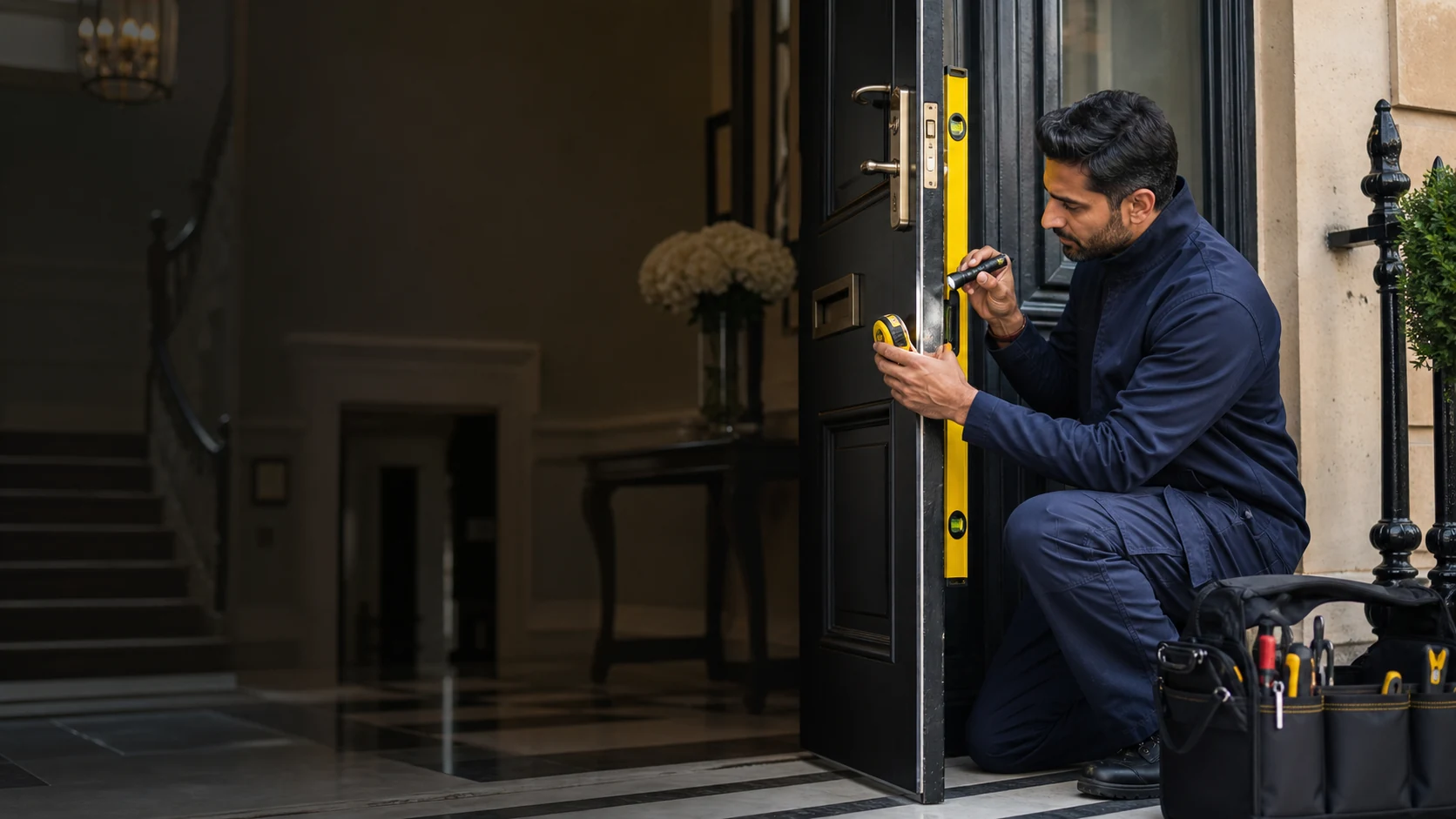
Manager-ready incident record
Record the development or estate, block, entrance letter or number, floor where relevant and whether the door is external or internal. A photograph of the complete doorway can help, provided it does not expose resident information or access codes. Use the same label in the booking, work record and follow-up.
Add who first noticed the issue and which user groups appear affected: one credential holder, several residents, visitors, staff or everyone attempting normal access. This does not diagnose the system, but it helps the manager check credential administration and decide which authorised provider should attend.
| Record field | What to enter | What not to infer |
|---|---|---|
| Door identity | Site, block, floor, entrance label and common or private status | Ownership from appearance alone |
| Reporter and users | Role of reporter and broad affected group | That one report proves a building-wide failure |
| User action | Fob presented, intercom call, key turn, handle or release-button action | Which internal component should be replaced |
| Visible response | Reader indication, sound, latch movement, door travel and return | Electrical or mechanical cause from one symptom |
| Door state | Open, closed, intermittently usable or supervised under building procedure | An improvised safety or security solution |
| Management owner | Named agent, housing team, facilities contact or authorised representative | That concierge presence equals alteration authority |
Private door within a managed block
A private flat lockout may begin beyond reception and common access. State the building entry process, floor and exact flat door, but keep proof of occupancy or ownership with the locksmith. The manager can facilitate the route without necessarily approving private replacement hardware.
If identification is inside, explain which landlord, owner, agent or management contact can support reasonable verification. Do not assume a concierge conversation alone is enough. The locksmith must be satisfied that the work is authorised at the correct private entrance.
Opening, repair and replacement are separate decisions. The resident or owner should receive the method explanation and approve additional work within their rights. Any common-door observation encountered on the way should return to the building incident record rather than being added informally to the private bill.
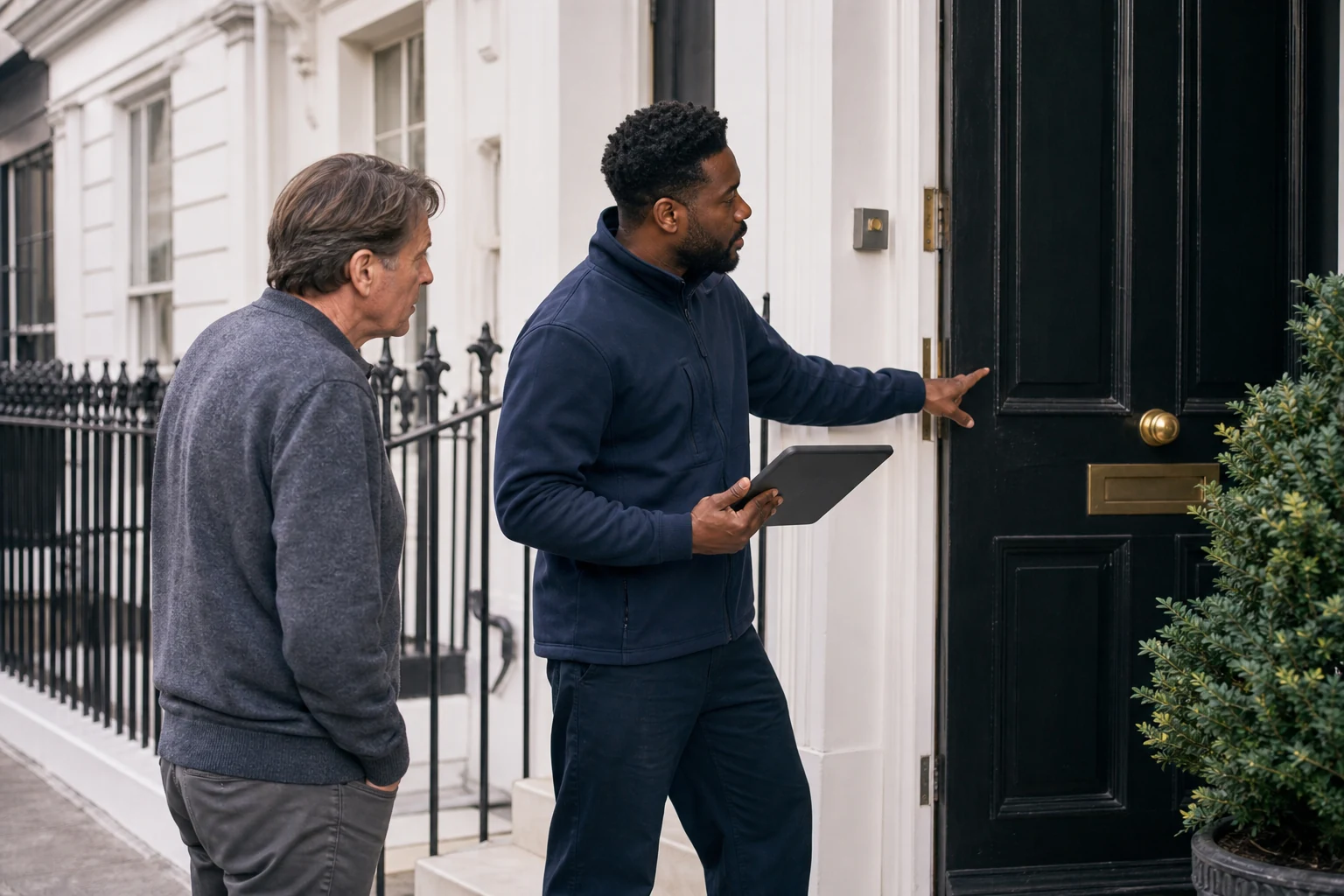
Allocation matrix
Common entrances may combine credentials, readers, intercoms, powered releases, mechanical latches, closers, hinges and the door leaf. Management should use evidence from the sequence to commission the correct assessment. Residents should not access controllers or defeat closing equipment.
| Observed condition | Initial management check | Potential workstream |
|---|---|---|
| Only one fob is rejected | Check authorised credential status and user record | Access administration before door hardware |
| All credentials are accepted but door stays shut | Record release response, door pressure and latch behaviour | Access-control, electrical and mechanical assessment allocation |
| Mechanical key turns without release | Confirm correct key and visible transmitted movement | Locksmith assessment under common-door authority |
| Door opens but fails to close | Observe hinges, closer, obstruction, frame and latch safely | Door, closer or lock service as supported by findings |
| Intercom fails for one flat | Compare other calls without entering resident settings | Apartment or system communications route |
| Handle or cylinder is visibly loose | Stop unnecessary use and keep fixings assembled | Authorised mechanical repair assessment |
| Leaf or frame is damaged | Preserve images and manage access under existing procedure | Securing plus structural door and finish work |
Service-route handoffs
Resident permissions, fob status and user records remain with the appointed building administrator.
Readers, controllers, powered releases and intercoms go to the relevant access or electrical provider.
An authorised locksmith can assess cylinders, cases, keys and latches within the named common door.
Leaf, frame, hinges, closer and structural damage can form a distinct specialist scope.
The resident, landlord or owner instructs flat-door work under the actual property agreement.
Management records functions tested, user outcome, remaining limitation and accountable next owner.
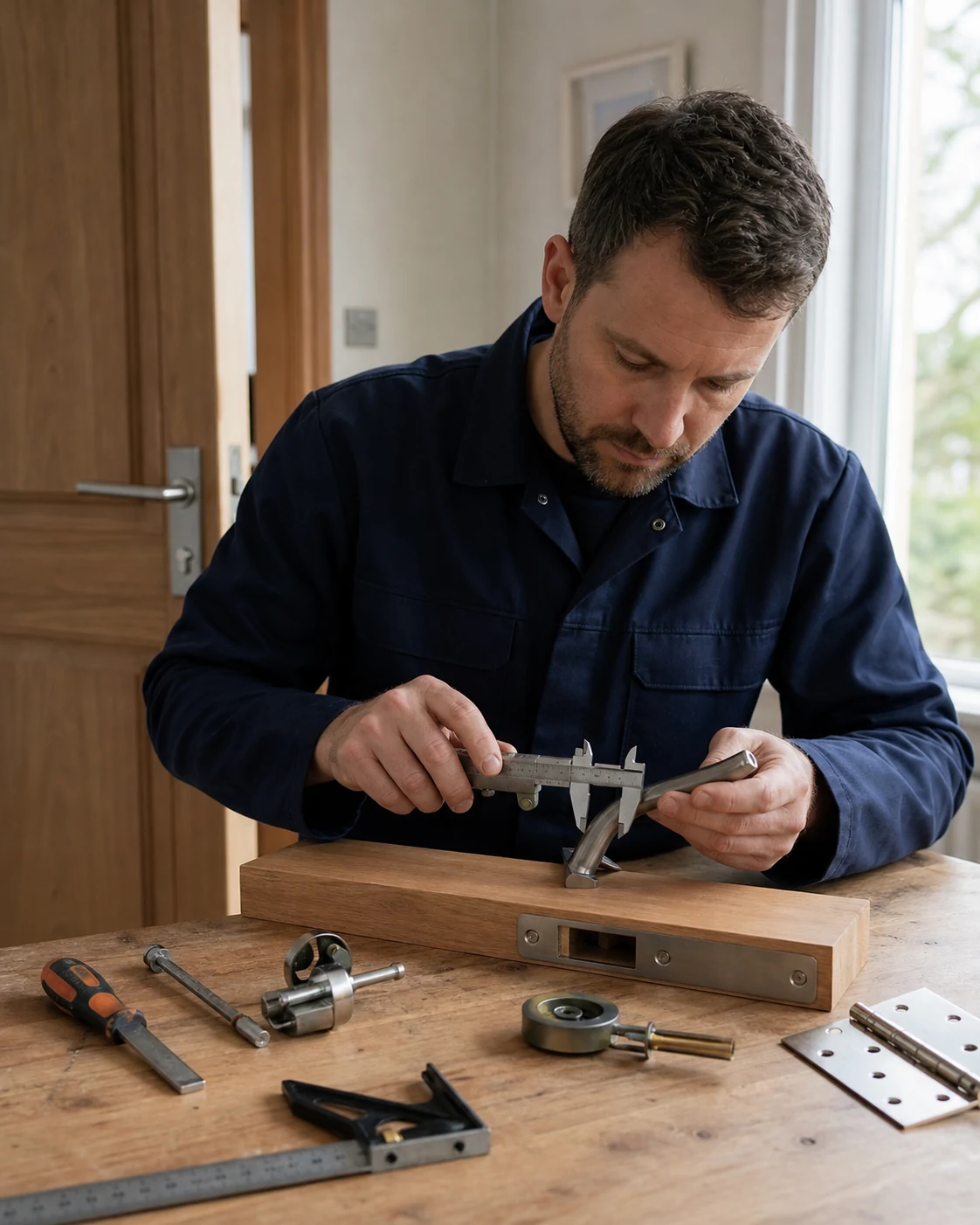
Croydon property context
Croydon enquiries can involve high-rise apartments, terraces, converted houses and management-controlled common doors. The setting helps identify likely handoffs; it does not establish tenure, fire performance, access technology or the cause of a fault at a given address.
In a high-rise or managed block, include reception, lift or controlled-floor access and the manager able to commission common work. For a conversion, distinguish the shared street entrance from each private flat. In a terrace occupied by one household, front and rear doors may sit within one instruction, while a subdivided terrace can have several authorities.
Where a door is described as a fire door, ask management for the actual door record and maintenance route. A locksmith can report the mechanical condition within scope, but should not declare the entire assembly compliant from appearance.
Parking, loading and contractor access differ by building. Give the current site instruction you genuinely hold rather than relying on a general statement about the town centre or a tower.
| Property setting | Lead record owner | Separate information needed |
|---|---|---|
| High-rise apartment | Managing agent or building facilities contact for common access | Resident authority for the private flat |
| Management-controlled entrance | Party holding the common-door maintenance and access records | Mechanical, electronic and door observations |
| Converted house | Freeholder or agent for the shared threshold | Individual occupier or owner for each flat |
| Single-household terrace | Owner, resident or landlord under the property agreement | Front, rear and side entrance states |
| Estate block | Housing or estate team using the block and entrance reference | Affected users and any private-door issue |
| Mixed residential building | Named residential manager for the route | Commercial access kept outside the home instruction |
Manager-ready quotation
Cost depends on site access, investigation, door state, labour, compatible hardware and any electronic or structural work. Croydon does not supply those facts. A useful quote lists the exact common or private door, the authorised scope and the decision process for newly identified work.
The door, users, action and response enter one stable record.
The manager or private customer owns the correct threshold.
Mechanical, electronic and structural questions remain distinct.
Labour, parts, destructive steps and exclusions receive consent.
Tests, keys, user access and remaining owners are documented.
Ask whether site attendance, fault investigation, successful opening, hardware, extra keys and making good are included. A contractor who cannot lawfully reach the door should record an access limitation, not a completed assessment.
Croydon locksmith FAQ
Include the stable door label, user action, credential or key response, physical movement, users affected, door state and manager contact.
A resident can report the problem, but the managing agent, freeholder, housing provider or other responsible body should commission shared work.
No. Controller output, power, release, latch, door pressure and alignment still need to be distinguished.
The locksmith needs reasonable evidence connecting the customer with that home, even when reception has admitted the visit.
Only if their role explicitly includes that authority. Site facilitation and alteration decisions are otherwise separate.
Use the building’s reporting and interim-management procedure. Do not prop, force or dismantle shared equipment without authority.
Management should appoint the appropriate access-control or electrical provider and coordinate any related mechanical locksmith scope.
Record it, define any immediate securing and allocate structural door repair and finishing rather than hiding them inside lock work.
Document the exact door, work, functions tested, keys where relevant, access outcome, limitations and named owner of each next step.
Nearby coverage
Use the related services for the workstream and current nearby pages for other access contexts.
One door, one managed record
Send the entrance identity, user action, visible response, authority and safe photographs for a properly assigned assessment.
