
A panel revealed old-looking marks
Record discovery and leave their age uncertain unless known.
PEST CONTROL / BATTERSEA
Recent building work and new signs.
Newly visible does not necessarily mean newly created.
Moving joinery or opening a room during works can reveal marks that were previously hidden. For a Battersea enquiry, describe what changed and what was actually observed afterwards. The timing is useful context, but it does not by itself prove the works caused a pest problem.
MAKE THE ENQUIRY SPECIFIC
Record discovery and leave their age uncertain unless known.
Give that event its own position and date.
Describe it without assuming it explains the concern.
Mention the planned work so any assessment and separate maintenance can be discussed coherently.
06 / SIGNS → LOCATION → NEXT STEP
| Pest problem | Signs to describe | Areas to mention | Next step |
|---|---|---|---|
| Mice | Mouse-like damage newly exposed | Fitting or storage edge | Describe discovery without dating the activity. |
| Rats | Larger rodent sighting | Actual event position | Keep temporary-opening theory separate. |
| Bed bugs | Physical furniture marks | Sleeping item and movement history | Seek identification from evidence. |
| Cockroaches | Recurring insects after changes | Fitting, events and prior products | Provide the work history as context. |
09 / FROM FIRST CONTACT
Expand the stages before closing or altering a suspected opening.

Name what moved or opened and when.
Separate marks from direct live observations.
Explain unfinished areas and any safe-access restrictions.
Avoid altering the scene simply to support a theory.
Keep later observations distinct from the original exposed trace.
Identify the person responsible for any recommended building action.
08 / THE CONTROL PLAN
New visibility and new activity are different findings.
Accessible marks and direct events can be considered with the known alterations while uncertainty remains explicit.
The selected method and preparation should be clear, with any building tasks identified rather than silently included.
Fresh observations after further work should be dated separately so the account remains useful.
05 / PROPERTY BRIEF
Identify fittings moved and the evidence exposed behind them.
Separate discovery of old-looking marks from actual new events.
Describe it and who is responsible for any remaining work.
Include previous and current positions where relevant to the finding.
Keep the household rooms and occupants in the proposed scope.
Discuss your homeCheck suitability separately rather than assuming a residential pest service covers a business project.
Check the premises requirementsADDRESS AND AVAILABILITY
Give the postcode and any building work that affects the route to the reported area.
Check availability before coordinating with trades. The map is an area reference, not a works-inspection office or confirmed appointment.
Open Battersea in Google Maps ↗07 / SCOPE BEFORE A QUOTE
A treatment quote is not automatically a contract to finish repairs or reopen completed work. Confirm the reachable areas and any separate trade requirement.
from £120
See published service pricingfrom £150
See published service pricing| Service | Pricing basis | Price |
|---|---|---|
| Mice control | Mouse concern and accessible findings | Assessed quotation |
| Rat control | Rat evidence and programme | Scope-based quote |
| Proofing / repairs | Joinery or structural repairs | Separate trade agreement |
Service guides checked on 27 August 2026 give starting amounts. Confirm Battersea coverage and the complete proposal without treating the work date as proof of a pest cause.
BATTERSEA / PROPERTY CONTEXT
A newly accessible wall edge can change what a householder sees without showing when a mark formed. Keep discovery, live events and building changes as separate entries.
State which fitting or surface was opened or moved. Avoid presenting the contractor’s activity as the cause unless that connection has actually been established.
Mention temporary gaps or incomplete repairs relevant to access. Do not seal a suspected route or reopen finished work merely to test a theory.
Ask which inspection areas and any follow-on recommendations belong in the pest scope. Joinery, structural work and other repairs need their own agreement.
03 / OBSERVATION CHECKLIST
A dated work history can support an assessment without determining the cause.
Do not disturb suspect residues or alter building work to obtain evidence.
Explain what previously concealed it and when it became visible.
Give the actual event and position separately from old traces.
Describe its condition without declaring it the route.
Keep its original position and the discovery context.
Disclose any intervention before or during works.
Leave a mark’s age unknown rather than assigning it to the contractor’s visit.
01 / START WITH THE EVIDENCE
The fact it appeared after work does not identify its age or species.
Damage or marks revealed at a storage edge.
Mice controlA direct larger-rodent observation.
Rats controlPhysical evidence on sleeping furniture.
Bed bug treatmentRecurring insects near household fittings.
Cockroaches controlState what was moved and when the marks became visible. Do not date them from the work alone.
Describe the direct observation separately from the existence of a temporary opening. A route still needs assessment.
Give the physical finding and movement history. A room disturbance or skin irritation is not a bed bug diagnosis.
Name the fitting and recurrence, with previous products. Keep known work details separate from an assumed source.
04 / AT A GLANCE
10 / PROBLEM → TREATMENT → CONTROL
A completed surface can conceal the original position again. Use assessment and later evidence rather than treating the finished appearance as an outcome.
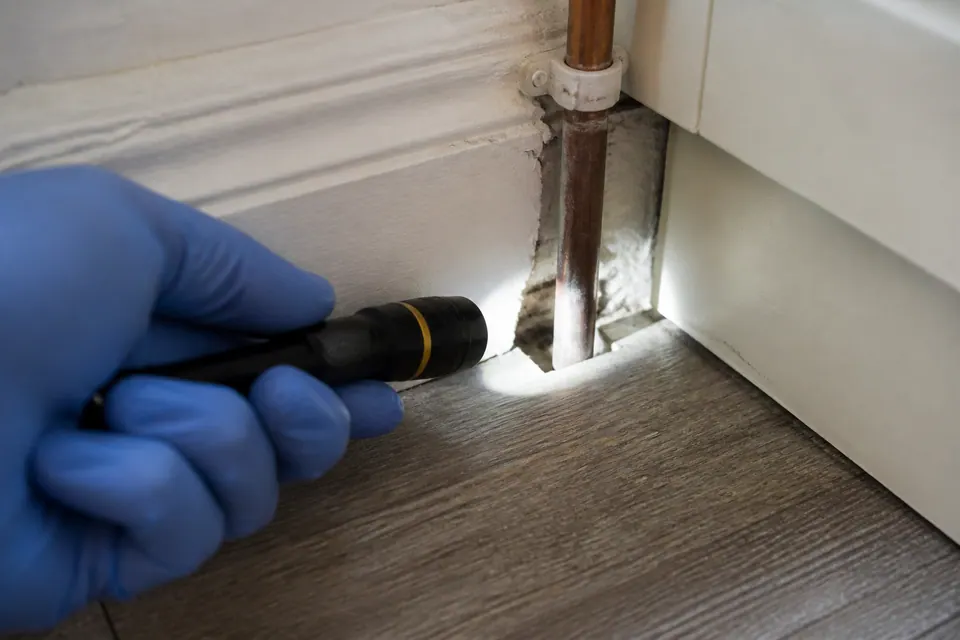

Generated scenes are not a Battersea works investigation or evidence assigning responsibility.
13 / CLEAR EXPECTATIONS
What became visible?
What was actually observed happening?
Which pest and building tasks are separately proposed?
BATTERSEA / QUESTIONS
Not necessarily. Record when it was revealed and what concealed it, leaving age uncertain where unknown.
Timing alone does not establish cause. Describe the works and findings separately.
Give the direct event and location, distinct from the exposed marks.
Do not make sealing the assumed response. Ask how any proofing should fit assessment.
No. Opening-up and repairs require their own suitable agreement and authority.
Keep the movement history and physical finding together without assigning a cause from relocation alone.
Disclose known products and where they were applied, including action during the works.
Explain the safe-access limitation rather than entering or altering the area yourself.
Follow the selected method’s household instructions; construction completion does not set a re-entry interval.
Add the new event separately and retain the original discovery history for review.
15 / TAKE THE NEXT STEP
Call with work dates, exposed findings and direct observations. Confirm assessment before treating the work as the cause or commissioning a presumed repair solution.
